| Ultimi arrivi - Saturn: the "Ringed Beauty" and His Moons |

Mimas-PIA06591.jpg"Phase-locked" Mimas!57 visiteCaption NASA originale:"Cassini's ability to remain precisely and steadily pointed at targets, such as Saturn's moon Mimas (seen here) yields sharp images despite the relatively high speed at which the spacecraft moves.
Cassini was traveling at more than 13 Km per second when it acquired this view, which shows crisp detail on Mimas against the backdrop of Saturn's Northern Hemisphere. Shadows of the icy rings stretch across the atmosphere and appear to be blurred because of the spacecraft motion.
The part of Mimas visible here always faces away from Saturn as the moon orbits the Gas Giant. In scientific language (jargon...), Mimas is said to be "phase-locked".
The image has been rotated so that North on Mimas (and Saturn) is up. This view was obtained with the Cassini spacecraft narrow angle camera on Jan. 18, 2005, at a distance of approx. 1,25 MKM from Mimas and at a phase angle of 114°. The image was taken using filters sensitive to wavelengths of infrared and polarized light. Res. is 7 Km/pixel".Feb 23, 2005
|
|

Tethys-PIA06590.jpgTethys from approx. 1,9 MKM54 visiteCaption NASA originale:"This Cassini view of Saturn's moon Tethys shows several large craters near the moon's eastern limb. These craters have fanciful names such as Phemius, Polyphemus and Ajax. The moon's massive rift-like canyon system, Ithaca Chasma, is in the darkness to the west. The image has been rotated so that north on Tethys is up and this view shows mainly the moon's trailing hemisphere. The image was taken in visible blue light with the Cassini spacecraft narrow angle camera on Jan. 19, 2005, at a distance of approximately 1,9 MKM (approx. 1,2 MMs) from Tethys and at a phase angle of 111°. Resolution in the original image was 11 Km (approx. 7 miles) per pixel. The image has been contrast-enhanced and magnified by a factor of two to aid visibility".Feb 22, 2005
|
|

Mimas-N00028872.jpgMimas and the Rings, from approx. 1.674.000 Km56 visitenessun commentoFeb 22, 2005
|
|

Rhea-N00028939.jpgRhea (from approx. 2,5 MKM) and Tethys58 visiteUn'altra immagine del "Carosello Planetario" costituito dalle Lune di Saturno che si inseguono e si incrociano, davanti agli occhi di Cassini. Forse ci sbagliamo, perchè - in fondo - viviamo in un mondo cui le "cose che interessano" sono altre... Tuttavia noi crediamo che un simile spettacolo riuscirebbe ad interessare ed affascinare chiunque!Feb 22, 2005
|
|
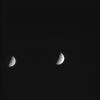
Dione-N00028856.jpgDione and Rhea (5)56 visitenessun commentoFeb 22, 2005
|
|

Dione-N00028850.jpgDione and Rhea (4)57 visitenessun commentoFeb 22, 2005
|
|

Dione-N00028848.jpgDione and Rhea (3)56 visitenessun commentoFeb 22, 2005
|
|

Dione-N00028847.jpgDione and Rhea (2)56 visitenessun commentoFeb 22, 2005
|
|

Dione-N00028844.jpgDione and Rhea (1)57 visiteLa "vena artistica" della Sonda Cassini sembra non calmarsi ed il risultato è in queste splendide immagini di Lune Saturniane che si rincorrono, si affiancano e poi sovrappongono, in un "girotondo spaziale" di grande suggestione visiva ed emotiva.
Nota: in prima battuta avevamo erroneamente ritenuto che la "danza" fosse fra Dione e Tethys; tuttavia, dopo aver meglio valutato i frames a disposizione (e grazie anche alla "NASA-Cassini/Huygens Homepage") abiamo rilevato e corretto il grave errore, per il quale ci scusiamo con i Lettori.Feb 22, 2005
|
|

Saturnian Aurora.jpgSaturnian Aurora - HST58 visiteDa "NASA - Picture of the Day" del 22 Febbraio 2005:
"Are Saturn's auroras like Earth's? To help answer this question, the Hubble Space Telescope and the Cassini spacecraft monitored Saturn's South Pole simultaneously as Cassini closed in on the gas giant in January 2004. Hubble snapped images in ultraviolet light, while Cassini recorded radio emissions and monitored the solar wind. Like on Earth, Saturn's auroras make total or partial rings around magnetic poles. Unlike on Earth, however, Saturn's auroras persist for days, as opposed to only minutes on Earth. Although surely created by charged particles entering the atmosphere, Saturn's auroras also appear to be more closely modulated by the solar wind than either Earth's or Jupiter's auroras. The above sequence shows 3 Hubble images of Saturn each taken two days apart".Feb 22, 2005
|
|

Dione-N00028445.jpgDione and Titan57 visitenessun commentoFeb 21, 2005
|
|

Rhea-N00028468.jpgRhea and the Rings, from about 540.000 Km58 visitenessun commentoFeb 21, 2005
|
|
| 2245 immagini su 188 pagina(e) |
 |
|
|
|
|
159 | |
|
|
|
|





