| Ultimi arrivi - Saturn: the "Ringed Beauty" and His Moons |
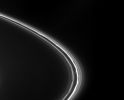
The F-Ring-PIA06600.jpgAttraction-Repulsion: the strange relationship between Prometheus and the F-Ring57 visiteCaption NASA originale:"Intriguing features resembling drapes and kinks are visible in this Cassini view of Saturn's thin F-Ring. Several distinct ringlets are present, in addition to the bright, knotted core of the ring.
The obvious structure in the ring and its strands has been caused by Prometheus, the inner F-Ring shepherd moon that recently swept past this region. (Prometheus is about 10° ahead of the F-Ring material in this image). These types of features were first seen in images taken just after Cassini entered into orbit around Saturn. The gravitational interaction of Prometheus (102 Km or 63 miles across) on the ring pulls material out the ring once every orbit (every 14,7 hours) as the moon gets close to the ring and its strands".Mar 09, 2005
|
|

Dione-PIA06199.jpgDione and Rhea: full sequence of their "dance"57 visiteCaption NASA originale:"Rhea (1.528 Km across) is larger than Dione (1.118 Km), but also is farther away as seen here, which explains why the two moons appear to be roughly the same angular size.
The view shows principally the anti-Saturn side of Dione, and the Saturn-facing side of far-off Rhea.
The images in this mosaic were taken in visible light with the Cassini spacecraft narrow-angle camera on Feb. 20, 2005, at a distance of approximately 1,5 MKM (approx. 900.000 miles) from Dione and about 2,3 MKM (approx. 1,4 MMs) from Rhea.
The image scale is approximately 9 Km per pixel on Dione and 14 Km per pixel on Rhea".Mar 04, 2005
|
|

Enceladus-PIA06597.jpgEnceladus and Tethys59 visiteCaption NASA originale:"In this unusual view, Cassini captured two icy moons of Saturn, Tethys and Enceladus, in a single narrow-angle frame. Little detail is visible on the surface of bright Enceladus, but battered Tethys shows many craters and the huge canyon system, Ithaca Chasma. Tethys has a diameter of 1.071 Km (approx. 665 miles) across, while Enceladus is 505 Km (approx. 314 miles) across.
The image was taken in visible light with the Cassini spacecraft narrow-angle camera on Jan. 29, 2005, at a distance of approx. 3,7 MKM (approx. 2,3 MMs) from Tethys and 3,5 MKM (approx. 2,2 MMs) from Enceladus. Resolution in the original image was 22 Km (approx. 14 miles) per pixel on Tethys and 21 Km (approx. 13 miles) per pixel on Enceladus. The image has been contrast-enhanced and magnified by a factor of two to aid visibility".Mar 03, 2005
|
|

The Rings-PIA06195.jpgGravitational Anomalies and Interferences in the Rings65 visiteCaption NASA originale:"Image A displays an unusual mottled-looking narrow region, with a radial width varying with longitude from 5 to 10 Km, seen for the first time about 60 Km inside the outer edge of Saturn's A-Ring.
Image B is a close-up of this region, mapped into a longitude-radius system and contrast enhanced, that is characterized by blotchy light and dark areas about 30/40 Km in longitudinal extent.
The mottled regions also are probably caused by particle clumping brought about by gravitational disturbances. The outer A-Ring edge is sculpted into a 7-lobed pattern called a Lindblad resonance (a type of dynamical resonance that occurs in rings systems) with the co-orbital satellites Janus and Epimetheus. The resonant perturbations in this region are complicated by the presence of these 2 moons whose orbits are within 50 Km of each other.
Image C is a dark-side image of the outer edge of the Encke gap, with a resolution of about 270 meters per pixel". Feb 27, 2005
|
|

Rhea-N00029094.jpgRhea and Prometheus71 visiteUna nuova istantanea di due dei protagonisti delle "danze planetarie" che si susseguono nello spazio di Saturno e che Sir Stanley Kubrick riuscì ad immaginare molto bene più di 36 anni fa ed a farne un tassello fondamentale del film di fantascienza più famoso (e certamente più suggestivo ed attuale) al Mondo.Feb 27, 2005
|
|

Saturn-PIA06196.jpgGravitational Anomalies and Interferences57 visiteIn fondo, per quanto ne sappiamo, i Fenomeni Transitori non sono una prerogativa unica della superficie dei pianeti e non si manifestano solamente attraverso 'outgassing', 'annebbiamenti' e/o fenomeni luminosi! Anche i fenomeni gravitazionali possono essere transitori, allorchè ci si trovi in un ambiente - per così dire - "affollato" da corpi celesti, quale può essere un'area di confine di uno degli Anelli di Saturno. Comunque eccoVi una parte della Caption NASA originale al riguardo:"Images taken of Saturn's rings by Cassini immediately after it entered orbit around Saturn have turned up circumstantial evidence that an unseen moon may be orbiting dead center in the narrow Keeler Gap in Saturn's outer A-Ring. Several faint discontinuities, or spikes, in the outer gap edge have been found in 2 narrow-angle camera images of the illuminated side of the Rings. These features are similar to the spikes protruding inward from the core of the F-Ring during Prometheus's passages and it is likely that the features are caused by the passages of a yet-unseen moonlet on an eccentric orbit within the Keeler gap".Feb 25, 2005
|
|

Saturn-PIA06194.jpgAre these "anomalies" the clock-tracks of a New Moon?59 visiteUna piccola premessa: le irregolarità fisiche del margine esterno dell'Anello A, situate in prossimità di quella zona conosciuta come Divisione Keeler (larga circa 42 Km), sono ritenute dalla NASA una evidenza indiretta (o prova circostanziale) dell'esistenza di una nuova 'luna nascosta'. In realtà, queste alterazioni fisiche - le quali altro non sono che il riflesso visibile delle interazioni gravitazionali esercitate da corpi sufficientemente vicini - allorchè i corpi interagenti sono, almeno relativamente, "stabili" (come dobbiamo ragionevolmente supporre che sia nel nostro caso), si caratterizzano per una sostanziale regolarità e ripetitività. Ora nell'immagine di riferimento, come potete vedere Voi stessi, questa 'anomalia gravitazionale' sembra tutt'altro che regolare e ripetitiva. Perchè non provare a pensare, dunque, ad una vera e propria 'interazione complessa' (possibile indice della presenza di più lune) o, magari, a qualcosa di diverso (per esempio ad un - raro - Fenomeno Transitorio)?Feb 25, 2005
|
|
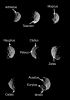
Phoebe-PIA06118.jpgThe Craters of Phoebe: names57 visitenessun commentoFeb 25, 2005
|
|

Phoebe-2-PIA06117.jpgPhoebe: names, features and details58 visitevedi il commento al frame che precedeFeb 25, 2005
|
|
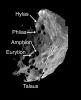
Phoebe-1-PIA06117.jpgPhoebe: names, features and details57 visiteCaption NASA originale:"The craters are named for the Argonauts, explorers of Greek mythology who sought the 'Golden Fleece' (--->Vello d'Oro). Argo was the name of their ship. The largest crater, approximately 100 Km (62 miles) across, is named after the leading Argonaut, Jason. Phoebe is an outer moon of Saturn and is 220 Km (136 miles) across.
The image montage displays mosaics made of individual, very HR images: from 80 meters (260 feet) to 200 meters (660 feet) per pixel".Feb 25, 2005
|
|

Janus-N00028962.jpgJanus and the "Lord of the Rings"58 visitenessun commentoFeb 25, 2005
|
|

Pandora-N00028964~0.jpgPandora: the "Prisoner" and yet the "Guardian" of the Rings57 visiteUn frame molto suggestivo per un'altra "luna pastore" - Pandora - che in questa immagine, a causa della particolare prospettiva, sembra essere stata "ingabbiata" dagli Anelli. In realtà - e da un punto di vista squisitamente fisico - semmai è vero il contrario: è Pandora che concorre nel "modellare" e "mantenere in equilibrio" e, dunque, nell'"imprigionare", in una serie coordinata di abbracci gravitazionali, i detriti che formano gli Anelli del Gigante!Feb 25, 2005
|
|
| 2245 immagini su 188 pagina(e) |
 |
|
|
|
|
157 | |
|
|
|
|





