| Ultimi arrivi - Saturn: the "Ringed Beauty" and His Moons |

Epimetheus-N00030849.jpgEpimetheus, from approx. 73.000 Km58 visiteE' inevitabile: una dopo l'altra, grazie alla permanenza della Sonda Cassini nel "ricco" Spazio di Saturno, tutte le lune del Gigante Anellato, prima o poi, vengono 'sfiorate' e riprese da angoli visuali sempre migliori. Anche la misteriosa e minuscola Epimetheus non è sfuggita a questa regola: siamo solo a 73.000 Km da questa piccolissima luna (uno spazio davvero risibile, nella logica delle distanze cosmiche) e, sebbene la qualità del frame non sia perfetta - notate gli innumerevoli artefatti fotografici che costellano l'immagine e che verranno "ripuliti" solo in un secondo momento - già possiamo farci un'idea pittosto precisa delle caratteristiche e, quindi, della storia di questo corpo celeste.Apr 01, 2005
|
|

Rings-PIA06616.jpgDistances...59 visiteCaption NASA originale:"This sweeping view from Cassini gives a sense of the awesome scale of the planet's disk-like ring system, which stretches many thousands of kilometers into the distance. The shepherd moon Prometheus maintains a lonely sojourn with the thin, outer F-Ring.
A notable brightening of the F-Ring material is visible ahead of Prometheus in its orbit, near the right side of this image.
The view was obtained in visible light with the Cassini spacecraft narrow-angle camera on Feb. 18, 2005, at a distance of approximately 1 MKM (approx. 621.000 miles) from Prometheus and at a phase angle of 105°. The image scale is 6 Km per pixel".Mar 31, 2005
|
|
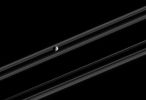
Epimetheus-PIA06615.jpgEpimetheus, from approx. 990.000 Km58 visiteCaption NASA originale:"Saturn's small, irregularly-shaped moon Epimetheus orbits against the backdrop of the planet's rings, which are nearly edge-on in this view. Some of the moon's larger geological features can be seen here. The image was taken in visible light with the Cassini spacecraft narrow-angle camera on Feb. 18, 2005, at a distance of approximately 990.000 Km (approx. 615.000 miles) from Epimetheus and at a phase angle of 99°. Resolution in the original image was 6 Km per pixel. The image has been contrast-enhanced and magnified by a factor of two to aid visibility".Mar 30, 2005
|
|

Epimetheus-PIA06614.jpgEpimetheus, from approx. 1,1 MKM56 visiteCaption NASA originale:"Epimetheus is one of Saturn's "co-orbital moons" because it shares nearly the same orbit as Janus at a distance of approximately 151.000 Km (such as 94.000 miles) from Saturn. Epimetheus is about 116 Km (72 miles) across while Janus is 181 Km (113 miles) across.
The image was taken in visible light with the Cassini spacecraft narrow-angle camera on Feb. 18, 2005, at a distance of approx. 1,1 MKM (684,000 miles) from Epimetheus and at a phase angle of 96°. Resolution in the original image was 6 Km (4 miles) per pixel. The image has been contrast-enhanced and magnified by a factor of four to aid visibility".Mar 29, 2005
|
|

Janus-PIA06613.jpgJanus (close-up)59 visiteCaption NASA originale:"This close-up view of Saturn's moon Janus shows what appear to be two large craters near the boundary between day and night. The left side of the moon is lit feebly by reflected light from Saturn. Janus is 181 Km across.
The image was taken in visible light with the Cassini spacecraft narrow-angle camera on Feb. 18, 2005, at a distance of approximately 1,1 MKM from Janus and at a phase angle of 108°. Resolution in the original image was 7 Km (approx. 4 miles) per pixel. The image has been contrast-enhanced and magnified by a factor of three to aid visibility".Mar 25, 2005
|
|
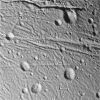
Enceladus-PIA06217.jpgCracks on Enceladus (and possible Anomaly)59 visiteCaption NASA originale:"During its very close flyby of Enceladus on March 9, 2005, Cassini took HR images of the icy moon that are helping scientists interpret the complex topography of this intriguing little world. This scene is an icy landscape that has been scored by tectonic forces. Many of the craters in this terrain have been heavily modified, such as the 10-Km-wide crater near the upper right that has prominent North-South fracturing along its northeastern slope".
Nota: è fortemente probabile che proprio al termine della frattura che taglia il frame nel suo margine superiore (Dx di chi guarda) vi sia una sorta di monolito (o comunque una struttura simile ad un pilastro) ad ore 1 del piccolo cratere che "chiude" il crepaccio (si nota, oltre all'ombra del bordo nord del cratere, anche l'ombra - MOLTO lunga! - di questo curioso rilievo).
Scherzo della prospettiva o un "nuovo monolito" (dopo le Lunar Spires - o Cuspidi di Blair - ed il Monolito di Phobos)?Mar 24, 2005
|
|
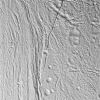
Enceladus-PIA06215.jpgCracks on Enceladus (and possible Anomaly)60 visiteCaption NASA originale:"This view of Enceladus shows an area that has undergone a very intriguing sequence of events. The craters here are subdued, as seen elsewhere on Enceladus and most, but not all, are older than the fractures. Fracturing has occurred at a wide variety of scales, from the wide rift running through the center of the image to much narrower sets of shorter fractures that crosscut the craters (and each other) to the left. This region is a transition from cratered to wrinkled terrain. Westward (left) of the central rift that divides the 2 regions are relatively parallel grooves and ridges that are reminiscent of terrain on Jupiter's large moon Ganymede. Very few craters are seen in this area of Enceladus. Right of the large rift the terrain becomes more cratered, although the craters are quite degraded. A prominent fracture runs North-South to the center of the image".
Nota: guardate bene che cosa c'è all'interno di questo crepaccio, in alto, proprio a ridosso del bordo superiore del frame!Mar 24, 2005
|
|

Janus-PIA06612.jpgJanus rides the Rings60 visiteCaption NASA originale:"Cassini was nearly in the plane of Saturn's Rings when it took this image of Janus. The nearly edge-on rings appear almost ribbon-like in this view and some surface detail is visible on the small moon. The image was taken in visible light with the Cassini spacecraft narrow-angle camera on Feb. 18, 2005, at a distance of approximately 911.000 Km from Janus and at a phase angle of 101°. The image scale is 5 Km per pixel".Mar 24, 2005
|
|

Dione-PIA06611.jpgStreaks on Dione57 visiteCaption NASA originale:"Wispy streaks curl over the horizon on Saturn's moon Dione, caught here in a distant view from Cassini. The streaks were first revealed by NASA's Voyager spacecraft and subsequently were shown by Cassini to be an immense system of linear fractures in the moon's surface. The image was taken with the Cassini spacecraft narrow-angle camera using a filter sensitive to wavelengths of ultraviolet light centered at 338 nnmts. The image was acquired on Feb. 18, 2005, at a distance of approximately 1,3 MKM from Dione and at a phase angle of 118°. The image scale is 8 Km per pixel".Mar 24, 2005
|
|

Saturn-tilted.jpgTilted Saturn58 visiteCaption NASA originale:"Saturn's whirling vortices and feathery cloud bands are the signs of a restless world. Cassini captured this arresting view of the giant planet scored by bold shadows cast by the rings. The rings are seen edge-on in this dramatic, artfully tilted scene.
The image was taken with the Cassini spacecraft wide-angle camera on March 6, 2005, at a distance of approx. 1,7 MKM (1 MMs) from Saturn through a filter sensitive to wavelengths of infrared light centered at 750 nnmts. The image scale is 10 Km per pixel".Mar 22, 2005
|
|

Mimas and Janus.jpgMimas (from 1,8 MKM) and Janus (from 1,9 MKM)63 visiteCaption NASA originale:"Saturn's icy, impact-riddled moon Mimas slips briefly in front of Saturn's moon Janus in this movie from Cassini. The movie was created from 37 original images taken over the course of 20 minutes as the spacecraft's narrow-angle camera remained pointed toward Janus. Although Mimas moves a greater distance across the field of view, Janus also moved perceptibly during this time. The images were aligned to keep Janus close to the center of the scene. Additional frames were inserted between the 37 Cassini images in order to smooth the appearance of Mimas' movement - a scheme called interpolation. Close-up images from the few minutes surrounding the occultation are arranged into a strip along the bottom of the movie. Contrast on Janus was mildly enhanced to aid the visibility of its surface. The right side of Mimas appears bright because the moon was partly overexposed in this image sequence". Mar 21, 2005
|
|

Rhea~0.jpgRhea (false colors)66 visiteCaption NASA originale:"This false-color picture of Saturn's moon Rhea from Cassini enhances slight differences in natural color across the moon's face. The extreme north and south latitudes have a notable difference in hue compared to the mid-latitudes.
This view of Rhea is a composite of images taken using filters sensitive to green (centered at 568 nnmts) and infrared light (2 infrared filters, centered at 752 and 930 nnmts) and has been processed to accentuate subtle color differences.
The image was taken with the Cassini spacecraft narrow angle-camera on Feb. 18, 2005, at a distance of approximately 890.000 Km from Rhea and at a Sun-Rhea-spacecraft phase angle of 116°. The image scale is 5 Km per pixel".Mar 21, 2005
|
|
| 2245 immagini su 188 pagina(e) |
 |
|
|
|
|
153 | |
|
|
|
|





