| Ultimi arrivi - Saturn: the "Ringed Beauty" and His Moons |
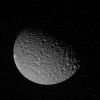
Mimas-N00032567.jpgMimas, from approx. 93.000 Km56 visiteUn'immagine che potrebbe essere bellissima, ma che invece è resa inguardabile - o quasi... - da un'infinità di artefatti fotografici. Resta comunque un frame importante - ed è per questo che lo proponiamo ugualmente - sia per ciò che riesce a mostrarci di Mimas, sia perchè ci permette di familiarizzare ancora di più con questi difetti delle immagini che in tantissimi frangenti possono essere e/o diventare causa di sviste e malintesi.Apr 16, 2005
|
|

Saturn-N00031212.jpgPan and Epimetheus (from approx. 1,5 MKM)63 visitenessun commentoApr 15, 2005
|
|
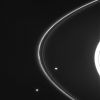
The Rings-N00032099.jpgThe "clumpy" F-Ring and two Shepherd Moons58 visiteUna spettacolare inquadratura dell'Anello F di Saturno il quale, come sapete si caratterizza (anche) a causa delle sue numerose irregolarità ed increspature (che alla NASA chiamano clumps---->grumi/agglomerati) che dovrebbero essere dovute all'azione mareale di Lune-Pastore come Pandora ed Atlas, per esempio.Apr 15, 2005
|
|
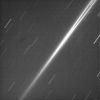
The Rings-PIA06627.jpgThe G-Ring and "Star-Trails"55 visiteCaption NASA originale:"Cassini's ability to remain sharply pointed at its targets allowed this image of Saturn's faint, dusty G-Ring to be made. The thin streaks visible here are "Star-Trails", which are created during long exposures, when the spacecraft remains locked onto a single target. The camera shutter was open for 3 and 1/2 minutes during this particular exposure. A long exposure was required to see details of this quite tenuous Ring.
The feature inside the G-Ring, at upper right, is also a star trail.
The image was taken in polarized visible light with the Cassini spacecraft narrow-angle camera on March 7, 2005, at a distance of approx. 1,2 MKM (such as approx. 750.000 miles) from Saturn. The image scale is approx. 10 Km per pixel". Apr 15, 2005
|
|

Dione-PIA06626.jpgSaturnshine59 visiteCaption NASA originale:"This Cassini image shows the night side of Saturn's moon Dione, dimly lit by "Saturnshine": that is, reflected light from the planet lying off to the left in Cassini's field of view when this image was taken.
The image was taken in visible green light with the Cassini spacecraft narrow-angle camera on Feb. 18, 2005, at a distance of about 1,3 MKM (approx. 808.000 miles) from Dione and at a phase angle of 118°. The image scale is 8 Km (approx. 5 miles) per pixel". Apr 13, 2005
|
|

Phoebe-PIA06070.jpgThe "true shape" of Phoebe56 visiteCaption NASA originale:"This colorful graphic illustrates that despite Phoebe's bumpy, irregular topography, the moon has a fairly round shape. A digitally rendered shape model of Phoebe was constructed using Cassini imaging data obtained before and after the spacecraft's close flyby of the Saturnian moon on June 11, 2004.
The average diameter of Phoebe is about 214 Km. The four views of the model are each separated by a 90° rotation; the upper left is centered at 0° West longitude. The others show regions of the moon centered at 90, 180 and 270° West longitude, as labeled. The coloring of the models corresponds to the height of Phoebe's surface, relative to the lowest point - a range of about 16 Km - going from blue (low) to red (high). Interestingly, much of this range in height occurs in 1 large crater, visible in the 180° West view".Apr 13, 2005
|
|
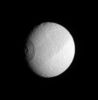
Tethys-PIA06625.jpgOdysseus: the "eye" of Tethys58 visiteCaption NASA originale:"Saturn's moon Tethys turns like a great eye as the enormous crater Odysseus (450 Km across) rotates into Cassini's view. The image was taken in visible light with the Cassini spacecraft narrow-angle camera on March 6, 2005, at a distance of approximately 1,7 MKM (approx. 1,1 MMs) from Tethys and from a Sun-Tethys-spacecraft, or phase, angle of 35°. The image scale is 10 Km (approx. 6 miles) per pixel. The image has been magnified by a factor of two and contrast- enhanced to aid visibility". Apr 13, 2005
|
|
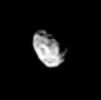
Hyperion-PIA06623.jpgHyperion from 1,7 MKM55 visiteCaption NASA originale:"The rugged surface of Saturn's irregular (and "tumbling") moon Hyperion is revealed in this Cassini image. Hyperion is 266 Km (approx. 165 miles) across.
The image was taken in visible light with the Cassini spacecraft narrow-angle camera on Feb. 23, 2005, at a distance of approx. 1,7 MKM (such as approx. 1 MMs) from Hyperion and at a Sun-Hyperion-spacecraft, or phase, angle of 42°. Resolution in the original image was 10 Km (approx. 6 miles) per pixel. The image has been contrast-enhanced and magnified by a factor of 3 to aid visibility".Apr 10, 2005
|
|

Rhea-PIA06620.jpgRhea and Enceladus: which is which?63 visiteCaption NASA originale:"Though much farther away from Cassini when the spacecraft acquired this image, Saturn's second-largest moon Rhea still dwarfs the brightest icy moon Enceladus in this scene. Rhea is 1.528 Km (approx. 949 miles) across. Enceladus is 505 Km (approx. 314 miles) across.
The image was taken in visible light with the Cassini spacecraft narrow-angle camera on Feb. 21, 2005, at a distance of approx. 2 MKM (approx. 1,3 million miles) from Enceladus and 2,5 MKM (approx. 1,6 MMs) from Rhea. The image scale is 12 Km (approx. 7 miles) per pixel on Enceladus and 15 Km (approx. 9 miles) per pixel on Rhea".Apr 05, 2005
|
|

Saturn-PIA06619.jpgThe Southern Side of Saturn58 visiteCaption NASA originale:"Viewed nearly edge-on, Saturn's rings appear dark and pencil-thin against the backdrop of the planet's swirling clouds. Notable here are the shadows cast by the rings onto the northern hemisphere, as well as details of the banded atmosphere, such as the bright equatorial region. The image was taken with the Cassini spacecraft wide-angle camera on Feb. 18, 2005, at a distance of approximately 1,2 MKM from Saturn through a filter sensitive to wavelengths of infrared light centered at 727 nnmts, where gaseous methane absorbs. The image scale is 67 Km per pixel".Apr 05, 2005
|
|

Pandora-PIA06618~0.jpgPandora at the edge of the Rings65 visiteCaption NASA originale:"Pandora is seen in this dramatic view, orbiting just beyond the outer edge of Saturn's F-Ring. Several bright areas are visible within the F-Ring. In the main Rings, the Keeler gap and the Encke gap - with a bright ringlet - are also visible. Pandora is 84 Km (approx. 52 miles) across. The image was taken in visible light with the Cassini spacecraft narrow-angle camera on Feb. 18, 2005, at a distance of approximately 1,2 MKM (approx. 746.000 miles) from Pandora and at a Sun-Pandora-spacecraft angle of 108°. The image scale is 7 Km per pixel".Apr 02, 2005
|
|
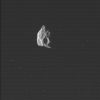
Epimetheus-N00030856.jpgEpimetheus, from approx. 75.000 Km59 visiteLa forma di Epimetheus, assolutamente irregolare, ci suggerisce una sua possibile origine "traumatica": forse si tratta, infatti, di un semplice frammento di un corpo celeste più grande il quale, in tempi lontani, andò in pezzi a seguito di una collisione con un grande asteroide. Non è neppure da escludere che Epimetheus sia un residuo di cospicue dimensioni della collisione che generò gli stessi Anelli di Saturno e questa ipotesi, laddove (in un futuro) venisse verificata ed accolta, ci spiegherebbe, in parte, le cause dell'attuale posizione e del ruolo di questa luna negli equilibri del complesso Sistema Saturniano. La superficie di Epimetheus, fortemente craterizzata, ci suggerisce un'età molto avanzata per questa luna; in primo piano, poi, notiamo un grande cratere da impatto che ricorda, per forma e dimensioni, lo Stickney Crater di Phobos.Apr 01, 2005
|
|
| 2245 immagini su 188 pagina(e) |
 |
|
|
|
|
152 | |
|
|
|
|





