| Ultimi arrivi - Saturn: the "Ringed Beauty" and His Moons |

Mimas-PIA06642.jpgMimas, Dione and Rhea58 visiteCaption NASA originale:"A scene straight out of science fiction, this fantastic view shows, from left to right, Saturn's moon's Mimas, Dione and Rhea, on the far side of Saturn's nearly edge-on rings.
The trailing hemispheres of all three moons are sunlit here and wispy markings can be seen on the limbs of both Dione and Rhea. The image was taken in visible blue light with the Cassini spacecraft narrow-angle camera on March 15, 2005, at a distance of approximately 2,4 mkm (approx. 1,5 MMs) from Saturn.
The image scale is 14 Km (approx. 9 miles) per pixel".Mag 06, 2005
|
|

Rhea-PIA06641.jpgTirawa impact basin on Rhea58 visiteCaption NASA originale:"The large Tirawa impact basin on Saturn's moon Rhea is visible at the two o'clock position in this Cassini image. This view shows principally the trailing hemisphere on Rhea and is centered on the moon's equator. North is up and tilted 25° to the left.
The image was taken with the Cassini spacecraft narrow-angle camera on March 13, 2005, through a filter sensitive to wavelengths of ultraviolet light centered at 338 nnmts.
The image was obtained at a distance of approximately 1,7 MKM(such as 1,1 MMs) from Rhea and at a phase angle of 90°. Resolution in the original image was 10 Km (approx. 6 miles) per pixel. The image has been contrast-enhanced and magnified by a factor of two to aid visibility".Mag 05, 2005
|
|

Epimetheus-PIA06640.jpgEpimetheus from 1,8 MKM88 visiteCaption NASA originale:"Small and asteroid-like in appearance, Epimetheus is seen here with Saturn's nearly edge-on rings in the distance. Epimetheus (that has been defined by NASA as a "rubble" moon - rubble----->macerie/detriti) has a mean density that is less than that of water, suggesting that it might be somewhat porous.
The image was taken in visible light with the Cassini spacecraft narrow-angle camera on March 12, 2005, at a distance of approx. 1,8 MKM (such as 1,1 MMs) from Saturn and at a phase angle of 90°. Resolution in the original image was 10 Km per pixel. The image has been contrast-enhanced and magnified by a factor of two to aid visibility".Mag 04, 2005
|
|

Epimetheus-PIA06226.jpgEpimetheus up close (from about 74.600 Km) but in false colors57 visiteCaption NASA originale:"The color of Epimetheus in this view appears to vary in a non-uniform way across the different facets of the moon's irregular surface. Usually, color differences among planetary terrains identify regional variations in the chemical composition of surface materials. However, surface color variations can also be caused by wavelength-dependent differences in the way a particular material reflects light at different lighting angles. The color variation in this false-color view suggests such "photometric effects" because the surface appears to have a more bluish cast in areas where sunlight strikes the surface at greater angles. The slightly reddish feature in the lower left is a crater named Pollux. The large crater just below center is Hilairea, which has a diameter of about 33 Km. At 116 Km across, Epimetheus is slightly smaller than its companion moon, Janus (181 Km across), which orbits at essentially the same distance from Saturn".Apr 28, 2005
|
|
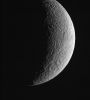
Tethys-PIA06633.jpgTethys (ultraviolet vision) from 200.000 Km55 visiteCaption NASA originale:"This view of Saturn's moon Tethys shows the contrast between the more heavily cratered region near the top and the more lightly cratered (and presumably younger) plains toward the bottom part of the image and near the limb. Some of the larger craters in the latter region appear to be somewhat subdued or filled in. This view shows principally the anti-Saturn hemisphere on Tethys; North is up and tilted 20° to the left.
The image was taken with the Cassini spacecraft narrow-angle camera on March 9, 2005, through a filter sensitive to wavelengths of ultraviolet light centered at 338 nnmts. The view was obtained at a distance of approximately 200.000 Km from Tethys and at a phase angle of 120°. Resolution in the image is 1 Km (approx. 0,6 mile) per pixel".Apr 22, 2005
|
|

Tethys-PIA06632.jpgTethys (infrared vision) from approx. 1,4 MKM57 visiteCaption NASA originale:"In this infrared view, Saturn's cratered moon Tethys shows a faint, dark band across its equatorial region. North is up in this view.
The image was taken with the Cassini spacecraft narrow-angle camera on March 11, 2005, through a filter sensitive to wavelengths of infrared light centered at 930 nnmts. The view was acquired at a distance of approximately 1,4 MKM from Tethys and at a phase angle of 80°. Resolution in the original image was 8 Km per pixel.
The image has been contrast-enhanced and magnified by a factor of two to aid visibility".Apr 22, 2005
|
|

Rhea-PIA06630.jpgRhea, from 1,8 MKM58 visiteCaption NASA originale:"The ancient and battered surface of Saturn's moon Rhea shows a notable dark swath of territory near the eastern limb in this image from Cassini.
This view shows principally the Saturn-facing hemisphere on Rhea (1.528 Km across). North is up and tilted 40° to the right.
The image was taken with the Cassini spacecraft narrow-angle camera on March 7, 2005, through a filter sensitive to wavelengths of ultraviolet light centered at 338 nnmts. The view was acquired at a distance of approx. 1,8 MKM (approx. 1,1 MMs) from Rhea and at a phase angle of 30°. Resolution in the original image was 10 Km per pixel.
The image has been contrast-enhanced and magnified by a factor of two to aid visibility".Apr 19, 2005
|
|

Dione&Tethys-PIA06629.jpgDione and Tethys58 visiteCaption NASA originale:"Cassini offers this lovely comparison between two of Saturn's satellites, Dione and Tethys, which are similar in size but have very different surfaces.
Extensive systems of bright fractures carve the surface of Dione. The double-pronged feature Carthage Linea points toward the crater Turnus at the nine o'clock position near the terminator and Palatine Linea runs toward the moon's bottom limb near the five o'clock position.
In contrast, the surface of Tethys appears brighter and more heavily cratered. The large crater Penelope is near the eastern limb. The huge rift zone Ithaca Chasma, which is 3 to 5 Km deep and extends for about 2.000 Km from north to south across Tethys, is hidden in shadow just beyond the terminator. For comparison, the Grand Canyon in Arizona is about 1,5 Km deep and about 450 Km long.
The image was taken in visible light from a distance of approx. 1,5 MKM from Tethys and 1,6 MKM from Dione. The image scale is 9 Km/pixel on Tethys and 10 Km/pixel on Dione".Apr 19, 2005
|
|

Enceladus-PIA06628.jpgEnceladus from 1,1 MKM57 visiteCaption NASA originale:"Saturn's bright moon Enceladus hovers here, in front of the Rings darkened by Saturn's shadow.
This view is from less than 1° beneath the Ring plane. If seen from directly beneath the Rings, the planet's giant shadow would appear as an elongated half-ellipse; the acute viewing angle makes the shadow look more like a strip here. The dark shadow first takes a bite out of the rings at the right, where the distant, outermost ring material appears to taper and fade. Ring features visible in this image from the outer ring edge inward include: the A-Ring, the Cassini Division and the B-Ring. The C-Ring is the darker region that dominates the Rings here. The 2 gaps visible near the center and below the left of the center are the Titan Gap, about 77.800 Km from Saturn and an unnamed gap about 75.800 Km from the planet. The image was taken in visible light with the Cassini spacecraft narrow-angle camera on March 7, 2005, at a distance of approx. 1,1 MKM from Enceladus, at a phase angle of 30°".Apr 16, 2005
|
|

Rhea-N00032543.jpgRhea, from approx. 242.000 Km (3)60 visitenessun commentoApr 16, 2005
|
|

Rhea-N00032542.jpgRhea, from approx. 242.000 Km (2)59 visitevedi il commento al frame che precedeApr 16, 2005
|
|

Rhea-N00032541.jpgRhea, from approx. 242.000 Km (1)59 visiteTre frames sequenziali che ci mostrano la superficie di Rhea con grande chiarezza ed un eccellente livello di definizione.
Vi suggeriamo di focalizzare la Vostra attenzione sui crateri che si stagliano propria lungo la linea del terminatore: come noterete, solo uno di essi - piuttosto grande, "incrociato" con un altro più piccolo e (riteniamo) più antico, visibile all'altezza dell'equatore apparente di Rhea - ci mostra un picco centrale il quale, però, sembra diventare più piccolo e meno luminoso durante quei 429 Km di viaggio che accorciano la distanza Rhea/Cassini fra il primo ed il terzo frame della serie. Si tratta, naturalmente, di un effetto visivo che deriva dal movimento della luna Saturniana intorno al proprio asse - rotazione dalla quale deriva un leggerissimo spostamento della linea del terminatore e degli oggetti che si trovano su di essa - durante l'intervallo di tempo che separa il primo dal terzo frame.
Giudicate Voi stessi..Apr 16, 2005
|
|
| 2245 immagini su 188 pagina(e) |
 |
|
|
|
|
151 | |
|
|
|
|





