| |

| Ultimi arrivi - Saturn: the "Ringed Beauty" and His Moons |

The Rings-N00034622.jpgSunshine and stars, through the F-Ring!58 visiteUn'immagine davvero molto bella e suggestiva; inutili altri commenti.Mag 25, 2005
|
|

The Rings-N00034670.jpgThe 'clumpy' F-Ring59 visiteUn frame HD che ci mostra, con ampio dettaglio, le 'imperfezioni' (cioè i 'clumps'------> addensamenti, nodi, blocchi et sim.) che caratterizzano questo sottile, ma sempre affascinante, Anello "F".Mag 25, 2005
|
|

Saturn-W00006821.jpgSpark in the Dark! (possible Anomaly)58 visiteCassini sta viaggiando nel cono d'ombra generato da Saturno e quindi, se il 'volto di Saturno' sta guardando il Sole, noi possiamo pure dire che Cassini è 'alle spalle' del Gigante Anellato.
Ciò premesso, riusciamo comunque a vedere una porzione dell'Anello F (ancora illuminato da Sole e davvero caratteristico ed inconfondibile per i suoi 'clumps'!) sull'estrema Dx dell'immagine mentre, proprio al centro del frame, distinguiamo chiaramente un corpo luminoso sferico e svariati altri puntini luminosi e svariati graffi. Sui 'puntini luminosi' ed i 'graffi', la nostra esperienza in campo di fotografia astronomica e spaziale ci dice che si tratta di semplici photo-artifacts. Il punto luminoso centrale, invece, secondo noi NON lo è.
Ora, dato che stiamo guardando in una regione immersa nell'ombra di Saturno (e dunque nel buio), quel punto - se effettivamente NON è un photo-artifact - NON può neppure essere una delle Lune Saturniane!
E allora che cos'è?Mag 25, 2005
|
|

Radio-Saturn.jpgRadio waves and the size of the Rings' forming particles59 visiteQuali sono le dimensioni delle particelle che formano gli Anelli di Saturno? Per scoprirlo, Cassini ha trasmesso verso Terra una serie di onde radio (aventi lunghezze d'onda approssimative di 1, 3,5 e 13 cm) le quali, viaggiando verso di noi, hanno dovuto attraversare gli Anelli stessi. Ora, premesso che le particelle sensibilmente più grandi di un'onda 'riflettono' l'onda stessa, guardate la fotografia: essa è una ricostruzione digitale in falsi colori di Saturno e dei suoi Anelli "visti" dalle onde radio. Il color lilla indica regioni in cui le dimensioni medie delle particelle superano i 5 cm; il verde, invece, indica regioni in cui le loro dimensioni medie sono inferiori ad 1 cm. Il bianco - al centro dell'Anello B - ci dice che la densità di particelle, in quella regione, è troppo alta per consentire una adeguata definizione delle loro dimensioni. Infine, secondo stime fatte impiegando delle onde radio a banda molto larga, si è ipotizzato che in alcune regioni queste 'particelle' abbiano dimensioni di svariati metri.Mag 25, 2005
|
|

The Rings-2-PIA07872.jpgThe "Rings": the most spectacular view ever seen!59 visiteSpecially designed Cassini orbits place Earth and Cassini on opposite sides of Saturn's rings, a geometry known as "occultation". Cassini conducted the 1st radio occultation observation of Saturn's Rings on May 3, 2005.
Three simultaneous radio signals of 0,94; 3,6, and 13 cm wavelengths (Ka-, X-, and S-bands) were sent from Cassini through the rings to Earth. The observed change of each signal as Cassini moved behind the Rings provided a profile of the distribution of ring material as a function of distance from Saturn, or an optical depth profile.
This simulated image was constructed from the measured optical depth profiles. It depicts the observed ring structure at about 10 Km in resolution. Color is used to represent information about ring particle sizes in different regions based on the measured effects of the 3 radio signals. Shades of purple, primarily over most of the inner ring (ring B) and the inner portion of the next ring (ring A), indicate regions where there is a lack of particles less than 5 centimeters (about 2 inches) in diameter. Green and blue shades indicate regions where there are particles of sizes smaller than 5 centimeters (2 inches) and 1 centimeter (less than one third of an inch), respectively, primarily in outer ring A and within most of ring C. From other evidence in the radio observations, all ring regions appear to be populated by a broad range of particle size distribution that extends to boulder sizes (several to many meters or yards across). Mag 23, 2005
|
|

Enceladus-PIA06653.jpgPink Rings and Enceladus, in "natural colors"58 visiteCaption NASA originale:"Saturn's icy moon Enceladus hovers above Saturn's exquisite Rings in this color view from Cassini.
The Rings, made of nearly pure water ice, have also become somewhat contaminated by meteoritic dust during their history, which may span several hundred million years. Enceladus shares the Rings' nearly pure water ice composition, but appears to have eluded dust contamination through resurfacing processes that scientists are still trying to fully understand. Dust affects the Rings' color, while differences in brightness are attributable to varying particle sizes and concentrations. The images for this natural color view were taken with the Cassini spacecraft narrow-angle camera on April 5, 2005, at a distance of approximately 2,2 MKM (approx. 1,4 MMs) from Saturn through red, green and blue spectral filters. The image scale is 13 Km (about 8 miles) per pixel".Mag 21, 2005
|
|

Rhea-PIA06648.jpgWhite young crater on Rhea57 visiteCaption NASA originale:"Looking closely at Saturn's moon Rhea during a distant flyby, Cassini provides this view of what appears to be a bright, rayed and therefore relatively young crater. This crater was also observed by Cassini at much lower resolution in the fall of 2004 and in spring of 2005. For comparison, viewing the same crater near the terminator (the line between day and night) would highlight the crater's topography (vertical relief), compared to its brightness, which is highlighted in this view where the Sun is at a higher angle.
North on Rhea is up and rotated about 15° to the left. This view shows principally the leading hemisphere on Rhea".
Nota: guardate molto bene il bordo di Rhea e poi chiedeteVi se esso sembri di più il bordo di una 'sfera' o di uno 'sferoide'. Poi, se avete tempo e voglia, provate a rileggere i commenti del Prof. Hoagland sulla forma di Giapeto e sulle sue possibili cause ed implicazioni.Mag 14, 2005
|
|

Japetus-PIA06646.jpgJapetus: a clear view in the darkness65 visiteNon è certo un frame di qualità eccezionale, ma - finalmente! - si torna a vedere Giapeto, la "Luna Bifronte" (ossìa per metà chiara e luminosa e per metà nera come la pece).
Questo il commento NASA originale:"This view shows one of the huge impact basins on the terminator of Saturn's moon Iapetus and a smaller, but still fairly large, crater near the southern bright-dark boundary. Just visible near the western limb, in the dark territory of Cassini Regio, is the moon's mysterious equatorial ridge. The ridge was discovered in Cassini images and reaches 20 Km (approx. 12 miles) high in places. This view shows principally the leading hemisphere on Iapetus. North is up and tilted 15 degrees to the right. The image was taken with the Cassini spacecraft narrow-angle camera on March 19, 2005, through spectral filters sensitive to wavelengths of infrared light centered at 752 nnmts. The view was acquired at a distance of approximately 1,4 MKM from Iapetus and at a phase angle of 70°. Resolution is 8 Km/pixel".Mag 11, 2005
|
|
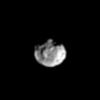
Hyperion-PIA06643.jpgSome of Hyperion's main surface features58 visiteCaption NASA originale:"Several distinct craters on Saturn's moon Hyperion can be seen here, as well as a protruding feature, perhaps a mountain, near the center.
The image was taken in visible light with the Cassini spacecraft narrow-angle camera on March 16, 2005, at a distance of approx. 1,8 MKM (such as approx. 1,1 MMs) from Hyperion and at a Sun-Hyperion-spacecraft, or phase, angle of 42°.
Resolution in the original image was 11 Km (approx. 7 miles) per pixel. The image has been contrast-enhanced and magnified by a factor of three to aid visibility".Mag 11, 2005
|
|

Hyperion-PIA06645.jpgThe "tumbling" Hyperion is still on sight58 visitenessun commentoMag 11, 2005
|
|

Saturn_s Rings-PIA06239.jpgS/2005 S1: The "Wave-Maker" (2)58 visiteCaption NASA originale:"In the vicinity of the newly discovered little moon, the Keeler Gap's edges bear striking similarities to the scalloped edges of the 322 Km-wide (approx. 200-mile) Encke Gap, where the small moon Pan (25 Km, or approx. 16 miles across) resides.
From the size of the waves seen in the scalloped edges of the Encke Gap, imaging scientists were able to estimate the mass of Pan.
They expect to do the same, eventually, with S/2005 S1".Mag 11, 2005
|
|

Saturn_s Rings-PIA06237.jpgS/2005 S1: The "Wave-Maker" (1)58 visiteLa NASA conferma che le curiose ed enigmatiche "onde" le quali caratterizzano il margine esterno dell'Anello "A" di Saturno, proprio a ridosso della "Divisione Keeler" sono, con ogni probabilità, causate da una piccola luna del diametro di circa 7 Km, dotata di una discreta albedo (al pari delle particelle che formano il vicino Anello) e che è stata temporaneamente chiamata S/2005 S1.
Caption NASA originale:"Imaging scientists predicted the moon's presence and its orbital distance from Saturn after July 2004, when they saw a set of peculiar spiky and wispy features in the Keeler Gap's outer edge. The similarities of the Keeler Gap features to those noted in Saturn's F-Ring and the Encke Gap led the scientists to conclude that a small body, a few Km across, was lurking in the center of the Keeler Gap, awaiting discovery".Mag 11, 2005
|
|
| 2245 immagini su 188 pagina(e) |
|
|
|
|
|
150 | |
|
|
|
|
|
|





