| |

| Ultimi arrivi - Saturn: the "Ringed Beauty" and His Moons |
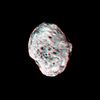
Hyperion-anagliph-PIA06244.jpgStereo-Hyperion! (from about 176.000 Km)58 visiteCaption NASA originale:"Saturn's moon Hyperion pops into view in this stereo anaglyph (or 3D view) created from Cassini images. Images taken from slightly different viewing angles allow construction of such stereo views, which are helpful in interpreting the moon's irregular shape.
Hyperion's unusual dimensions are 164 by 130 by 107 Km (such as 102 by 81 by 66 miles).
Craters are visible on the moon's surface down to the limit of resolution in this image, about 1 Km (0,6 mile) per pixel. The fresh appearance of most of these craters, combined with their high spatial density, makes Hyperion look something like a sponge. The moon's spongy-looking exterior is an interesting coincidence, as Hyperion's density seems to indicate that it is porous and much of its interior is filled with voids.
Dark material is concentrated in the bottoms of many craters visible here, perhaps resulting from the down slope movement of material, combined with sublimation of brighter ice".Lug 12, 2005
|
|

SaturnandCompanions-PIA07538.jpgSaturn's Space Panorama61 visiteCaption NASA originale:"Three of Saturn's icy moons are seen here, along with the magnificent water-ice rings and the cold gaseous envelope of the Planet's atmosphere. Saturn's dark shadow stretches completely across the rings.
At nine and a half times farther from the Sun than Earth, Saturn inhabits the deep cold of the outer Solar System. The Sun appears only 1% as bright there as it appears at Earth, creating an environment where ice dominates over rock.
The icy Moons visible here, from left to right are: Janus (181 kilometers, or 113 miles, across), Enceladus (505 kilometers, or 314 miles, across), and Epimetheus (116 kilometers, or 72 miles, across).
The image was taken in visible green light with the Cassini spacecraft wide-angle camera on June 1, 2005, at a distance of approximately 2,4 MKM from Saturn. The image scale is 139 Km per pixel".Lug 09, 2005
|
|

Mimas-PIA07534.jpgRound? Not really...59 visiteCaption NASA originale:"Saturn's moon Mimas, whose low density suggests that it is primarily composed of ice, has a flattened or oblate shape reminiscent of Saturn's. The moon's equatorial dimension is nearly 10% larger than the polar one due to the satellite's rapid rotation. This view shows principally the leading hemisphere on Mimas. Mimas' largest crater, Herschel (130 Km, or 80 miles wide), is centered roughly on the equator and can be seen here. North on Mimas is toward upper left.
The moon's oblateness is exaggerated by Cassini's viewing angle here -- the Sun-Mimas-spacecraft, or phase, angle was only 5° leaving a sliver of the moon's disk in shadow on the northwest limb.
The image was taken in visible light with the Cassini spacecraft narrow-angle camera on May 20, 2005, at a distance of approx. 916.000 Km (about 569.000 miles) from Mimas. Resolution in the original image was 5 Km (about 3 miles) per pixel".Lug 05, 2005
|
|

Tethys-IMG001589-br500.jpgItaca Chasma on Tethys59 visiteCaption NASA originale:"Saturn's icy moon Tethys displays a very old impact basin here, just South-East of its giant canyon system, Ithaca Chasma. The large crater has been degraded, or softened, by time and a more recent impact has formed a smaller crater near its southern edge. This large basin was first seen in images from the NASA Voyager mission. A sharper, presumably younger crater called Penelope lies near the eastern limb, at the 3 o'clock position. This view shows principally the trailing hemisphere on Tethys and North is directly up.
The image was taken in visible light with the Cassini spacecraft narrow-angle camera on May 20, 2005, at a distance of approx. 1 MKM (approx. 600.000 miles) from Tethys and at a Sun-Tethys-spacecraft, or phase, angle of 31°. Resolution in the original image was 6 Km (about 4 miles) per pixel. The image has been contrast-enhanced and magnified by a factor of two to aid visibility".Lug 05, 2005
|
|

Tethys-N00036303.jpgTethys from 487.484 Km61 visitenessun commentoGiu 29, 2005
|
|

Epimetheus-PIA07531.jpgEpimetheus57 visiteCaption NASA originale:"Cassini continues to survey the small worlds that orbit near Saturn's Rings, capturing this view of Epimetheus.
The moon's lumpy, irregular topography can be seen here, along with several impact craters. The image was taken in visible light with the Cassini spacecraft narrow-angle camera on May 20, 2005, at a distance of about 345.000 Km from Epimetheus and at a phase angle of 26°.
Resolution in the original image was 2 Km per pixel.
The view was also magnified by a factor of two and contrast-enhanced to aid visibility of the moon's surface".Giu 29, 2005
|
|

Pandora-PIA07530.jpgPandora: the closest view so far!58 visiteCaption NASA originale:"This is one of Cassini's closest views to date of Saturn's F-Ring shepherd moon Pandora. At least one crater is visible on the surface of this moon, which is thought to be an icy rubble pile, loosely bound together by gravity. Pandora is 84 Km across.
Several of Saturn's Ring moons, including Pandora, show elongated, oval-like shapes with their long axes oriented along the moon-Saturn line. In this view, Cassini is looking at the side of Pandora facing away from Saturn. The image shows the moon's leading hemisphere (although, as mentioned, Pandora is not actually round). To the right, much of the moon's surface is in shadow. The image was taken in visible light with the Cassini spacecraft narrow-angle camera on May 20, 2005, at a distance of approx. 346.000 Km from Pandora and at a Sun-Pandora-spacecraft, or phase, angle of 21°".Giu 29, 2005
|
|

Janus-PIA07529.jpgJanus from 357.000 Km61 visiteThis close-up look at Saturn's moon Janus reveals spots on the moon's surface which may be dark material, maybe exposed by impacts. If the dark markings within bright terrain are indeed impact features, then Janus' surface represents a contrast with that of Saturn's moon Phoebe, where impacts have uncovered bright material beneath a darker overlying layer. Recent theories say also that Janus may be a porous body, composed mostly of water ice.
This image was taken in visible light with the Cassini spacecraft narrow-angle camera on May 20, 2005, at a distance of approx. 357.000 Km (about 222.000 miles) from Janus and at a Sun-Janus-spacecraft, or phase, angle of 6°. Resolution in the original image was 2 Km (about 1,3 miles) per pixel. The view was magnified by a factor of two and contrast-enhanced to aid visibility of the moon's surface".Giu 28, 2005
|
|

DioneandEpimetheus-PIA07525.jpgDione and Epimetheus59 visiteCaption NASA originale:"Cassini looks toward Saturn's night side in this view, capturing a glimpse of Dione's tortured surface in the foreground and a far-off view of Epimetheus, beyond Saturn. The spacecraft was just 1/10th of a degree above the ring-plane when this image was taken.
Parts of Dione's surface have been stretched and ripped apart by tectonic forces. Some of these faults are visible here, as is a large impact basin (not seen in NASA Voyager spacecraft images) near the moon's South Pole. Although this crater's diameter has not yet been measured by imaging scientists, it appears to be wider than 250 Km, which would make it the largest impact structure yet identified on this moon.
The image was taken in visible light with the Cassini spacecraft narrow-angle camera on May 5, 2005, at a distance of approx. 910.000 Km from Dione; 1,28 MKM from Epimetheus and 1,42 MKM from Saturn. The image scale is 5 Km per pixel on Dione and 9 Km per pixel on Epimetheus".Giu 22, 2005
|
|

Prometheus_and_the_Rings.jpgPrometheus and the Rings60 visiteCaption NASA originale:"What do Saturn's Rings look like from the other side? From Earth, we usually see Saturn's Rings from the same side of the ring-plane that the Sun illuminates them. Geometrically, in the above picture taken in April by the Cassini Spacecraft, the Sun is behind the camera but on the other side of the ring-plane. Such a vantage point gives a breathtaking views of the most splendid ring system in the Solar System. Strangely, the Rings have similarities to a photographic negative of a front view. For example, the dark band in the middle is actually the normally bright B-Ring. The Ring brightness as recorded from different angles indicates ring thickness and particle density of ring particles. Images like these are also interesting for what they do not show: such as the spokes. The unexpected shadowy regions once recorded by the Voyager missions when they passed Saturn in the early '80s are not, so far, being seen by Cassini. Extra credit: Can you spot the small moon (Prometheus)?Giu 22, 2005
|
|

Pandora-PIA07523.jpgPandora and the F-Ring59 visiteCaption NASA originale:"The shepherd moon, Pandora, is seen here alongside the narrow F-Ring that it helps maintain in the right equlibrium.
Cassini obtained this view from about 4° above the ringplane. Captured here are several faint, dusty ringlets in the vicinity of the F-Ring core.
The ringlets do not appear to be perturbed to the degree seen in the core.
The appearance of Pandora here is exciting, as the moon's complete shape can be seen, thanks to reflected light from Saturn, which illuminates Pandora's dark side; also the hint of a crater is visible on the dark side of the moon.
The image was taken in visible light with the Cassini spacecraft narrow-angle camera on May 4, 2005, at a distance of approx. 967.000 Km (such as approx. 601.000 miles) from Pandora and at a Sun-Pandora-spacecraft angle of 117°. The image scale is 6 Km per pixel".Giu 18, 2005
|
|

TheRings-PIA07522.jpgFour versions of the "F-Ring"59 visiteCaption NASA originale:"This montage of 4 images of Saturn's knotted F-Ring shows different locations around the Ring itself. Even though all the images were taken within a few hours of each other, there is remarkable variation in the structure of the F-Ring at these four locations.
For example, the number of ring strands differs from image to image and in some images, kinks are clearly visible in the F-Ring, while other regions appear more smooth.
Astronomers believe that the structure of Saturn's F-Ring is governed by its shepherding moons, Prometheus and Pandora. The F-Ring's appearance is expected to vary depending on how recently a ring section has encountered each moon and how close the moon came to the ring".
Nota: nel primo quadro (in alto a Sx) c'è qualcosa, posto proprio al di sopra del 'nodo' centrale visibile sull'intreccio più luminoso dell'Anello F, che sembra un 'filamento' o, comunque, un oggetto estraneo all'Anello F stesso, ma reale (NON crediamo che sia un photo-artifact). Cos'è?Giu 17, 2005
|
|
| 2245 immagini su 188 pagina(e) |
|
|
|
|
|
148 | |
|
|
|
|
|
|





