| Ultimi arrivi - Saturn: the "Ringed Beauty" and His Moons |

Mimas-N00037627.jpgMimas, from approx. 89.258 Km61 visite...abbiano sofferto, come o più di altri, degli impatti catastrofici. L'assunzione logica che sta alla base di questo ragionamento dice che, tanto più il cratere che vediamo è grande, tanto più grande deve essere stato il corpo impattante. Ora, a nostro modo di vedere, questa Teoria può anche essere valida, ma solo entro 'limiti definiti' e matematicamente determinabili. Non è certo questa la sede per entrare nel calcolo puro ma comunque possiamo già dire questo: la dimensione di ogni cratere, in termini di diametro, può essere definita da un quoziente il quale è il risultato del rapporto tra un coefficiente numerico che esprime la valutazione globale delle variabili di impatto in relazione al corpo impattante ed un altro coefficiente che esprime la valutazione globale delle variabili relative al corpo impattato. Semplici verifiche empiriche dimostreranno che, oltre un certo rapporto (che chiamiamo x), le conseguenze dell'impatto NON produrranno un cratere, bensì la distruzione di entrambi i corpi.Ago 03, 2005
|
|

Mimas-N00037611.jpgMimas, from approx. 104.424Km60 visiteLa maggior parte di questi elementi - se non la totalità - in difetto di osservazioni dirette dell'impatto, dovrà essere dedotta da elementi circostanziali quali, ad esempio: 1) le dimensioni del cratere; 2) la forma del cratere; 3) la composizione della superficie impattata all'interno del cratere e nei suoi dintorni, sia quelli immediati, sia quelli più lontani (a tal riguardo è corretta l'analisi chimico-fisica degli ejecta; 4) la composizione del bolide (sempre ammesso che sia possibile trovarne qualche "pezzo" - non è da escludere, infatti, l'ipotesi di una totale annichilazione del corpo impattante al momento dell'impatto) e così via.
Ora, semplificando questa modesta trattazione il più possibile, ciò che possiamo dedurre - guardando un cratere come lo "Stickney Crater" di Phobos, oppure il "Copernicus Crater" della Luna e poi, naturalmente, il cratere che stiamo osservando ora e che chiamiamo "Occhio di Mimas" (ma il cui vero nome è "Herschel") - è che, in epoche remote, alcuni corpi celesti...Ago 03, 2005
|
|

Mimas-N00037585.jpgMimas, from approx. 155.923 Km58 visitePensate, lasciando per ora da parte i calcoli sulle energie che vengono sprigionate da un impatto, a che cosa accade quando un corpo "piccolo" (diciamo tra i 100 ed i 500 metri di diametro) si abbatte, muovendosi a velocità comprese fra i 50 ed i 70.000 Km orari, su di un altro corpo celeste. L'energia che si sprigiona da un simile impatto può essere solo equiparata (e con un'ampia approssimazione PER DIFETTO) a quella emessa dall'esplosione di una buona ventina di bombe atomiche simili a quelle sganciate sul Giappone nel 1945.
Nell'effettuazione dei calcoli di supporto a qualsiasi teorizzazione, come sapete, occorre tenere in considerazione una molteplicità di elementi e fattori. Eccone solo alcuni: 1) le dimensioni del corpo impattante; 2) la velocità del corpo impattante al momento dell'impatto; 3) l'angolo di impatto; 4) la composizione del corpo impattante; 5) le dimensioni del corpo impattato; 6) la composizione e la struttura dell'area impattata e così via.Ago 03, 2005
|
|

Mimas-N00037581.jpgMimas, from approx. 183.583 Km61 visiteL'impressionante "Occhio di Mimas" non sembra essere rivolto nella nostra direzione e quindi, memori delle avventure di Ulisse, possiamo tentare di passare inosservati nelle sue vicinanze...
Mitologia a parte, l'immenso cratere che domina questa - tutto sommato - minuscola luna di Saturno dovrebbe farci riflettere sulle sue origini e, più in generale, sulla - sempre presunta - "origine da impatto" della quasi totalità delle formazioni crateriche che vediamo sui diversi corpi celesti. Abbiamo già accennato a questa complessa e controversa problematica in altri momenti, ma sono immagini come questa che devono spingerci a non "accettare acriticamente ed aprioristicamente come valide" tutte le Teoria Esplicative delle Fenomenologie Complesse (TEFC) allorchè l'acquisizione di nuovi dati ed informazioni le mette, se non in crisi, quantomeno in grandissima difficoltà.Ago 03, 2005
|
|

Rhea-PIA07554.jpgRhea's "Bright Splat"71 visiteCaption NASA originale:"This view of Saturn's moon Rhea shows the tremendous "Bright Splat" that coats much of the moon's leading hemisphere. The bright feature may be impact-related and is visible in other Cassini images of Rhea.
The image was taken in visible green light with the Cassini spacecraft narrow-angle camera on June 25, 2005, at a distance of approx. 1,1 MKM from Rhea and at a phase angle of less than 1°. Resolution in the original image was 7 Km (about 4 miles) per pixel (...)".
Nota: in qualità di Ricercatori nel campo delle Scienze Planetarie e quindi al di fuori di ogni intendimento strumentalmente polemico nei confronti della NASA e degli Scienziati che attribuiscono il 99,99% dei crateri presenti sui corpi celesti attualmente più conosciuti (dalla nostra Luna alle lune di Nettuno) all'azione di impatti, desideriamo sottolineare che un "Bright Splat" come questo, al 99,99%, NON è attribuibile ad un impatto (a meno che l'agente impattante non fosse una gigantesca palla di fango).Ago 01, 2005
|
|

Enceladus-PIA06433.jpgThe heat inside Enceladus...59 visiteThis image shows the warmest places in the South Polar Region of Enceladus. The unexpected temperatures were discovered by Cassini's Composite Infrared Spectrometer during a close flyby on July 14, 2005. The image shows how these temperatures correspond to the prominent, bluish fractures dubbed "Tiger Stripes". Such "warm" temperatures (91 and 89° Kelvin - about minus 296 and minus 299° Fahrenheit - are unlikely to be due to heating of the surface by the feeble sunlight striking Enceladus' South Pole. They are a strong indication that internal heat is leaking out of Enceladus and warming the surface along these fractures. Evaporation of this relatively warm ice probably generates the cloud of water vapor detected above Enceladus' South Pole by several other Cassini instruments. Scientists are unsure how the internal heat reaches the surface. The process might involve liquid water, slushy brine, or soft but solid ice.Lug 30, 2005
|
|

Enceladus-PIA06250.jpgZooming-in on Enceladus58 visiteCaption NASA originale:"The tortured Southern Polar terrain of Enceladus appears strewn with great boulders of ice in these 2 fantastic views - the Highest Resolution images obtained so far by Cassini of any world.
This comparison view consists of a wide-angle camera image (left) for context, and a HR narrow-angle camera image (right). The 2 images were acquired at an altitude of approx. 208 Km, as Cassini made its closest approach yet to Enceladus. The wide-angle view shows what appears to be a geologically youthful, tectonically fractured terrain.
In the narrow-angle view, some smearing of the image due to spacecraft motion is apparent. Both of these views were acquired as Enceladus raced past Cassini's field of view near the time of closest approach. At the time, the imaging cameras were pointed close to the moon's limb (edge), rather than directly below the spacecraft. This allowed for less 'motion blur' than would have been apparent had the cameras pointed straight down. Thus, the terrain imaged here was actually at a distance of 319 kilometers (198 miles) from Cassini".Lug 28, 2005
|
|

Enceladus-PIA06254-br500.jpgEnceladus (false-colors mosaic)61 visiteFrom afar, Enceladus exhibits a bizarre mixture of softened craters and complex, fractured terrains. This large mosaic of 21 narrow-angle camera images has been arranged to provide a full-disk view of the anti-Saturn hemisphere of Enceladus. This mosaic is a false-color view that includes images taken at wavelengths from the ultraviolet to the infrared portion of the spectrum and is similar to another, LR false-color view obtained during the flyby. In false-color, many long fractures on Enceladus exhibit a pronounced difference in color (represented here in blue) from the surrounding terrain. A leading explanation for the difference in color is that the walls of the fractures expose outcrops of coarse-grained ice that are free of the powdery surface materials that mantle flat-lying surfaces.
The original images in the false-color mosaic range in resolution from 350 to 67 mt per pixel (distance range from about 11.000 up to 61.000 Km).Lug 26, 2005
|
|
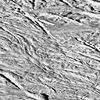
Enceladus-PIA06251.jpgEnceladus from about 208 Km57 visiteThis wide-angle view is one of the highest resolution images yet acquired by Cassini and shows what appears to be a geologically youthful, tectonically fractured terrain.
The image was taken during Cassini's very close flyby of Enceladus on July 14, 2005, from a distance of approx. 208 Km (such as about 129 miles) above Enceladus. Resolution in the image is about 37 mt (or 121 feet) per pixel. The image's contrast has been enhanced to improve the visibility of surface features.Lug 26, 2005
|
|

Enceladus-PIA06252.jpgEnceladus from about 208 Km56 visiteThe tortured southern polar terrain of Enceladus appears strewn with great boulders of ice in this fantastic view, one of the best HR images obtained so far by Cassini of any world.
Some smearing of the image due to spacecraft motion is apparent in this scene, which was acquired as Enceladus raced past Cassini's field of view near the time of closest approach. At the time, the imaging cameras were pointed close to the moon's limb, rather than directly below the spacecraft. This allowed for less motion blur than would have been apparent had the cameras pointed straight down. Thus, the terrain imaged here was actually at a distance of 208 Km from Cassini.
At this fine scale, the surface is dominated by ice blocks between 10 and 100 mt across. The origin of these icy boulders is enigmatic: scientists are interested in studying the sizes and numbers of the blocks in this bizarre scene and in understanding whether terrain covered with boulders is common on Enceladus. Lug 26, 2005
|
|

Hyperion.jpgHyperion: the "sponge-like" moon59 visiteDa "NASA - Picture of the Day" del 26 Luglio 2005:"Recent HR images from the Cassini spacecraft orbiting Saturn show Hyperion to be an even stranger place than thought before. Previously, it was known that the length of a day on Hyperion is unpredictable. The moon's highly elliptical orbit around Saturn, its highly non-spherical shape and its locked 4:3 orbital resonance with Titan torque Hyperion around so much it is hard to predict when the Sun will rise next. The newly imaged craters on the unusually coarse surface are surely the result of impacts, but for some reason have dark centers. The low density of Hyperion indicates it might even be a spelunker's paradise, riddled with tremendous caverns".
Nota: è la prima volta che la NASA dice espressamente che i crateri visibili sono "surely the result of impacts". A parte l'ovvia assurdità di una simile certezza (irraggiungibile per definizione), molti Ricercatori credono che gli impatti ebbero un ruolo MARGINALE nella definizione di questo ed altri mondi...Lug 26, 2005
|
|

Prometheus-PIA07549~0.jpgPrometheus from approx. 438.000 Km56 visiteCaption NASA originale:"Saturn's shepherd moon Prometheus reveals its elongated, irregular form to Cassini in this image. The moon's long axis points toward Saturn, while this view shows the southern part of the moon's anti-Saturn side (such as the face that always points away from Saturn).
The image was taken in visible red light with the Cassini spacecraft narrow-angle camera on June 7, 2005, at a distance of approx. 438.000 Km (about 272.000 miles) from Prometheus. Resolution in the original image was 3 Km per pixel. The image has been contrast-enhanced and magnified by a factor of two to aid visibility".Lug 25, 2005
|
|
| 2245 immagini su 188 pagina(e) |
 |
|
|
|
|
144 | |
|
|
|
|





