| Ultimi arrivi - Saturn: the "Ringed Beauty" and His Moons |

Mimas-PIA06257.jpgMimas: surface geology through "false colors"57 visiteThe image at the left is a narrow angle clear-filter image, which was separately processed to enhance the contrast in brightness and sharpness of visible features. The image at the right is a color composite of narrow-angle ultraviolet, green, infrared and clear filter images, which have been specially processed to accentuate subtle changes in the spectral properties of Mimas' surface materials. To create this view, 3 color images (ultraviolet, green and infrared) were combined into a single black and white picture that isolates and maps regional color differences. This "color map" was then superimposed over the clear-filter image at the left.
The combination of color map and brightness image shows how the color differences across the Mimas surface materials are tied to geological features.
Shades of blue and violet in the image at the right are used to identify surface materials that are bluer in color and have a weaker infrared brightness than the average Mimas materials (green).Ago 06, 2005
|
|

Saturn-PIA06436.jpgSaturn's Aurora59 visiteThe Cassini spacecraft has obtained new images of Saturn's auroral emissions, which are similar to Earth's Northern Lights. Images taken on June 21, 2005, with Cassini's UVA Imaging Spectrograph are the first from the mission to capture the entire "oval" of the auroral emissions at Saturn's South Pole.
In the side-by-side, false-color images, blue represents aurora emissions from H gas excited by electron bombardment, while red-orange represents reflected sunlight. The images show that the aurora lights at the Polar Regions respond rapidly to changes in the Solar Wind. Previous images have been taken closer to the Equator, making it difficult to see the Polar Regions. Changes in the emissions inside the Saturn South-Pole aurora are visible by comparing the 2 images, taken about 1 hour apart. The brightest spot in the left aurora fades and a bright spot appears in the middle of the aurora in the second image. Like Earth's aurora, those on Saturn form in an oval at high latitudes around each pole, along with associated spots and streaks. The ultraviolet imaging spectrograph data shows that the Saturn aurora lasts at least one hour, but small changes are visible in that time between the two images.
The same process produces auroras on both planets: variations in the plasma environment release trapped electrons, which stream along the magnetic field lines into the upper atmosphere. There, they collide with atoms and molecules, exciting them to higher energies. The atoms and molecules release this added energy by radiating light at particular characteristic colors and wavelengths. On Earth, this light is mostly from oxygen atoms and nitrogen molecules. On Saturn, it is from emissions of molecular and atomic hydrogen.
Ago 05, 2005
|
|

Tethys-PIA07557_modest.jpgOdysseus: the Eye of Tethys57 visiteCaption NASA originale:"This richly textured look at Saturn's moon Tethys shows the huge crater Odysseus and its central mountain in relief, as well as many smaller impact sites. Vertical relief on solid Solar System bodies is often most easily visible near the terminator (the line between day and night).
North on Tethys is up in this view. The lit portion of Tethys seen here is on the moon's leading hemisphere as it orbits Saturn.
The image was taken in visible light with the Cassini spacecraft narrow-angle camera on June 27, 2005, at a distance of approximately 490.000 Km (approx 304.000 miles) from Tethys and at a Sun-Tethys-spacecraft, or phase, angle of 117°. The image scale is 3 Km (about 2 miles) per pixel".Ago 05, 2005
|
|

Rings-PIA07556.jpgThe "Opposition Effect"63 visiteCaption NASA originale:"The "opposition effect" can be seen in this image of Saturn's B ring. The bright spot occurs where the angle between the spacecraft, the Sun and the Rings is near zero.
Studies of the Opposition Effect on Saturn's Rings may help scientists constrain some of the properties of the Ring particles, such as their sizes and spatial distribution.
The image was taken in visible light with the Cassini spacecraft wide-angle camera on June 26, 2005, at a distance of approximately 478.000 Km (about 297.000 miles) from Saturn. The image scale is 3 Km (about 2 miles) per pixel".Ago 04, 2005
|
|
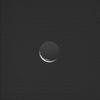
Tethys-N00037660.jpgCrescent Tethys57 visiteUn'immagine di Tethys, ripresa da una distanza di circa 840.000 Km, che ci mostra, alla luce di un Sole lontano, solo una sottilissima falce della sua rocciosa superficie.
Ben visibile, comunque - poichè illuminata dalla luce di Saturno - la parte di Tethys immersa nella notte.
A ridosso della Linea del Terminatore, due grandi crateri che, simili a degli occhi, sembrano scrutare le profondità del cielo.Ago 04, 2005
|
|

Mimas-N00037785.jpgMimas, from approx. 62.000 Km57 visitenessun commentoAgo 04, 2005
|
|

Mimas-N00037768.jpgMimas, from approx. 63.000 Km58 visitenessun commentoAgo 04, 2005
|
|

Mimas-N00037684.jpgMimas, from approx. 63.000 Km67 visitenessun commentoAgo 04, 2005
|
|

Rhea-N00037566.jpgRhea, from about 211.000 Km60 visitenessun commentoAgo 03, 2005
|
|

Rhea-N00037507.jpgRhea, from about 255.000 Km63 visiteUn'altra spettacolare ripresa della grande Rhea, in cui possiamo vedere - e con grande chiarezza - non solo due grandi crateri (da impatto?), ma anche una serie di almeno 2 "crater clusters" che giacciono a ridosso della linea del terminatore.
Chiarissima (ed inesplicabile, naturalmente) la grande depressione (forse un altro cratere?) che caratterizza la Regione a ridosso del Polo Nord (dal nostro punto di vista) di Rhea.Ago 03, 2005
|
|

Dione-N00037544.jpgDione, from about 244.000 Km57 visiteUn'immagine troppo bella per fare dei commenti...Ago 03, 2005
|
|

Mimas-N00037630.jpgMimas, from approx. 88.531Km58 visiteChe cosa significa tutto questo in relazione al Cratere Herschel? Significa che, dopo aver operato le prime - fondamentali - verifiche teoriche sulla validità di questo Modello (che abbiamo chiamato "Coefficiente PGF") in relazione a svariati crateri noti (Herschel incluso), è emerso che alcuni di essi, date le loro attuali dimensioni, semplicemente NON potrebbero esistere!
O meglio: la dimensione del cratere, rapportata alle dimensioni del Corpo Celeste al quale esso accede (un altro elemento che entra a far parte del coefficiente che esprime la valutazione globale delle variabili di impatto in relazione al corpo impattato), implicherebbe delle dimensioni del corpo impattante tali per cui, qualora un siffatto urto fosse realmente occorso, il corpo impattato NON avrebbe retto alla collisione.
Insomma: alcuni crateri - tipo Herchel e Stickney - NON POSSONO ESSERE DERIVATI DA UN IMPATTO.
E' evidente che il Coefficiente PGF necessita di probanti verifiche, ma è - almeno - un primo passo...Ago 03, 2005
|
|
| 2245 immagini su 188 pagina(e) |
 |
|
|
|
|
143 | |
|
|
|
|





