| Ultimi arrivi - Saturn: the "Ringed Beauty" and His Moons |

Rhea-PV-PIA07566.jpgRhea, from about 239.000 Km59 visiteOriginal caption:"Like the rest of Rhea's surface, the Southern Polar Region of this Saturn moon has been extensively re-worked by cratering over the eons. This close-up shows that most sizeable craters have smaller, younger impact sites within them. Near the left lies an intriguing gash (---> taglio lungo e profondo, ivi sinonimo di "chasm" o "cleft").
The largest well-defined crater visible here is an oval-shaped impact toward the upper right. The crater is 115 by 91 Km (such as 71 by 57 miles) in size. Cassini acquired this view during a distant flyby of Rhea on July 14, 2005.
The image was taken in visible light with the Cassini spacecraft narrow-angle camera at a distance of approx. 239.000 Km (such as 149.000 miles) from Rhea and at a Sun-Rhea-spacecraft angle of 56°. The image was obtained using a filter sensitive to wavelengths of infrared light centered at 930 nnmts. The image scale is about 1 Km per pixel".Ago 19, 2005
|
|

Epimetheus-PIA07567.jpgEpimetheus, from approx. 87.000 Km54 visiteCaption originale:"From 34° above Saturn's equatorial plane, Cassini gazed down at Saturn's moon Epimetheus. The region seen here includes territory farther North and East than that imaged in March 2005 (PIA06226).
The two largest craters visible here are the only officially named features on Epimetheus. The crater at the left (at about the 9 o'clock position) is named Pollux; the crater at lower left (containing a string of several smaller craters) is called Hilairea. Epimetheus is 116 Km (about 72 miles) across. The image was taken in visible light with the Cassini spacecraft narrow-angle camera on July 14, 2005, at a distance of approx. 87.000 Km (about 54.000 miles) from Epimetheus and at a phase angle of 95°. The image scale is 520 mt (approx. 1710 feet) per pixel".Ago 19, 2005
|
|

Saturn-PIA07568.jpgThe "dusty" D-Ring of Saturn58 visiteOriginal caption:"This close-up view is Cassini's best look yet at Saturn's tenuous innermost D-Ring. The narrow ringlet visible here is named D68 and is the innermost discrete feature in the D-Ring.
This image also clearly shows how the diffuse component of the D-Ring tapers off as it approaches the Planet.
The view is looking down on the dark side of the Rings, with the Planet's lower half being illuminated by reflected light from the Rings. The upper half of the Planet is also dark. The image was taken at a high phase angle - such as the Sun-Saturn-spacecraft angle - such as 177°. Viewing the Rings at high phase angle makes the finest dusty particles visible.
The inner edge of the C-Ring enters the scene at the lower left and Saturn's shadow cuts off the view of the Rings. Several background stars can also be seen here.
The image was taken in visible light with the Cassini spacecraft wide-angle camera on July 15, 2005, at a distance of approx. 293.000 Km from Saturn".Ago 19, 2005
|
|

Hyperion-N00038106.jpgHyperion, from about 868.000 Km58 visiteUn'immagine molto bella e che ci spinge a considerare molto seriamente l'ipotesi che la Luna conosciuta come "Hyperion" non sia altro che una cometa mancata, ovvero un astro composto prevalentemente da ghiaccio d'acqua, il cui cammino verso il Sole venne interrotto (repentinamente e per sempre) dall'abbraccio gravitazionale di Saturno. A proposito: se osservate Hyperion con una certa attenzione, dovreste notare una certa (e forte) somiglianza con un altro corpo celeste "vagante", recentemente salito agli onori delle Cronache Spaziali.
Quale?Ago 17, 2005
|
|

Saturn-PIA07563.jpgSaturn or Van Gogh?57 visiteSaturn's turbulent atmosphere is reminiscent of a Van Gogh painting in this view. However, unlike the famous impressionist painter, Cassini records the world precisely as it appears to the spacecraft's cameras.
The feathery band that cuts across from the upper left corner to the right side of this scene has a chevron, or arrow, shape near the right. The center of the chevron is located at the latitude (about 28° South) of an eastward-flowing zonal jet in the atmosphere. Counter-flowing eastward and westward jets are the dominant dynamic features seen in the giant planet atmospheres. A chevron-shaped feature with the tip pointed East means that this is a local maximum in the eastward wind and a region of horizontal wind shear where clouds to the North and South of the jet are being swept back by the slower currents on the sides of the jet.
The image was taken in visible light with the Cassini spacecraft narrow-angle camera on July 6, 2005, at a distance of approx. 2,5 MKM from Saturn using a filter sensitive to wavelengths of infrared light centered at 727 nanometers. The image scale is 14 kilometers (9 miles) per pixel.Ago 13, 2005
|
|
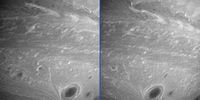
Saturn-PIA07562.jpgThe "anti-hurricanes" of Saturn59 visiteVortices mingle amidst other turbulent motions in Saturn's atmosphere in these two comparison images. The image on the right was taken about two Saturn rotations after the image on the left.
Both views show latitudes from -23° to -42°. The region below center in these images (at -35°) has seen regular storm activity since Cassini first approached Saturn in early 2004.
Cassini investigations of the atmosphere from February to October 2004 showed that most of the oval-shaped storms in the latitude region near -35° rotate in a counter-clockwise direction, with smaller storms occasionally merging into larger ones.
On Earth, hurricanes in the Southern Hemisphere rotate clockwise. Thus, the storms in these images of Saturn's southern latitudes could be called "anti-hurricanes."
This backwards spiraling (compared to Earth) is common on the giant planets.Ago 12, 2005
|
|

Saturn-PIA07560.jpgSaturn and Tethys56 visiteOriginal caption:"Saturn poses with Tethys in this Cassini view. The C ring casts thin, string-like shadows on the Northern Hemisphere. Above that lurks the shadow of the much denser B-Ring. Cloud bands in the atmosphere are subtly visible in the south. Tethys is 1071 Km (about 665 miles) across.
Cassini will perform a close flyby of Tethys on Sept. 24, 2005. This image was taken on June 10, 2005, in visible green light with the Cassini spacecraft wide-angle camera at a distance of approx. 1,4 MKM (such as about 900.000 miles) from Saturn. The image scale is 81 Km (about 50 miles) per pixel".Ago 09, 2005
|
|

Saturn-PIA07559.jpgRings in the Rings, both cut by the darkness...59 visiteCaption NASA originale:"This view shows the unlit face of Saturn's Rings, visible via scattered and transmitted light. In these views, dark regions represent gaps and areas of higher particle densities, while brighter regions are filled with less dense concentrations of ring particles.
The dim right side of the image contains nearly the entire C-Ring. The brighter region in the middle is the inner B-Ring, while the darkest part represents the dense outer B-Ring. The Cassini Division and the innermost part of the A-Ring are at the upper-left.
Saturn's shadow carves a dark triangle out of the lower right corner of this image.
The image was taken in visible light with the Cassini spacecraft wide-angle camera on June 8, 2005, at a distance of approximately 433.000 Km (about 269.000 miles) from Saturn. The image scale is 22 Km (about 14 miles) per pixel".Ago 09, 2005
|
|

Mimas-PIA06412.jpgMimas and the Rings54 visiteCaption NASA originale:"During its close flyby of Saturn's moon Mimas on Aug. 2, 2005, Cassini caught a glimpse of Mimas against the broad expanse of Saturn's Rings. The Keeler Gap in the outer A-Ring, in which Cassini spied a never-before-seen small moon, is at the upper right.
The ancient, almost asteroid-like surface of Mimas is evident in its crater-upon-crater appearance. Even the material which has slumped down into the bottom of some of its craters bears the marks of later impacts.
This image was taken through the clear filter of the Cassini spacecraft narrow-angle camera at a distance of 68.000 Km (about 42.500 miles) from Mimas and very near closest approach. The smallest features seen on the moon are about 400 mt wide (approx. 440 yards); the Sun-Mimas-Cassini angle is 44°".Ago 06, 2005
|
|

Mimas-PIA06256.jpgMimas: spectacular overview57 visiteThe most detailed images ever taken of Saturn's moon Mimas show it to be one of the most heavily cratered Saturnian moons, with little (if any) evidence for internal activity. Mimas has been so heavily cratered that new impacts can only overprint or even completely obliterate other older craters. Mimas is about 397 Km across.
The moon displays an unexpected array of crater shapes. The highest crater walls tower 6 Km above the floors and show signs of material sliding down slope. Indeed, many of the large craters - more than 15 Km in diameter - appear to be filled in with rough-surfaced material, likely the result of landslides triggered by subsequent impacts elsewhere on Mimas' surface. Some of these deposits have craters superimposed on them, demonstrating that the landslides themselves may be quite old.
Grooves, some of which are over a Km deep, cut across the surface for more than 100 Km. These are some of the only indications that there might have once been internal activity under this ancient, battered surface.Ago 06, 2005
|
|

Mimas-PIA06258.jpgThe "Eye of Mimas": Herschel Crater54 visiteCaption NASA originale:"During its approach to Mimas on Aug. 2, 2005, the Cassini spacecraft narrow-angle camera obtained multi-spectral views of the moon from a range of 228.000 Km (about 142.500 miles).
This image is a narrow angle clear-filter image which was processed to enhance the contrast in brightness and sharpness of visible features.
Herschel Crater, a 140-kilometer-wide impact feature with a prominent central peak, is visible in the upper right of this image.
This image was obtained when the Cassini spacecraft was above 25° South, 134° West latitude and longitude. The Sun-Mimas-spacecraft angle was 45° and North is at the top".Ago 06, 2005
|
|

Mimas-PIA06259.jpgMimas: surface geology through "false colors" (Herschel Crater)54 visiteHerschel Crater, a 140-Km-wide (about 88 miles) impact feature with a prominent central peak, is visible in the upper right of each image. The unusual bluer materials are seen to broadly surround Herschel Crater. However, the bluer material is not uniformly distributed in and around the Crater. Instead, it appears to be concentrated on the outside of the Crater and more to the West than to the North or South.
The origin of the color differences is not yet understood. It may represent ejecta material that was excavated from inside Mimas when the Herschel impact occurred.
The bluer color of these materials may be caused by subtle differences in the surface composition or the sizes of grains making up the icy soil.
The images were obtained when the Cassini spacecraft was above 25°South, 134° West latitude and longitude.
The Sun-Mimas-spacecraft angle was 45° and North is at the top.
Ago 06, 2005
|
|
| 2245 immagini su 188 pagina(e) |
 |
|
|
|
|
142 | |
|
|
|
|





