| Ultimi arrivi - Saturn: the "Ringed Beauty" and His Moons |

Enceladus-Model0-PIA03553.jpgWater Vapor & Particles Over Enceladus54 visiteThis plot shows results from Cassini's Ion Neutral Mass Spectrometer (INMS) and Cosmic Dust Analyzer (CDA), obtained during the spacecraft's close approach to Enceladus on July 14, 2005. Within a minute of that closest approach, the 2 instruments detected material coming from the surface of the Moon. The INMS measured a large peak in the abundance of water vapor at approx. 35" before closest approach to Enceladus, as it flew over the South Polar Region at an altitude of 270 Km. The high rate detector of the CDA observed a peak in the number of fine, powder-sized icy particles coming from the surface approx. 1' before reaching closest approach, at an altitude of 460 Km. The character of these detections is very similar to the venting of vapor and fine, icy particles from the surfaces of comets when they are warmed as they near the Sun. On Enceladus, it is believed that internal heat, possibly from tidal forces, is responsible for the activity. The close but different occurrences of the two detections are yielding important clues to the location of the vents and even the venting process.Ago 30, 2005
|
|

Enceladus-Model3-PIA07727.jpg"Warm" Ice on Enceladus (Model 3)57 visiteOriginal NASA caption:"This graphic represents a possible third model for mechanisms that could generate the water vapor and tiny ice particles detected by Cassini over the Southern Polar terrain on Enceladus.
This model shows sublimation of an "ammonia-water slush" (slush----> fanghiglia costituita da un mix di ammoniaca ed acqua) or "slurry" (slurry---->sin. di slush, ma anche 'combinazione') on the surface".Ago 30, 2005
|
|

Enceladus-Model2-PIA07726-br500.jpg"Warm" Ice on Enceladus (Model 2)58 visiteOriginal NASA caption:"This graphic represents a second possible model for mechanisms that could generate the water vapor and tiny ice particles detected by Cassini over the Southern Polar terrain on Enceladus. This model shows venting by plumes". Ago 30, 2005
|
|

Enceladus-Model1-PIA07725.jpg"Warm" Ice on Enceladus (Model 1)57 visiteOriginal NASA caption:"This graphic represents a possible model for mechanisms that could generate the water vapor and tiny ice particles detected by Cassini over the Southern Polar terrain on Enceladus. This Model shows sublimation of warmed surface ice. Sublimation is to cause to change directly from a solid to a gas, or from a gas to a solid, without becoming a liquid". Ago 30, 2005
|
|

RingsStructure-2-PIA03550.jpgThe "Rings' Structure"58 visiteSaturn's Rings make up an enormous, complex structure. From edge-to-edge, the Ring System would not even fit in the distance between Earth and the Moon. The 7 main rings are labeled in the order in which they were discovered. From the planet outward, they are D, C, B, A, F, G and E. The D-Ring is very faint and closest to Saturn. The main Rings are A, B and C. The outermost Ring, easily seen with Earth-based telescopes, is the A-Ring. The Cassini Division is the largest gap in the Rings and separates the B from the A-Ring. Just outside the A-Ring is the narrow F-Ring, shepherded by tiny moons Pandora and Prometheus. Beyond that are 2 much fainter Rings named G and E. Saturn's diffuse E-Ring is the largest planetary ring in our Solar System, extending from Mimas' orbit to Titan's orbit, about 1 MKM.
The particles in Saturn's rings are composed primarily of water ice and range in size from microns to tens of meters. The rings show a tremendous amount of structure on all scales; some of this structure is related to gravitational interactions with Saturn's many moons, but much of it remains unexplained. One moonlet, Pan, actually orbits inside the A ring in a 330-kilometer-wide (200-mile) gap called the Encke Gap. The main rings (A, B and C) are less than 100 meters (300 feet) thick in most places, compared to their radial extent of 62,120 kilometers (38,600 miles). The main rings are much younger than the age of the solar system, perhaps only a few hundred million years old. They may have formed from the breakup of one of Saturn's moons or from a comet or meteor that was torn apart by Saturn's gravity.Ago 30, 2005
|
|

Mimas-PIA07573.jpgMimas in the shadows of the B-Ring56 visiteAs the closest-orbiting of Saturn's intermediate-sized moons, Mimas is occasionally captured against the planet's dim and shadowed northern latitudes. The Moon is seen here next to the shadows cast by the dense B-Ring. The image was taken with the Cassini spacecraft narrow-angle camera on July 18, 2005, at a distance of approx. 1,6 MKM (such as about 1 MMs) from Mimas and at a Sun-Mimas-spacecraft, or phase, angle of 90°. Image scale is 10 Km (about 6 miles) per pixel.Ago 28, 2005
|
|

Rhea-PIA07572.jpgRhea, from about 342.000 Km56 visiteCassini looks upward at the South Polar Region on Rhea during a recent distant encounter. Rhea's icy surface is so heavily saturated with impact craters that the moon's limb, or edge, has a rugged, bumpy appearance. The bright splotch seen here near the upper right is impact material (or ejecta) from a relatively fresh crater.
The image was taken with the Cassini spacecraft narrow-angle camera on July 14, 2005, at a distance of approx. 342.000 Km (about 212.000 miles) from Rhea and at a Sun-Rhea-spacecraft, or phase, angle of 36°. The image was obtained using a filter sensitive to wavelengths of infrared light centered at 298 nnmts. The image scale is 1,6 Km per pixelAgo 26, 2005
|
|

Tethys-PIA07571.jpgTethys and...Odysseus54 visiteCaption NASA originale:"Saturn's moon Tethys displays its distinctive dark equatorial band here, along with two sizeable impact craters in the West. The larger crater to the North is Odysseus, which has a diameter (450 Km across) that is a substantial fraction of the Moon's width - remember that Tethys is 1.071 Km (about 665 miles) across.
Several moons in the Outer Solar System have large impact features like Odysseus and scientists are interested in learning how such powerful impacts have altered the moons' surfaces.
The image was taken in visible light with the Cassini spacecraft narrow-angle camera on July 10, 2005, at a distance of approx. 1,8 MKM (such as 1,1 MMs) from Tethys. The image scale is 11 Km (about 7 miles) per pixel. The image has been magnified by a factor of two to aid visibility".Ago 25, 2005
|
|

Pandora-PIA07570.jpgPandora, from 1,3 MKM57 visiteWhile close to Saturn in its orbit, Cassini stared directly at the Planet to find Saturn's moon Pandora in the field of view. The F-Ring shepherd moon is gliding towards the right in this scene. The F-Ring is thinly visible just above the main rings. Pandora is 84 Km (about 52 miles) across.
Near the lower left, some variation in the height of Saturn's cloud tops can be detected. This effect is often visible near the terminator (such as the day and night boundary), where the Sun is at a very low angle above Saturn's horizon.
The image was taken in visible light with the Cassini spacecraft narrow-angle camera on July 16, 2005, at a distance of approx. 1,3 MKM (about 800.000 miles) from Saturn.
The image scale is about 8 Km (about 5 miles) per pixel on Saturn and about 6 Km (about 4 miles) per pixel on Pandora.Ago 25, 2005
|
|

Epimetheus.jpgEpimetheus, from approx. 87.000 Km58 visiteOriginal caption:"How did Epimetheus form? No one is yet sure. To help answer that question, this small moon has recently been imaged again in great detail by the robot spacecraft Cassini now orbiting Saturn. Epimetheus sometimes orbits Saturn in front of Janus, another small satellite, but sometimes behind. The above false-color image, taken during mid July, shows a surface covered with craters indicating great age. Epimetheus spans about 115 Km across. Epimetheus does not have enough surface gravity to restructure itself into a sphere".Ago 24, 2005
|
|
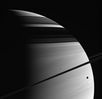
Saturn-PIA07569.jpgThe Kingdom of Beauty60 visiteAbbiamo da tempo notato che le immagini di Saturno (e/o di Giove) e dei loro Sistemi non sembrano interessare i Lettori. Non è solo il counter che esprime "quante volte" un frame è stato aperto che parla e ci racconta, bensì anche gli altri indici statistici che ci informano su quanti Visitatori sono entrati in ciascuna Sezione o sub-Sezione del Sito. Ebbene, quando verifichiamo questi dati per le sub-Sezioni dedicate a Giove e Saturno, la delusione è grande. Forse la colpa è nostra, ci siamo detti, perchè non riusciamo a rendere 'accattivante' il Regno dei Giganti Gassosi...O forse la colpa, se di colpa si può parlare, è dei media i quali, spesso e volentieri, parlano - anche a vanvera - di Marte e/o della Luna, ma molto raramente (2/3 volte l'anno) accennano a Saturno (e Titano). Giove, ormai, è solo un ricordo.
La verità, secondo noi, è che su Marte i media si sono sbizzarriti così tanto che viene quasi naturale interessarsi solo al Pianeta Rosso...Ma attenti: il Futuro, è ben oltre le sabbie di Cydonia!Ago 23, 2005
|
|

Mimas Map-PIA06255.jpgMimas' Map55 visiteOriginal caption:"This map of the surface of Saturn's moon Mimas illustrates the Regions that were imaged by Cassini during the spacecraft's flyby of the moon on Aug. 2, 2005. At closest approach, the spacecraft passed within approx. 62.900 Km above the Moon's surface. The colored lines delineate the Regions that were imaged at differing resolutions. The closest images were obtained near closest approach. Mimas has never been imaged this closely before. The flyby provided the best views yet of the South Pole of Mimas and some of its northern latitudes, as well as distant views of the giant crater Herschel, near the terminator.
The highest resolution images show the trailing hemisphere of Mimas, opposite Herschel. Several fracture systems have been seen in the region in NASA Voyager images, like Pelion Chasma and Tintagil Chasma. Images obtained from this Cassini encounter may help test whether these canyons and others on Mimas' surface, are related to the formation of Herschel (...)".Ago 19, 2005
|
|
| 2245 immagini su 188 pagina(e) |
 |
|
|
|
|
141 | |
|
|
|
|





