| Ultimi arrivi - Saturn: the "Ringed Beauty" and His Moons |

Saturn-PIA03557.jpgSaturn's pressure70 visiteOriginal NASA caption:"This new view on the right side shows clouds at an altitude where pressure is nearly 2 bars. (nota---->1 bar rappresenta l'unità di misura della pressione atmosferica terrestre esistente al livello del mare). These clouds are about 30 Km underneath the clouds usually observed on Saturn. This is distinctly different from the typical view of Saturn in reflected sunlight, shown on the left.
The left view is characterized by broad expanses of clouds near the 1-bar level, such as the white cloud seen circling the Equator, with little hint of the discrete cloud complexes lying underneath (...)".Set 07, 2005
|
|

Janus-PIA07580.jpgJanus61 visiteOriginal NASA caption:"The Roman god Janus is usually depicted with two faces (nota: "Giano Bifronte"), one looking forward and one behind. Janus is captured here by Cassini, showing two faces of its own.
This view shows a sliver of Janus's dayside, plus much of the dark side. Part of the darkened terrain to the left is lit dimly by reflected light from Saturn, revealing craters there.
North on Janus is up in this image. A brightly sunlit view of Janus (181 Km, or 113 miles across) can also be seen in PIA07529.
The image was taken in visible green light with the Cassini spacecraft narrow-angle camera on Aug. 2, 2005, at a distance of approx. 541.000 Km (about 336.000 miles) from Janus and at a Sun-Janus-spacecraft, or phase, angle of 147°. Resolution in the original image was 3 Km (about 2 miles) per pixel.
The image has been contrast-enhanced and magnified by a factor of two to aid visibility".
Set 07, 2005
|
|

Rings-PIA07718.jpgArcs in the G-Ring59 visiteOriginal NASA caption:"This sequence of images shows a faint arc of material in Saturn's G-Ring, a tenuous ring outside the main Ring System. These images were each taken about 45' apart. During this time, the arc (slightly brighter than the Ring itself) moves around the outer edge of the Ring. The arc is visible on the lower part of the Ring in the first image, just beneath the ansa (or outer edge). In the second image the arc is easily seen on the outer edge and then faintly just above the outer edge in the third image.
What makes this part of the G-Ring brighter than other parts is not clear. However, the existence of this arc might hold clues about how this ring was formed and where the material which makes up this ring comes from. These 3 images were taken in polarized near-infrared light using the Cassini spacecraft narrow-angle camera on May 24, 2005, at a distance of approx. 1,7 MKM (about 1,1 MMs) from Saturn. Resolution in the original images was about 97 Km per pixel".Set 07, 2005
|
|

Rings-PIA07716.jpgCan the "clumps" in the Rings be the TSP (Transient Saturnian Phoenomena)?58 visite"Scientists have long suspected that small moons hiding among Saturn's Rings strands might be producing some of the unusual structure observed in the F-Ring. While the shepherd moon Prometheus is the main culprit behind the strange behavior of Saturn's F-Ring, it cannot explain all observed features. The current dilemma facing scientists is that Cassini is detecting extended objects like those pictured here - that may be either solid moons or just loose clumps of particles within the Ring. This montage of 4 enhanced Cassini narrow-angle camera images shows bright clump-like features at different locations within the F-Ring.
Two objects in particular, provisionally named S/2004 S3 and S/2004 S6, have been repeatedly observed by Cassini over the past 13,5 months and 8,5 months, respectively. The orbits for these 2 objects have not yet been precisely determined, in part because perturbations from other nearby moons make the orbits of objects in this region complicated. Thus, scientists cannot be completely confident at the present time if they in fact have observed new sightings of S3 and S6, or additional transient clumps.
The upper two images show features that may be S6. From previous observations, S6 appears to have an orbit that crosses that of the main F ring. This unexpected behavior currently is a subject of great interest to ring scientists.
The upper left image was taken on June 21, 2005, and shows an object in the outer ringlets of the F ring. The radial (or lengthwise) extent of the feature is approximately 2,000 kilometers (1,200 miles). The radial resolution on the ring is about 13 kilometers (8 miles) per pixel.
The image at the upper right was taken on June 29, 2005, and shows a bright feature within the F ring's inner ringlets. The radial extent of the feature seen here is about 2,000 kilometers (1,200 miles); the radial resolution is 36 kilometers (22 miles).
The image at the lower left was taken on August 2, 2005, and shows a feature that may be S3. S3 has been found to have an orbital path that is tightly aligned with that of the main F ring. The radial resolution in the image is 3.5 kilometers (2.2 miles) per pixel.
The lower right image was taken on April 13, 2005, and has a radial resolution of 7 kilometers (4 miles) per pixel. This object does not appear to be either S3 or S6.
Structures like knots and clumps within the F ring often are transient, appearing and then disappearing within months. Repeated observation of the objects seen in this region hopefully will give scientists firm evidence about whether these features are actual moons that disturb the material around them or perhaps the short-lived products of interactions between the F ring and larger moons such as Prometheus.
Set 07, 2005
|
|

Rings-PIA07579.jpgPandora, Prometheus and the F-Ring60 visiteOriginal NASA caption:"From just outside the faint edge of Saturn's F-Ring, the moon Pandora keeps watch over her fine-grained flock.
The outer flanks of the F-Ring region are populated by ice particles approaching the size of the particles comprising smoke!
As a shepherd moon, Pandora helps her cohort Prometheus confine and shape the main F-Ring (Pandora is 84 Km (such as 52 miles) across while Prometheus is 102 Km (such as 63 miles) wide and orbits interior to the F-Ring.
The small knot seen attached to the core is one of several that Cassini scientists are eyeing as they attempt to distinguish "embedded moons" from "transient clumps of material".
The image was taken with the Cassini spacecraft narrow-angle camera on Aug. 2, 2005, using a filter sensitive to wavelengths of infrared light centered at 930 nnmts at a distance of approx. 610.000 Km (such as about 379.000 miles) from Pandora and at a Sun-Pandora-spacecraft, or phase, angle of 146°. Image scale is 4 Km per pixel".Set 07, 2005
|
|

Rings-PIA03556.jpg"Clumps" in the A-Ring59 visiteOriginal NASA caption:"The left image is a false-color view of Saturn's A-Ring from the Ultraviolet Imaging Spectrograph aboard Cassini.
The A-Ring is the bluest in the center, where the gravitational clumps are the largest. The thickest black band in the Ring is the "Encke-Gap" while the thin black band further to the right is the "Keeler-Gap".
The right image is a computer simulation about 150 mt (about 490 feet) across illustrating a "clumpy region" of particles in the A-Ring. And, there and that is the 'real surprise'...The particles are moving counterclockwise, from bottom to top!".Set 07, 2005
|
|

Enceladus~1.jpgEnceladus' "Tiger Stripes"57 visiteDa "NASA - Picture of the Day" del 6 Settembre 2005:"The Tiger Stripes on Saturn's moon Enceladus might be active. Even today, they may be spewing ice from the Moon's icy interior into space, creating a cloud of fine ice particles over the Moon's South Pole and creating Saturn's mysterious E-Ring. Recent evidence for this has come from the Cassini spacecraft. Cassini detected a marked increase in particle collisions during its July flyby only 270 Km over a South Polar Region of Enceladus. Pictured above, a HR image of Enceladus is shown from the close flyby. The unusual surface features dubbed "Tiger Stripes" are visible on the left in false-color blue. Why Enceladus is active remains a mystery, as the neighboring moon Mimas, approximately the same size, appears quite dead".Set 06, 2005
|
|

Mimas-HerschelCrater.jpgHerschel Crater on Mimas59 visitenessun commentoSet 01, 2005
|
|

Rhea-PIA07575.jpgTirawa Impact Basin on Rhea59 visiteThe giant Tirawa impact basin straddles the day and night boundary on Saturn's moon Rhea in this view from the Cassini spacecraft. The ancient basin is 5 Km deep in places, as measured in NASA Voyager images. The whole basin is about 360 Km across.
The prominent bright splotch to the southeast of Tirawa is ejecta from a fairly fresh crater. This view of Rhea (1.528 Km, such as about 949 miles across) reveals terrain slightly to the East of a similar Cassini view, released earlier (see Diversity of Impacts). The sunlit surface in this view is principally on the leading hemisphere of Rhea. North is up and rotated 13° to the left.
The image was taken in visible light with the Cassini spacecraft narrow-angle camera on Aug. 13, 2005, at a distance of approx. 2 MKM (about 1,2 MMs) from Rhea and at a Sun-Rhea-spacecraft, or phase, angle of 50°. Resolution in the original image was 12 kilometers (7 miles) per pixel. The image has been contrast-enhanced and magnified by a factor of two to aid visibility.Ago 31, 2005
|
|

Enceladus-GroundTrack-PIA07723_modest.jpgEnceladus: the "Ground-Track"56 visiteThis graphic shows Cassini's path, or Ground Track, as it crossed over the surface of Enceladus near the time of closest approach during the flyby on July 14, 2005. The Ground Track is indicated by a yellow line, marked by increments of 10" before and after closest approach. The spacecraft came within 175 Km from the surface of Enceladus at closest approach.
The red contour encloses the Region on Enceladus around the South Pole that is the approx. boundary of the warm region, as measured by the Composite Infrared Spectrometer (CIS) on Cassini. As previously announced, temperatures observed within this region reached as high as 110 Kelvin (about -260 Fahrenheit). (...) Results like these, pouring in from various Cassini instruments, indicate the warm South Polar Region and, in particular, the 'tiger stripe' fractures straddling the South Pole, as the sources of heat, water vapor and small, icy particles.
Enceladus is a surprisingly active moon. Why its South Pole is the site of this activity is a mystery.Ago 30, 2005
|
|
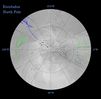
Enceladus-S-NP-PIA07721_modest.jpgEnceladus: Global Patterns of Fracture (Northern Polar Projection)57 visiteTerrain near the North Pole is among the most heavily cratered and oldest on the surface of Enceladus. The conspicuously fractured Southern Polar Region is nearly devoid of impact craters, making this terrain among the youngest on the Moon's surface.
A unique feature of the South Polar terrains is that broad networks of folded or kinked fractures can be found throughout the Region. A prominent "chain" of these fractures (marked in red in the South Polar Map) abruptly separates the youthful South Polar terrains from the older terrains that lie closer to the Equator and appears to encircle the South Pole near about 55° South Latitude.
The wavy boundary of the South Polar terrain is interrupted in numerous places by Y-shaped, or funnel-shaped, discontinuities that curve and taper northward. Well-developed examples of the funnel-shaped discontinuities appear to transition to systems of North-South trending surface cracks (marked in blue).
These north-south trending cracks are best explained as if they formed in response to tension stresses that are parallel to lines of latitude. Such extensional "hoop stresses" would be expected to develop if the equator became wider, perhaps in response to a change in the moon¿s spin rate.
Globally systematic patterns of fracture on Enceladus occur in ancient, cratered terrain as well as youthful terrain. Shown in green on the maps -- and particularly apparent in the northern hemisphere projection -- are roughly orthogonal (or perpendicular) systems of north-south and east-west trending fractures that formed quite close to the tidal axis of Enceladus. The moon¿s tidal axis is a line extending from 0-degrees longitude to 180-degrees longitude. Such orthogonal fractures might have formed in response to tidal stresses exerted on Enceladus by Saturn.
Ago 30, 2005
|
|
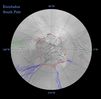
Enceladus-SP-PIA07722_modest.jpgEnceladus: Global Patterns of Fracture (Southern Polar Projection)55 visiteFractures on the surface of Enceladus record a long and complex history of tectonic activity. Many of the geologically youngest fractures define remarkably systematic patterns relative to Enceladus' axis of rotation, as well as to its tidal orientation (that is, the longitudes that point toward and away from Saturn). These fracture patterns offer clues to global changes of shape that the satellite has undergone over time, possibly in response to tidal forces exerted by Saturn or as a result of changes in the internal structure of the icy moon. Some of the most prominent global patterns of fracture are delineated in color in the Southern Hemisphere map shown here.
This map is a polar stereographic projection that was mosaicked from the best-available Cassini and Voyager clear-filter images.
The map is centered on the South Pole and coverage extends to the Equator. Gridlines show latitude and longitude in 30° increments.Ago 30, 2005
|
|
| 2245 immagini su 188 pagina(e) |
 |
|
|
|
|
140 | |
|
|
|
|





