| Ultimi arrivi - Saturn: the "Ringed Beauty" and His Moons |

Pandora-PIA07602.jpgPandora59 visiteOriginal caption:"Saturn's moon Pandora is almost overwhelmed by the brightness of the F-Ring in this view. The F-Ring's bright core displays kinks and is flanked by fainter ringlets. Imaging scientists recently determined these fainter ringlets to be a single spiral ring that winds around the Planet. Pandora is faintly lit by "Saturnshine," or reflected light from the planet, and few features can be seen here. This image was acquired by Cassini exactly three hours after the spacecraft took the image seen in previous PIA07601, which showed Prometheus interior to the F-Ring.
The image was taken in visible light with the Cassini spacecraft narrow-angle camera on Aug. 21, 2005, at a distance of appx. 583.000 Km from Saturn and at a high Sun-Saturn-spacecraft angle of 136°. Resolution is about 3 Km per pixel".
Nota: osservate il frame PIA07530 e poi confrontate le due immagini di Pandora. A noi sembra che ci sia una "profonda" differenza e che il corpo celeste ripreso nei due frames NON sia lo stesso.Ott 07, 2005
|
|

Prometheus-PIA07601.jpgPrometheus leaves a "dark track" inside the F-Ring64 visiteOriginal caption:"Prometheus poses here with its latest creation: a dark, diagonal gore (---> incisione/striscia) in the tenuous material interior to Saturn's F-Ring. The shepherd moon creates a new gore each time it comes closest to the F-Ring while the memory of previous passes is preserved in the Rings' structure for some time afterward. The image was taken in visible light with the Cassini spacecraft narrow-angle camera on Aug. 20, 2005, at a distance of approx. 499.000 Km (about 310.000 miles) from Saturn and at a very high phase angle, such as 144°.
Resolution in the original image was 3 Km about 2 miles) per pixel".Ott 05, 2005
|
|

Saturn-W00010821.jpgSaturn and Enceladus61 visiteOriginal caption:"W00010821.jpg was taken on October 02, 2005 and received on Earth October 04, 2005. The camera was pointing toward Saturn at approximately 2.408.824 Km away and the image was taken using the MT2 and CL2 filters".Ott 05, 2005
|
|
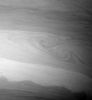
Saturn-PIA07600.jpgSaturnian Atmosphere: the "Cat's Eye"59 visiteOriginal caption:"During its time in orbit Cassini has already spotted many beautiful "Cat's Eye-shaped" patterns like the ones visible here. These patterns occur in places where the winds and the atmospheric density at one latitude are different from those at another latitude.
The opposing East-West flowing cloud bands are the dominant patterns seen here and elsewhere in Saturn's atmosphere. Contrast in the image was enhanced to aid the visibility of atmospheric features.
The image was taken with the Cassini spacecraft wide-angle camera on Aug. 20, 2005, at a distance of approx. 420.000 Km (about 261.000 miles) from Saturn using a filter sensitive to wavelengths of infrared light centered at 728 nnmts. The image scale is 22 Km (about 13 miles) per pixel".Ott 05, 2005
|
|
Saturn-PIA07599.jpgSaturnian Meteorology59 visitePrima del commento NASA ufficiale, un nostro commento: sappiamo che le immagini di Saturno (come quelle di Giove e degli altri Giganti Gassosi) non "incontrano" molto i gusti dei nostri Lettori. Peccato.
Peccato perchè questi Mondi non solo sono davvero affascinanti, ma anche perchè essi sono così grandi che basta solo riflettere per qualche istante sulle immagini che proponiamo per capire che cosa renda il nostro lavoro di Divulgatori così splendidamente "bello".
Pensate: state guardando delle formazioni nuvolose che caratterizzano gli strati superficiali dell'atmosfera di Saturno da quasi 500mila Km. Le osservate da quasi 500mila Km e le VEDETE! Capite che cosa vuol dire questo, in termini anche solo meramente "dimensionali"?!? Vuol dire che la Terra è davvero piccola. E che dire allora dell'Uomo il quale, rispetto alla Terra, è insignificante?!?...
Pensateci, prima di andare a guardare qualche altra immagine...
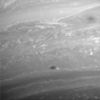
There is much to examine in detailed close-ups like this one of Saturn's atmosphere. Scientists are particularly interested in the bright, and in some places turbulent-looking, thin boundary between the large-scale features in the upper half of the image. The characteristic features of this thin boundary might be suggestive of a place where convection is occurring. Convection in Saturn's atmosphere occurs when sufficiently warm air at deeper levels rises to levels where it becomes less dense than the surrounding air.
Coverage on Saturn extends here from 18 degrees south to 50 degrees south latitude. Contrast in the image was enhanced to aid the visibility of atmospheric features.
The image was taken with the Cassini spacecraft wide-angle camera on Aug. 19, 2005, at a distance of approximately 487,000 kilometers (302,000 miles) from Saturn using a filter sensitive to wavelengths of infrared light centered at 752 nanometers. The image scale is 25 kilometers (16 miles) per pixel
Ott 04, 2005
|
|

Hyperion-PIA07740.jpgHyperion - false colors61 visiteOriginal caption:"This stunning false-color view of Hyperion reveals crisp details across the strange, tumbling moon's surface. Differences in color could represent differences in the composition of surface materials. The view was obtained during Cassini's close flyby on Sept. 26, 2005.
Hyperion has a notably reddish tint when viewed in natural color. The red color was toned down in this false-color view and the other hues were enhanced, in order to make more subtle color variations across Hyperion's surface more apparent.
Images taken using infrared, green and ultraviolet spectral filters were combined to create this view. The images were taken with the Cassini spacecraft's narrow-angle camera at a distance of approx. 62.000 Km (about 38.500 miles) from Hyperion and at a Sun-Hyperion-spacecraft angle of 52°.
The image scale is 362 mt (about 1200 feet) per pixel".Set 30, 2005
|
|

Hyperion-PIA07741-3.jpgHyperion's unusual craters (3) - HR59 visiteUn piccolo applauso a Lunar Explorer Italia la quale, con due giorni e mezzo di anticipo sulla NASA (Commenti Ufficiali), è riuscita ad individuare ed estrapolare, dall'analisi dei "raw frames Cassini" - usando gli occhi dei Ricercatori e qualche altro mezzo informatico davvero "povero"... - le tematiche di maggiore interesse che riguardano questa piccola Luna Saturniana e che la NASA stessa ha, come avete letto nelle note di commento - "original caption" - ai due frames precedenti, enfaticamente portato all'attenzione dei Lettori.
Un "Bravo" a Lunar Explorer Italia quindi (...che ogni tanto lo meritiamo davvero...).Set 30, 2005
|
|

Hyperion-PIA07741-2.jpgHyperion's unusual craters (2) - HR64 visiteOriginal caption:"Scientists will also be examining Cassini's sharp views to try to determine whether there have been multiple episodes of landslides on Hyperion. Such "downslope" movement is evident in the filling of craters with debris and the near elimination of many craters along the steeper slopes. Answers to these questions may help solve the mystery of why this object has evolved different surface forms from other moons of Saturn.
The images comprising this mosaic were taken with the Cassini spacecraft narrow-angle camera at distances ranging from approximately 8.500 Km (about 5.300 miles) to 4.600 Km (about 2.900 miles) from Hyperion. Image scale is 26 mt (about 85 feet) per pixel".Set 30, 2005
|
|

Hyperion-PIA07741-1.jpgHyperion's unusual craters (1) - HR58 visiteOriginal caption:"This HR Cassini mosaic shows that Hyperion truly has a surface different from any other in the Saturn System. The mosaic is composed of 5 clear filter images taken during Cassini's close flyby of Hyperion on Sept. 26, 2005. The spacecraft passed approximately 500 Km(310 miles) above the moon's surface. Hyperion is 266 Km (about 165 miles) in diameter.
Scientists are extremely curious to learn what the dark material is that fills many craters on this oddball moon. Features within the dark terrain, including a 200-meter-wide impact crater surrounded by rays to the right of center (Sezione 3 del frame) and numerous bright-rimmed craters, indicate that the dark material may be only tens of meters (hundreds of feet) thick with brighter material beneath".Set 30, 2005
|
|
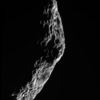
Hyperion-PIA07739.jpgGood-bye Hyperion...58 visiteOriginal caption:"As Cassini sped away from its close encounter with Saturn's moon Hyperion on Sept. 26, 2005, it took this parting shot of the battered moon's shadowy limb.
The image was taken in visible light with the Cassini spacecraft narrow-angle camera at a distance of approx. 32.300 Km (about 20.000 miles) from Hyperion and at a Sun-Hyperion-spacecraft angle of 127°.
Image scale is 192 meters (630 feet) per pixel".Set 30, 2005
|
|

Tethys-PIA07737.jpgLandslides on Tethys (HR & false colors)58 visiteOriginal caption:"This false-color image, created with infrared, green and ultraviolet frames, reveals a wide variety of surface colors across this terrain. The presence of this variety at such small scales may indicate a mixture of different surface materials. Tethys was previously known to have color differences on its surface, especially on its trailing side, but this kind of color diversity is new to imaging scientists.
This view is centered on terrain at approx. 4,2° South Latitude and 357° West Longitude on Tethys. The view has been rotated so that North on Tethys is up.
The images for this view were obtained using the Cassini spacecraft narrow-angle camera at distances ranging from approx. 18.400 to 19.000 Km (about 11.400 to 11.800 miles) from Tethys and at a Sun-Tethys-spacecraft, or phase, angle of 17°. Image scale is 213 mt (700 feet) per pixel".Set 30, 2005
|
|

Tethys-PIA07736.jpgLandslides on Tethys (HR)57 visiteOriginal caption:"This view is among the closest Cassini images of Tethys' icy surface taken during the Sept. 24, 2005 flyby. This image is a clear-filter view and is the highest resolution image acquired by Cassini during the encounter. The two large craters at the right show evidence that landslides have modified their outlines and covered their floors with large quantities of debris. Linear depressions cutting across the terrain probably mark the surface expressions of faults or fractures.
This view is centered on terrain at approx. 4,2° South Latitude and 357° West Longitude on Tethys. The image has been rotated so that North on Tethys is up.
The view was obtained using the Cassini spacecraft narrow-angle camera at a distance of approx. 19.000 Km (about 11.800 miles) from Tethys and at a Sun-Tethys-spacecraft, or phase, angle of 17°.
Image scale is 110 mt (360 feet) per pixel".Set 30, 2005
|
|
| 2245 immagini su 188 pagina(e) |
 |
|
|
|
|
134 | |
|
|
|
|





