| Ultimi arrivi - Saturn: the "Ringed Beauty" and His Moons |

Dione-N00041099.jpgDione's Fly-By (2): from about 60.000 Km60 visitenessun commentoOtt 13, 2005
|
|

Dione-N00041054.jpgDione's Fly-By (1): from about 115.000 Km58 visitenessun commentoOtt 13, 2005
|
|
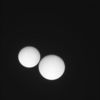
Dione-N00041010.jpgDione and Rhea (5)59 visitenessun commentoOtt 13, 2005
|
|

Dione-N00041007.jpgDione and Rhea (4)58 visitenessun commentoOtt 13, 2005
|
|

Dione-N00041006.jpgDione and Rhea (3)58 visitenessun commentoOtt 13, 2005
|
|

Dione-N00041005.jpgDione and Rhea (2)61 visiteOriginal caption:"The Cassini spacecraft successfully completed its only flyby of Saturn's moon Dione on Oct. 11, 2005. In the process, Cassini captured Dione eclipsing Saturn's moon Rhea. In the picture above, the distance between Dione and Rhea was roughly 330.000 Km (about 205.000 miles). Cassini will swoop by Rhea on Nov. 26, 2005".Ott 13, 2005
|
|
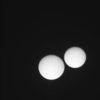
Dione-N00041004.jpgDione and Rhea (1)60 visiteIn questa serie di frames vediamo una splendida eclisse che coinvolge Rhea e Dione (con Dione che eclissa Rhea). Si tratta, come ovvio, di un evento frequente, quando le Lune che orbitano attorno al loro Mondo Genitore sono decine e decine... Ma per noi, abituati a vedere una sola Luna nel nostro cielo, spettacoli come questo costituiscono sempre una sorgente di profonda emozione e di meraviglia: una fusione perfetta fra Natura e Scienza.Ott 13, 2005
|
|

Rhea-PIA07606.jpgHalf-Rhea, in the darkness...58 visiteOriginal caption:"This half-lit view beautifully captures the ponderously old and cratered surface of Saturn's icy moon Rhea. The sunlit terrain shown here is on the moon's Leading Hemisphere, on the side of Rhea that always faces toward Saturn. North is up and rotated 20° to the left.
The image was taken in visible light with the Cassini spacecraft narrow-angle camera on Aug. 21, 2005, at a distance of approximately 922.000 Km (about 573.000 miles) from Rhea and at a Sun-Rhea-spacecraft, or phase, angle of 88°. The image scale is 6 Km (about 4 miles) per pixel".Ott 12, 2005
|
|
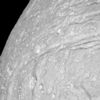
Tethys.jpgIcy cliffs, canyons and crevasses on Tethys (HR)57 visiteOriginal caption:"The surface of Saturn's moon Tethys is riddled with icy cliffs and craters. The most detailed images ever taken of Tethys were captured late last month as Cassini spacecraft swooped past the frozen ice moon. The above image was taken from from about 32.000 Km and shows a jagged landscape of long cliffs covered with craters. At the bottom of many craters appears some sort of unknown light-colored substance, in contrast to the unknown dark substance that appears at the bottom of Saturn's moon Hyperion. Tethys is one of the larger moons of Saturn, spanning about 1000 Km across and its density indicates a composition almost entirely of water ice. Tethys is thought to have been predominantly liquid sometime in its distant past, creating some of its long ice-cliffs as it cracked during freezing".Ott 12, 2005
|
|
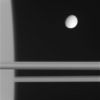
Tethys-N00040990.jpgTethys and the Rings59 visiteOriginal caption:"N00040990.jpg was taken on October 10, 2005 and received on Earth October 11, 2005. The camera was pointing toward TETHYS at approximately 1.258.610 Km away and the image was taken using the BL1 and CL2 filters".Ott 11, 2005
|
|

Pandora-PIA07604.jpgOccultation!58 visiteOriginal caption:"Saturn's moon Pandora glides in front of the narrow F-Ring, making the moon's oblong outline visible. The image also shows the A-Ring, the Cassini Division, the B-Ring and part of the C-Ring. This view is from beneath the Ring plane. The image was taken in visible light with the Cassini spacecraft narrow-angle camera on Aug. 23, 2005, at a distance of approximately 1,6 MKM (about 1 MMs) from Pandora and at a Sun-Pandora-spacecraft, or phase, angle of 97°. Resolution in the original image was 9 Km (about 6 miles) per pixel".Ott 10, 2005
|
|

Dione-PIA07603.jpgDione: the "Aeneidian Moon", from 1,1 MKM58 visiteOriginal caption:"When naming features on other worlds, scientists like to follow themes, and Dione is no exception. Dione possesses numerous features with names from Virgil's 'Aeneid'. The prominent crater showing a central peak below the center is Dido, a 118-Km-wide (about 73-mile) crater named after the supposed founder of Carthage. The crater just above Dido is Antenor, an 82-Km-wide (about 51-mile) impact crater named after the nephew of Priam who founded the Italian city of Padua. At the upper right is the 97-Km-wide (about 60-mile) impact crater Turnus, which lies at the western end of Carthage Linea, a region of bright, fractured terrain. The sunlit terrain seen here shows some of the wispy markings on the Moon's trailing hemisphere. Cassini revealed that these markings are actually a complex system of fractures. North on Dione is up and rotated 25° to the left (...)".Ott 09, 2005
|
|
| 2245 immagini su 188 pagina(e) |
 |
|
|
|
|
133 | |
|
|
|
|





