| Ultimi arrivi - Saturn: the "Ringed Beauty" and His Moons |

Tethys-PIA07607.jpgTethys and the Rings54 visiteOriginal caption:"The dramatic Ithaca Chasma carves an enormous gash for more than 1000 Km (about 620 miles) across Saturn's moon Tethys. Stretching across the top of this view are the B and A-Rings, separated by the Cassini Division. Ithaca Chasma is on the moon's Saturn-facing Hemisphere. North on Tethys is up and rotated 15° to the left in this view.
This image was taken in visible light with the Cassini spacecraft narrow-angle camera on Aug. 24, 2005, at a distance of approx. 2,2 MKM (such as about 1,3 MMs) from Tethys and at a Sun-Tethys-spacecraft angle of 87°. The image scale is 13 Km (about 8 miles) per pixel".Ott 14, 2005
|
|

Mimas-PIA07608.jpgMimas and the Rings59 visiteOriginal caption:"Saturn's shadow spreads across the Rings here, extending beyond the F-Ring and its tenuous, flanking ringlets. This view catches Saturn's moon Mimas on its day-long sojourn around the Planet.
The image was taken in visible light with the Cassini spacecraft narrow-angle camera on Aug. 24, 2005, at a distance of approx. 2,1 MKM (such as about 1,3 MMs) from Mimas and at a phase angle of 84°. The image scale is 13 Km (about 8 miles) per pixel".Ott 14, 2005
|
|

Telesto-N00041291.jpgTelesto58 visiteOriginal caption:"N00041291.jpg was taken on October 11, 2005 and received on Earth October 12, 2005. The camera was pointing toward TELESTO at approximately 12,230 kilometers away, and the image was taken using the CL1 and CL2 filters. This image has not been validated or calibrated".
Nota: ricordate il discusso Fly-By di Hyperion durante il quale questa piccola luna rimaneva completamente immobile durante l'avvicinamento di Cassini (vedi "Hyperion", di A. Feltri e P. C. Fienga su NEXUS)? Notate ora come Telesto, invece, cambi VISIBILMENTE posizione tra un frame e l'altro. Sarà perchè Telesto ruota su sè stesso molto più rapidamente di Hyperion o forse perchè Cassini ha diminuito la sua velocità di crociera?
O magari perchè queste immagini sono genuine e quelle del Fly-By di Hyperion non lo erano?...
Voi che dite?Ott 13, 2005
|
|

Telesto-N00041282.jpgTelesto60 visiteOriginal caption:"N00041282.jpg was taken on October 11, 2005 and received on Earth October 12, 2005. The camera was pointing toward TELESTO at approx. 15.409 Km away; this image was taken using the P0 and GRN filters. This image has not been validated or calibrated".Ott 13, 2005
|
|
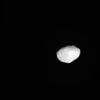
Telesto-N00041270.jpgTelesto90 visiteOriginal caption:"N00041270.jpg was taken on October 11, 2005 and received on Earth October 12, 2005. The camera was pointing toward TELESTO at approx. 19.676 Km away; this image was taken using the CL1 and CL2 filters. This image has not been validated or calibratedOtt 13, 2005
|
|

Telesto-N00041294.jpgTelesto59 visiteOriginal caption:"N00041294.jpg was taken on October 11, 2005 and received on Earth October 12, 2005. The camera was pointing toward TELESTO, at approx. 11.408 Km away; the image was taken using the CL1 and CL2 filters. This image has not been validated or calibrated".Ott 13, 2005
|
|

Dione-N00041252.jpgExtremely high "albedo" on some of Dione's surface features (3)67 visiteLe montagne (forse una catena) che brillano al Sole rendono questa immagine davvero spettacolare e, se portate il frame sino a full-size e poi lo analizzate con calma, noterete come è anche ben visibile il panorama di Dione situato nel suo lato in ombra.
Quest'ultimo fenomeno, forse, è il risultato del "Saturn-Shine" o "Chiaro di Saturno" (vale a dire che la debole - ma percepibile! - illuminazione del lato di Dione immerso nella notte viene procurata dalla intensa luce che arriva da Saturno).
Un fenomeno del tutto analogo lo possiamo vedere anche noi da Terra quando la nostra Luna - al primo quarto - , ci mostra anche il resto della sua superficie (di regola immersa nell'ombra e non visibile) la quale ci appare debolmente illuminata dal "Chiaro di Terra" - o "Earth-Shine").
Ad ogni modo - ed a parte le piccole annotazioni sul 'Saturn-Shine' di cui sopra - la luminosità dei rilievi di Dione esposti alla luce diretta del Sole ci sembra eccessiva e meritevole di ulteriori e specifiche analisi.Ott 13, 2005
|
|

Dione-N00041251.jpgExtremely high "albedo" on some of Dione's surface features (2)57 visitevedi il commento svolto per il frame precedenteOtt 13, 2005
|
|

Dione-N00041249.jpgExtremely high "albedo" on some of Dione's surface features (1)60 visiteLo spettacolare "passaggio ravvicinato" di Cassini accanto a Dione sta per finire ed ora la Sonda Euro-Americana è già ad oltre 16.000 Km di distanza da questa "icy moon", come la chiamano alla NASA. Questi ultimi 3 frames che Vi proponiamo, però, nonostante la loro non buona qualità, ci fanno vedere qualcosa di davvero strano: si tratta dell'albedo elevatissima dei rilievi di Dione che - supponiamo - si trovano proprio sulla Linea del Terminatore. Uno dei 3 frames è molto mosso e sfuocato; gli altri 2 sono appena migliori, ma la nostra sorpresa non cambia: il rilievo illuminato di Dione brilla di luce davvero intensa e, a nostro parere, si tratta di un evento che, in queste proporzioni, diventa meritevole di un particolare interesse.
Verificate Voi stessi...Ott 13, 2005
|
|

Dione-N00041245.jpgDione's Fly-By (17): from about 1.360 Km57 visitenessun commentoOtt 13, 2005
|
|

Dione-N00041243.jpgDione's Fly-By (16): from about 1.835 Km56 visitenessun commentoOtt 13, 2005
|
|

Dione-N00041240.jpgDione's Fly-By (15): from about 2.800 Km55 visitenessun commentoOtt 13, 2005
|
|
| 2245 immagini su 188 pagina(e) |
 |
|
|
|
|
131 | |
|
|
|
|





