| Ultimi arrivi - Saturn: the "Ringed Beauty" and His Moons |
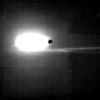
The Rings-N00042087.jpgThe "G-Ring" and a "Dark Object" in the light...56 visiteOriginal caption:"N00042087.jpg was taken on October 24, 2005 and received on Earth October 25, 2005. The camera was pointing toward SATURN-G-RING at approximately 2.120.861 kilometers away and the image was taken using the IR2 and CL2 filters. This image has not been validated or calibrated".
Una simile immagine - un probabile photo-artifact, ma non si può esserne sicuri al 100% - l'avevamo già incontrata quando, diversi mesi fa, la Sonda Cassini si era avvicinata a Giapeto ed aveva effettuato due scatti che produssero un risultato visivo molto simile a questo. E Voi cosa dite? Stiamo guardando una Nave Spaziale Aliena che si "nasconde" nei raggi e nella luce di un Sole lontano - ma comunque brillante - oppure è solo un artefatto fotografico (una "distorsione" da sovraesposizione)?Ott 25, 2005
|
|
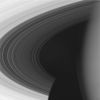
The Rings-PIA07613.jpgThe C-Ring56 visiteOriginal caption:"The Cassini spacecraft looks close at Saturn to frame a view encompassing the entire C-Ring. In the dark region closer to the planet lies the much dimmer D-Ring. The bright B-Ring wraps around the left side of the scene, while Saturn's shadow darkens the Rings at bottom. For reference, Saturn’s Ring sequence from its surface outwards is "D", "C", "B", "A", "F", "G" then "E".
The image was taken in visible light with the Cassini spacecraft wide-angle camera on Sept. 4, 2005, at a distance of approx. 627.000 Km (390.000 miles) from Saturn. The image scale is 34 Km (about 21 miles) per pixel".Ott 22, 2005
|
|

Prometheus&Pandora-PIA07612.jpgCosmic race: Prometheus and Pandora74 visiteSaturn's moon Prometheus (Sx) chases Pandora (Dx) in this Cassini view, but the outcome of their race has already been decided by gravity. Prometheus orbits closer to Saturn and thus moves faster than does Pandora. This view is from a third of a degree (1/3°) beneath the Ringplane. Familiar Ring features that are visible from higher angles above the Rings are foreshortened here. The Planet's dark shadow stretches across the Ringplane at center.
The image was taken in visible light with the Cassini spacecraft narrow-angle camera on Sept. 8, 2005, at a distance of approx. 1,8 MKM (such as about 1,1 MMs) from Saturn. The image scale is 10 Km (about 6 miles) per pixel on Prometheus and Pandora.Ott 21, 2005
|
|

The Rings-PIA07611.jpgDeep inside the "C-Ring"77 visiteOriginal caption:"This close-up view shows an inner region of Saturn's C-Ring. It covers a radial location on the rings located approx. 78.000 to 80.500 Km (about 48.500 to 50.000 miles) from the center of the Planet. Saturn itself has a radius of 60.330 Km (that is about 34.490 miles).
A bright feature, informally referred to as a "plateau", arcs across the image center. The plateau is not high in terms of elevation, but rather in terms of particle density (seen here as brightness). The density is fairly uniform within the bright band, and some five times higher than in the surrounding ring structure. Although the many plateaus in Saturn's Rings appear unchanged over 25 years of observations, scientists do not know what determines their locations or maintains their sharp boundaries.
The image was taken in visible light with the Cassini spacecraft narrow-angle camera on Sept. 5, 2005, at a distance of approx. 418.000 Km(such as about 260.000 miles) from Saturn. The image scale is 2 Km per pixel".Ott 20, 2005
|
|

The Rings-PIA07610.jpgClose look at the "B-Ring"56 visiteOriginal caption:"This detailed view of Saturn's mid-B ring shows intriguing structure, the cause of which has yet to be explained by ring scientists. The image shows a radial location located between approx. 107.200 to 115.700 Km (about 66.600 to 71.900 miles) from Saturn.
The image was taken with the Cassini spacecraft narrow-angle camera on Sept. 3, 2005, at a distance of approx. 1,1 MKM (roughly 700.000 miles) from Saturn using a filter sensitive to wavelengths of infrared light centered at 752 nnmts. The image scale is 6 Km (about 4 miles) per pixel".Ott 20, 2005
|
|

Prometheus-N00041980.jpg"Family Group": Prometheus, Dione and Titan57 visiteOriginal caption:"N00041980.jpg was taken on October 17, 2005 and received on Earth October 18, 2005. The camera was pointing toward PROMETHEUS - approximately 2.358.256 Km away - and the image was taken using the CL1 and CL2 filters. This image has not been validated or calibrated".Ott 19, 2005
|
|

Dione-PIA07748.jpgThe surface of Dione from about 4486 Km69 visiteThe terrain in this image is located within a 60-Km-wide impact crater along the feature called Padua Linea. The western rim of the encompassing crater runs from the middle left to the upper right. The crater's central peak can be seen at the lower right. Multiple generations of fractures are visible here. Numerous fine, roughly parallel linear grooves run across the terrain from top to bottom and are interrupted by the larger, irregular bright fractures. In several places, fractures postdate some deposits in the bottoms of craters that are not badly degraded by time. Such a fracture, for example, runs from the center toward the upper right. Most of the craters seen here have bright walls and dark deposits of material on their floors. As on other Saturnian moons, rockslides on Dione may reveal cleaner ice, while the darker materials accumulate in areas of lower topography and lower slope (e.g. crater floors and the bases of scarps). This view is centered on terrain near 11° South lat. and 238° West long.Ott 18, 2005
|
|

Dione-PIA07747.jpgDione (full view - false colors)58 visiteNon sappiamo se siamo stati sufficientemente chiari sulla delicatissima tematica che abbiamo cercato di affrontare, sebbene solo per sommi capi. Ciò che conta, in ultima analisi, è non uccidere l'immaginazione e, con essa, la capacità di meravigliarsi davanti a qualcosa che supera (per definizione) i confini dello Spazio e del Tempo: lo studio dell'Astronomia e dell'Astrofisica, una volta eliminata la componente "immaginifica" che è propria di queste Scienze, rischia di diventare - sempre a nostro parere - uno studio fine a se stesso.
Coniugare l'armonia delle cosiddette "Meccaniche Celesti" a qualcosa di più vicino alla nostra Natura Umana, invece, potrebbe permetterci di arrivare davvero - in un futuro - a "vedere" qualcosa di più ed a "capire" qualcosa di più.
Ma forse questa visione è solo una nostra "fantasia". Le Vostre opinioni al riguardo, ad ogni modo, saranno bene accette.Ott 18, 2005
|
|

Dione-PIA07746.jpgDione (full view - natural colors)58 visiteNoi siamo d'accordo sul fatto che Scienza e Tecnica (in questo campo specifico) si debbano costruire su basi "matematiche" (o, se preferite, su "elementi fattuali esatti ed incontrovertibili"); ciò su cui NON siamo d'accordo, però, è quella tendenza (ormai diffusa e radicata in tutti gli ambienti Scientifici, a cominciare dalle Università) che vuole costruire TUTTA la Scienza e la Tecnica su basi ESCLUSIVAMENTE matematiche (nel senso anzidetto). La Scienza, infatti, non può prescindere - per essere di vero aiuto all'Uomo - dall'Umanesimo. E dire Umanesimo non significa dire (solo) Letteratura. Umanesimo è "tutto ciò che fa parte dell'Uomo e che contribuisce al suo crescere ed al suo evolversi", secondo noi. Dunque l'Umanesimo comprende anche la Scienza (e la Tecnica), ma NON viceversa. Costruire Scienziati su basi esclusivamente matematiche, quindi, vuol dire - a nostro modesto parere - costruire degli 'Scienziati Incompleti'. Il che vuol anche dire formare degli 'Uomini Incompleti', con tutto ciò che segue.Ott 18, 2005
|
|

Dione-PIA07745-6~1.jpgDione's horizon (full)59 visiteUn commento, a chiusura della panoramica sull'orizzonte di Dione - così come visto dalla Sonda Cassini mentre si allontanava da questa "Luna di Ghiaccio" (o "Icy-Moon", come dice la NASA) - ci pare giusto farlo cercando di concentrarci sul significato "profondo" delle immagini e sul possibile motivo per cui la visione di Saturno e del suo Sistema non pare incontrare un grande interesse da parte dei Lettori. Abbiamo già detto che, in fondo, quello che "cattura" di più l'attenzione è ciò che si trova - sempre relativamente - "più vicino" a noi: la Luna e Marte, su tutti. Ma esistono anche altri fattori condizionanti:
1) l'eco "mediatica" dell'evento. Di Marte, ogni tanto, si parla; della Luna...già di meno. Ma di Saturno, ve lo possiamo garantire, non si parla mai;
2) il modo di "porgere" l'evento. La NASA (e l'ESA) non stimolano MAI l'immaginazione e l'immaginario dei Lettori (Tecnici ed "Amateurs"), ma si limitano a fornire solo aridi dati sulla cui accuratezza, per giunta, si potrebbe discutere per anni.Ott 18, 2005
|
|

Dione-PIA07745-5.jpgDione's horizon - HD (5)58 visitenessun commentoOtt 18, 2005
|
|

Dione-PIA07745-4.jpgDione's horizon - HD (4)59 visitenessun commentoOtt 18, 2005
|
|
| 2245 immagini su 188 pagina(e) |
 |
|
|
|
|
129 | |
|
|
|
|





