| |

| Ultimi arrivi - Saturn: the "Ringed Beauty" and His Moons |

Japetus-N00042823.jpgApproaching Japetus70 visiteOriginal caption:"N00042823.jpg was taken on November 08, 2005 and received on Earth November 09, 2005. The camera was pointing toward IAPETUS at approx. 774,151 Km away, and the image was taken using the CL1 and IR3 filters".Nov 10, 2005
|
|

Dione-PIA07627.jpgDione and the F-Ring (in natural colors)56 visiteOriginal caption:"Saturn's moon Dione is about to swing around the edge of the thin F-Ring in this color view. More than one thin strand of the F-Ring's tight spiral can be seen here.
The terrain seen on Dione is on the moon's Saturn-facing hemisphere.
Images taken using infrared, green and ultraviolet spectral filters were composited to create this color view. The images were taken with the Cassini spacecraft narrow-angle camera on Sept. 20, 2005, at a distance of approx. 2 MKM (about 1,2 MMs) from Dione and at a phase angle of 48°.
The image scale is of about 12 Km (such as roughly 7 miles) per pixel".Nov 10, 2005
|
|

0-Saturn and Friends.jpgSaturn and His Moons203 visiteThe dozens of moons orbiting Saturn vary drastically in shape, size, age and origin. Some of these moons have rocky surfaces, while others are porous, icy bodies. Many have craters, ridges and valleys and some show evidence of tectonic activity. Some appear to have formed billions of years ago, while others appear to be pieces of a bigger, fragmented body. The most interesting one is Titan, the biggest of them all. Larger than Earth's Moon, Titan even has its own thick atmosphere - the only natural satellite in the Solar System with such a luxury. During its 4-year mission in this immense region, the Cassini spacecraft will extensively photograph many of these moons and collect data that will increase our understanding of their composition.
To date, 34 moons have been officially named. In alphabetic order, they are: Albiorix, Atlas, Calypso, Dione , Enceladus, Epimetheus, Erriapo, Helene, Hyperion, Iapetus, Ijiraq, Janus, Kiviuq, Methone, Mimas, Mundilfari, Narvi, Paaliaq, Pallene, Pan, Pandora, Phoebe, Polydeuces, Prometheus, Rhea, Siarnaq, Skadi, Suttung, Tarvos, Telesto, Tethys, Thrym, Titan and Ymir.
Nov 09, 2005
|
|

Japetus-N00042815.jpgApproaching Japetus56 visiteOriginal caption:"N00042815.jpg was taken on November 08, 2005 and received on Earth November 08, 2005. The camera was pointing toward Japetus at approximately 853.040 Km away and the image was taken using the CL1 and IR1 filters".
Giapeto, una Luna misteriosa come tutte, forse più di altre. La vedremo meglio? La conosceremo di più? Forse. Ma il prossimo fly-by è ancora lontano, nel futuro... (Sett. 10, 2007 - 1.227 Km ovvero, circa 762 miglia)
Nota: osservate, con il frame a full-size, l'apparente Polo Nord di Giapeto e la sua configurazione superficiale. Semplicemente incredibile...Nov 09, 2005
|
|

PandoraandDione-PIA07625.jpgPandora and Dione56 visiteOriginal caption:"This view looks up toward the sunlit side of Saturn's rings, as Dione and Pandora trundle by. The moons are on the near side of the Rings and the Planet's shadow stretches across the Rings in the background.
The Cassini spacecraft took this image in visible light with its narrow-angle camera on Sept. 16, 2005, at a distance of approx. 2,4 MKM (such as roughly 1,5 MMs) from Saturn. The image scale is of about 12 Km (7 miles) per pixel on Dione".Nov 09, 2005
|
|

Dione-N00042630.jpgDione behind the Rings57 visiteOriginal caption:"N00042630.jpg was taken on November 03, 2005 and received on Earth November 05, 2005. The camera was pointing toward DIONE at approximately 2.460.100 Km away, and the image was taken using the P120 and UV3 filters. This image has not been validated or calibrated".Nov 07, 2005
|
|

Space-N00042679.jpgThe "Space" of Saturn60 visitenessun commentoNov 07, 2005
|
|

Japetus-W00012022.jpgIs this Japetus?!?61 visiteOriginal caption:"W00012022.jpg was taken on November 03, 2005 and received on Earth November 05, 2005. The camera was pointing toward IAPETUS at approximately 1.624.627 Km away, and the image was taken using the CL1 and CL2 filters. This image has not been validated or calibrated".Nov 07, 2005
|
|

Japetus-N00042610.jpgJapetus, in the darkness...55 visiteOriginal caption:"N00042610.jpg was taken on November 04, 2005 and received on Earth November 05, 2005. The camera was pointing toward IAPETUS at approximately 1.433.927 Km away, and the image was taken using the CL1 and IR1 filters".
Note: un'immagine "inquietante" di Giapeto il quale, già in sè misterioso a causa della sua superficie - in parte - completamente nera, adesso ci appare anche curiosamente "schiacciato" ai poli. Si tratta, probabilmente, di un semplice effetto ottico sulla cui causa, tuttavia, non sapremmo che cosa dire. Bizzarra la configurazione assunta - in questo frame - dal picco centrale del grande cratere (l'Occhio di Giapeto) che domina il Polo Nord apparente di questo incredibile Corpo Celeste.
Inoltre, portando il frame sino al full-size, riuscirete a vedere tanti altri dettagli interessanti della superficie di Giapeto: un mondo - secondo noi - assolutamente affascinante ma ancora poco (almeno apparentemente...) considerato.Nov 07, 2005
|
|

Japetus-N00042704.jpgJapetus: very bright, maybe too bright...59 visiteOriginal caption:"N00042704.jpg was taken on November 03, 2005 and received on Earth November 05, 2005. The camera was pointing toward IAPETUS at approximately 1.617.693 Km away and the image was taken using the CL1 and CL2 filters". Nov 07, 2005
|
|

Helene-N00042585.jpgHelene and Enceladus59 visiteOriginal caption:"N00042585.jpg was taken on November 02, 2005 and received on Earth November 04, 2005. The camera was pointing toward HELENE at approximately 2.186.673 Km away, and the image was taken using the CL1 and CL2 filters.
This image has not been validated or calibrated".Nov 05, 2005
|
|
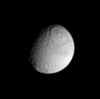
Tethys-PIA07622.jpgOdysseus and Melanthius56 visiteOriginal caption:"Cassini offers up this nice view of the craters Odysseus (at the top) and Melanthius (at the bottom) on Saturn's moon Tethys. Melanthius appears to have an elongated mountain range, rather than a single central peak, at its center.
This is the trailing hemisphere of Tethys, being centered on terrain at roughly 270° Longitude. North on Tethys is up.
This image was taken with the Cassini spacecraft narrow-angle camera on Sept. 20, 2005, through a filter sensitive to wavelengths of ultraviolet light centered at 338 nanometers. This view was obtained at a distance of approx. 1,4 MKM (about 900.000 miles) from Tethys and at a phase angle of 50°. Resolution in the original image was 8 Km (about 5 miles) per pixel. The image has been magnified by a factor of 2 to aid visibility".Nov 04, 2005
|
|
| 2245 immagini su 188 pagina(e) |
|
|
|
|
|
127 | |
|
|
|
|
|
|





