| Ultimi arrivi - Saturn: the "Ringed Beauty" and His Moons |
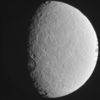
Rhea-N00047219.jpgRhea60 visiteOriginal caption:"N00047219.jpg was taken on December 24, 2005 and received on Earth December 24, 2005. The camera was pointing toward RHEA that, at the time, was approximately 255.628 Km away.
The image was taken using the CL1 and CL2 filters".Dic 25, 2005
|
|

Hyperion-N00047056.jpgHyperion? (2)60 visiteOriginal caption:"N00047056.jpg was taken on December 23, 2005 and received on Earth December 23, 2005. The camera was pointing toward HYPERION that, at the time, was approximately 235.195 Km away.
The image was taken using the CL1 and CL2 filters".Dic 24, 2005
|
|

Hyperion-N00047027.jpgHyperion? (1)60 visiteOriginal caption:"N00047027.jpg was taken on December 23, 2005 and received on Earth December 23, 2005. The camera was pointing toward HYPERION that, at the time, was approx. 227.969 Km away.
The image was taken using the CL1 and CL2 filters".
Saranno scherzi della luce, dell'angolo di fase (o di quello di ripresa), della distanza...Chissà. L'unica cosa che a noi sembra evidente è che Hyperion, in questo frame (e nel successivo) non assomiglia per nulla al corpo celeste che avevamo già visto in passato ed ammirato durante l'ultimo fly-by di Cassini.
Diremmo che assomiglia ad Epimetheus e, comunque, ricorderete anche Voi un altro "face-change" che rilevammo qualche mese fa analizzando alcune immagini MGS di Phobos (un "cambio-faccia" del quale Vi abbiamo già parlato in passato, nella Sezione "Mars and His Moons").
Le possibili cause di questi (apparenti?) "cambi-faccia"? Ripetiamo: la luce, l'angolo di ripresa, l'angolo di fase...senza dimenticare le "sviste": nostre e non solo! Dic 24, 2005
|
|

Janus-N00047102.jpgJanus and...?59 visiteOriginal caption:"N00047102.jpg was taken on December 23, 2005 and received on Earth December 23, 2005. The camera was pointing toward JANUS that, at the time, was approximately 1.111.348 Km away.
The image was taken using the CL1 and CL2 filters".Dic 24, 2005
|
|

Dione-PIA07658.jpgCutting Dione...76 visiteDione is partly occulted by Saturn's Rings in this nearly edge-on view, taken from less than 1/10th of 1° above the Ring-Plane. The side of the Rings nearer to the Cassini spacecraft was masked by Saturn's shadow at the time and appears dark.
Bright, wispy fractures on Dione's trailing Hemisphere curl around the horizon. Sunlit terrain seen on Dione is on the moon's Saturn-facing Hemisphere.
North is up.
The image was taken in infrared light (centered at 752 nanometers) with the Cassini spacecraft narrow-angle camera on Nov. 3, 2005 at a distance of approximately 2.5 million kilometers (1.5 million miles) from Dione and at a Sun-Dione-spacecraft, or phase, angle of 109 degrees. Resolution in the original image was 15 kilometers (9 miles) per pixel.Dic 23, 2005
|
|

Dione-PIA07771.jpgBlack&White&Colors: Dione and Saturn62 visiteCool and icy Dione floats in front of giant Saturn bedecked in a dazzling array of colors.
The surface of Dione, which exhibits contrasting bright and dark areas when viewed up close, appears pale in this image. It is Saturn's multi-hued cloud bands that boldly steal the show. Discrete clouds and eddies in Saturn's Northern Hemisphere can be seen within the faint shadows of the Rings on the Planet. Cassini is in a phase of its mission in which its orbit will be nearly equatorial for some time. This view was obtained from about 1/3ed of 1° out of the Ring-Plane.
Images taken with red, green and blue filters were used to create this natural-color view.
The images were obtained with the wide-angle camera on Sept. 22, 2005, from a distance of approx. 803.000 Km (roughly 499.000 miles) from Dione and at a phase angle of about 43°.
The image scale is about 48 Km (30 miles) per pixel.Dic 23, 2005
|
|

Saturn-PIA07772.jpgThe Light Colors of Saturn59 visiteFew sights in the Solar System are more strikingly beautiful than softly hued Saturn embraced by the shadows of its stately Rings. The gas Planet's subtle Northward gradation from gold to azure is a striking visual effect that scientists don't fully understand.
Current thinking says that it may be related to seasonal influences, tied to the cold temperatures in the Northern (winter) Hemisphere. Despite Cassini's revelations, Saturn remains a world of mystery. Currently, the Rings' shadows shield the mid-northern latitudes from the harshest of the Sun's rays. As Saturn travels around the Sun in its 29-year orbit, the shadows will narrow and head southward, eventually blanketing the opposite hemisphere.
Images taken with blue, green and red spectral filters were used to create this color view, which approximates the scene as it would appear to the human eye. The view was brightened to enhance detail visible in the rings and within their shadows.Dic 23, 2005
|
|

Saturn-PIA07656.jpgA "Dry Hurricane" on Saturn!57 visiteAn oval-shaped feature, wider than Earth and with streamers extending out to the East and West, swirls in Saturn's Southern Hemisphere.
Like the rainbands of a Southern Hemisphere hurricane on Earth, the streamers spiral into the feature in a clockwise direction.
Unlike Earth's hurricanes, this storm probably contains no liquid water.
The Planet's equatorial Rings cut across the top of the image.
The image was taken in wavelengths of polarized infrared light with the Cassini spacecraft wide-angle camera on Oct. 30, 2005, at a distance of approximately 324.000 Km (appx. 202.000 miles) from Saturn. The image scale is about 32 Km (appx. 20 miles) per pixel.Dic 21, 2005
|
|

The Rings & Rhea-PIA07655.jpgThe F-Ring and crescent Rhea60 visiteThe searing arc of light seen here is Saturn's icy F-Ring, seen nearly edge-on. In the background, Rhea is lit by reflected light from Saturn and the Rings, with only the slightest sliver of light at its bottom being from direct Sunlight.
The faint material surrounding the F-Ring likely lies in the Planet's equatorial plane, extending radially farther out and in from the main F-Ring core.
A smaller fraction of this material could be vertically extended, and Cassini's investigations should help to clarify this.
The image was taken in visible light with the Cassini spacecraft narrow-angle camera on Oct. 30, 2005, at a distance of approximately 689.000 Km (about 428.000 miles) from Saturn. The image scale is approximately 4 Km (2 miles) per pixel.Dic 20, 2005
|
|

Saturn-W00012439.jpgSaturn and some of His Moons58 visiteHow thin are the Rings of Saturn? Brightness measurements from different angles have shown Saturn's rings to be about 1 Km thick, making them many times thinner, in relative proportion, than a razor blade. This thinness sometimes appears in dramatic fashion during an image taken nearly along the Ring-Plane. The Cassini spacecraft now orbiting Saturn has captured another shot that dramatically highlights the Ring's thinness. The above artistic looking image was taken early last month in infrared polarized light. If alone in space, the unlit part of Saturn would be much darker. Reflection of light off of moons (...) and the billions of small particles in Saturn's Rings, however, gives the giant space orb an unusual glow, an effect highlighted in polarized light.
W00012439.jpg was taken on December 17, 2005 and received on Earth December 18, 2005. The camera was pointing toward PROMETHEUS from a distance of approximately 2.830.065 Km.
The image was taken using the CL1 and CL2 filters.Dic 19, 2005
|
|

Enceladus-PIA06443.jpgThe biggest "Geyser" in the Solar System: the Enceladus' Fountain61 visiteDuring a non-targeted flyby by the Cassini spacecraft of Enceladus on Nov. 26, 2005, the Cassini's Visual and Infrared Mapping Spectrometer (VIMS) measured the spectrum of the plumes originating from the South Pole of the icy moon. The instrument captured a very clear signature of small ice particles in the plume data, at the 2,9 micron wavelength. This image of Enceladus, taken with the VIMS, shows not only the plume over the South Pole, but also the dark side of the moon, silhouetted against a foggy background of light from the E-Ring.
The bottom graph shows the measurements of the spectrum, of this background light. It shows a very similar signature of small ice particles to that in the plumes, confirming earlier expectations that Enceladus is indeed the source of the E-Ring.
Preliminary analyses suggest that the average size of the particles in the plume is about 10 microns (or 1/100.000 of a meter). The particles in the E-Ring are about 3 times smaller.
The sunlit surface of Enceladus itself, visible as a thin crescent at the bottom of the image, is also composed of water ice, but with a much larger grain size than the plume.Dic 17, 2005
|
|

Rings-PIA07654.jpgCrescent Enceladus and Crescent Rings60 visiteSunlight reflects off the bright, frozen surfaces of the billions and billions of particles comprising Saturn's Rings to brighten the Planet's Southern Skies.
The particles in Saturn's Rings are each too small to be seen by Cassini in this image but, if they could, each would look like the bright reflective crescent of Enceladus seen here, with each reflecting sunlight onto the Southern Hemisphere of the Planet.
The image was taken in polarized infrared light with Cassini's wide-angle camera on Nov. 2, 2005, at a distance of approx. 1,7 MKM (1,1 MMs) from Saturn and at a phase angle of 119°. The image scale is roughly 104 Km (about 65 miles) per pixel.Dic 17, 2005
|
|
| 2245 immagini su 188 pagina(e) |
 |
|
|
|
|
121 | |
|
|
|
|





