| Ultimi arrivi - Saturn: the "Ringed Beauty" and His Moons |

Rhea-PIA08120.jpgRhea, from 245.000 Km and in "extreme" false colors...59 visiteBright, wispy markings stretch across a region of darker terrain on Rhea. In this extreme false-color view, the roughly North-South fractures occur within strips of material (which appear greenish here) that are a different color from the surrounding cratered landscape. To create the false-color view, ultraviolet, green and infrared images were combined into a single black and white picture that isolates and maps regional color differences. Most of the large-scale variations in brightness across the surface are removed by this process. This color map was then superimposed over a clear-filter image. The origin of the color differences is not yet understood, but it may be caused by subtle differences in the surface composition or grain sizes making up the icy soil. Wispy markings were seen on the trailing Hemispheres of both Rhea and Dione, in images taken by Voyager spacecrafts, and were hypothesized by some researchers to be the result of material extruded onto the surface by ice volcanism. Feb 23, 2006
|
|
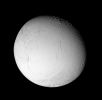
Enceladus-PIA07709.jpgEnceladus: a VERY active moon... (2)55 visiteWrinkles and cracks have reworked the surface of Enceladus, perhaps due to the influence of tidal stresses. The monochrome view also makes it clear that certain geological provinces on the moon have been altered by the activity, erasing ancient craters, while other places have retained much of the cratering record.
The terrain seen here is on the Trailing Hemisphere of Enceladus; North is up.
This image was taken using a near infrared spectral filter sensitive to wavelengths of light centered at 752 nnmts. The view was obtained using the Cassini spacecraft narrow-angle camera on Jan. 17, 2006 at a distance of approx. 153.000 Km (about 95.000 miles) from Enceladus and at a phase angle of 29°. Image scale is about 912 mt (such as approx. 2.994 feet) per pixel.
Nota: i 4 Giganti Gassosi (Giove, Saturno, Urano e Nettuno) sono mondi circondati da tante lune, alcune delle quali ancora geologicamente attive, a dispetto delle loro dimensioni e della enorme - e via-via crescente - distanza di questi Sistemi dal Sole. Pensate, p.e., ad Io ed Europa (per Giove); a Titano ed Encelado (per Saturno) ed infine ad Ariel (per Urano) e Tritone (per Nettuno). I piccoli mondi rocciosi, invece, hanno poche lune (o nessuna, come Venere e Mercurio) e queste lune NON sembrano - il dubitativo è d'obbligo - essere geologicamente attive. Il caso del Sistema Multiplo di Plutone va trattato a parte. Tutto ciò premesso, che cosa si può dedurre? Forse che la "Gioventù Geologica" di una piccolo pianeta roccioso (una "luna") dipende anche dalle caratteristiche del suo "Mondo Madre"? I 4 Giganti Gassosi emettono enormi quantitativi di radiazioni e posseggono caratteristiche tali da farli rassomigliare, ora più ed ora meno, a piccole "stelle mancate": questa circostanza potrebbe avere un peso?Feb 23, 2006
|
|
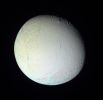
Enceladus-PIA07708.jpgEnceladus: a VERY active moon... (1)54 visiteA false color look reveals subtle details on Enceladus that are not visible in natural color views. The now-familiar bluish appearance (in false color views) of the Southern "Tiger Stripes" features and other relatively youthful fractures is almost certainly attributable to larger grain sizes of relatively pure ice, compared to most surface materials.
On the Tiger Stripes, this coarse-grained ice is seen in the colored deposits flanking the fractures as well as inside the fractures. On older fractures in other areas of Enceladus, the blue ice mostly occurs on the exposed wall scarps.
The color difference across the moon's surface (a subtle gradation from upper left to lower right) could indicate broad-scale compositional differences across the moon's surface. It is also possible that the gradation in color is due to differences in the way the brightness of Enceladus changes toward the limb, a characteristic which is highly dependent on wavelength and viewing geometry.Feb 23, 2006
|
|

SaturnStorm-PIA07789.jpgTurbulence... - detail mgnf (2)56 visiteNo lightning flashes are visible in the image (they would look like medium-sized bright spots, since the light would spread out before it reaches the cloud tops), but non-detection does not mean that lightnings are absent, however. Lightning might be too faint to stand out above background or too deep to be seen through the thick clouds. Bad luck is another possibility: the camera might have missed the strong flashes during the 10' that the shutter was open. A narrow-cloud band crosses the storm from left to right. It is illuminated by the Rings from the North and is brighter on that side. Cassini scientists are looking forward to an extensive Night Side image set, designed to look for lightning. That set will be collected during the first half of 2006.
The view was obtained in visible light with the Cassini spacecraft narrow-angle camera at a distance of approx. 3,5 MKM (about 2,2 MMs) from Saturn. The image scale is approx. 20 Km (about 12 miles) per pixel.Feb 15, 2006
|
|

SaturnStorm-PIA07788.jpgTurbulence... (1)57 visiteThis image shows a rare and powerful storm on the Night-Side of Saturn.
Light from Saturn's Rings (called "Ringshine") provided the illumination, allowing the storm and other cloud features to be seen.
The storm is a possible source of radio emissions believed to come from electrical discharges (lightning) deep in Saturn's atmosphere. Cassini began detecting the radio emissions, which are like those from lightning, on January 23, 2006. At about the same time, amateur astronomers reported that a storm had appeared in Saturn's Southern Hemisphere at Lat. - 35°. Cassini was in the wrong place to take good images of the storm on the day side, since the Planet showed only a thin crescent to the spacecraft, but night side imaging was possible using light from the Rings.
The image shows the storm as it appeared to the Cassini imaging system on January 27, 2006, and the storm's North-South dimension is about 3.500 Km (approx. 2.175 miles).Feb 15, 2006
|
|

Telesto-PIA07702.jpgTelesto61 visiteThe Cassini spacecraft passed within a cosmic stone's throw of Telesto in October, 2005 capturing this shot of the tiny Trojan moon. Telesto (24 Km, or 15 miles across) appears to be mantled in fine, icy material, although a few craters and some outcrops and/or large boulders are visible. Its smooth surface does not appear to retain the record of intense cratering that most of Saturn's other moons possess.
The image was taken in polarized green light with the Cassini spacecraft narrow-angle camera on Oct. 11, 2005, at a distance of approx. 14.500 Km (9.000 miles) from Telesto. The image scale is 86 mt (about 283 feet) per pixel.Feb 14, 2006
|
|
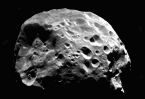
Phoebe.jpgPhoebe (Original NASA/JPL/ASU b/w Image-Mosaic)58 visiteWas Saturn's moon Phoebe once a comet? Images from the Cassini spacecraft taken two years ago (early 2004) when entering the neighborhood of Saturn, indicate that Phoebe may have originated in the outer Solar System.
Phoebe's irregular surface, retrograde orbit, unusually dark surface, assortment of large and small craters, and low average density appear consistent with the hypothesis that Phoebe was once part of the Kuiper Belt of icy comets beyond Neptune before being captured by Saturn. Visible in the above image of Phoebe are craters, streaks, and layered deposits of light and dark material. The image was taken from around 30.000 Km out from this 200-Km diameter moon.
Two weeks after taking the above image, Cassini fired its engines to decelerate into orbit around Saturn. Feb 12, 2006
|
|

Janus&Epimetheus-PIA07699.jpgHigh-Phase in the Darkness: Janus and Epimetheus59 visiteThis close pairing of Janus and Epimetheus shows the 2 moons at "high phase," meaning that only a thin sliver of sunlit terrain is visible on each moon. Portions of each are also lit feebly by reflected light from Saturn.
Janus (181 Km, or about 113 miles across) is at top and Epimetheus (116 Km, or about 72 miles across) is below.
The image was taken in visible light with the Cassini spacecraft narrow-angle camera on Dec. 25, 2005, at a distance of approx. 479.000 Km(roughly 298.000 miles) from Janus and about 455,000 Km (roughly 283.000 miles) from Epimetheus. The image scale is about 3 Km (approx 2 miles) per pixel on both moons. Feb 11, 2006
|
|

Tethys-PIA07698.jpgSmiling Tethys...57 visiteCaption originale:"The profile of Ithaca Chasma forms a great scar in the icy crescent of Tethys. The chasm stretches more than a 1.000 Km (about 620 miles) over Tethys' surface, from North to South.
The image was taken in visible light with the Cassini spacecraft narrow-angle camera on Dec. 25, 2005 at a distance of approximately 313.000 Km (about 195.000 miles) from Tethys and at a Sun-Tethys-spacecraft, or phase, angle of 151°. Image scale is about 2 Km (approx. 1 mile) per pixel".Feb 10, 2006
|
|

Telesto-PIA07696.jpgTelesto59 visiteThese views show surface features and color variation on the Trojan moon Telesto. The smooth surface of this moon suggests that, like Pandora, it is covered with a mantle of fine, dust-sized icy material.
This monochrome image was taken in visible light. To create the false-color view (see PIA07697), ultraviolet, green and infrared images were combined into a single black and white picture that isolates and maps regional color differences.
The "color map" was then superposed over a clear-filter image. The origin of the color differences is not yet understood, but may be caused by subtle differences in the surface composition or the sizes of grains making up the icy soil.
Tiny Telesto is a mere 24 Km (about 15 miles) wide.
The image was acquired with the Cassini spacecraft narrow-angle camera on Dec. 25, 2005 at a distance of approx. 20.000 Km (about 12.000 miles) from Telesto and at a Sun-Telesto-spacecraft, or phase, angle of 58°. Image scale is 118 meters (387 feet) per pixel.Feb 09, 2006
|
|

Saturn-PIA07695.jpgDark Saturn, Bright Rings60 visiteCaption originale:"The Cassini spacecraft looked toward the darkened night side of Saturn to capture the eerie glow of the Rings, which, not being blocked by the Planet's bulk, remained brilliant in full Sunlight.
The image was taken in visible light with the Cassini spacecraft wide-angle camera on Dec. 24, 2005, at a distance of approx. 286.000 Km (roughly 178.000 miles) from Saturn.
The image scale is about 13 Km (approx. 8 miles) per pixel".Feb 08, 2006
|
|

Enceladus-PIA07694.jpgThe "Young Face" of Enceladus57 visiteOriginal caption:"For Enceladus, wrinkles mean the opposite of old age. This view of a crescent Enceladus shows a transition zone between a wrinkled and presumably younger Region of terrain and an older, more heavily cratered Region. The moon's geologically active Southern Polar Region is seen on the left.
The lit terrain shown here is on the side of Enceladus that faces away from Saturn.
The image was taken in visible light with the Cassini spacecraft narrow-angle camera on Dec. 24, 2005 at a distance of approx. 108.000 Km (such as about 67.000 miles) from Enceladus, at a Sun-Enceladus-spacecraft angle of 102°.
Image scale is roughly 646 mt (about 2.118 feet) per pixel".Feb 07, 2006
|
|
| 2245 immagini su 188 pagina(e) |
 |
|
|
|
|
116 | |
|
|
|
|





