| Ultimi arrivi - Saturn: the "Ringed Beauty" and His Moons |
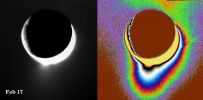
Enceladus-PIA07798.jpgEnceladus' active South Pole (1)60 visitePlumes of icy material extend above the Southern Polar Region of Enceladus, as imaged by the Cassini spacecraft in February 2005. The monochrome view is presented along with a color-coded version on the right. The latter reveals a fainter and much more extended plume component.
Images like these are being analyzed by scientists as they seek to explain the processes that could be producing such incredible features. As reported in the journal Science on March 10, 2006, imaging scientists believe that the plumes are geysers erupting from pressurized subsurface reservoirs of liquid water above 273 degrees Kelvin (0° C.).
Another plume view was taken 1 month earlier and looks broadside at the moon's prominent "Tiger Stripe" fractures. In the January view, the plume appears to have a single component. The February view looks along the Tiger Stripe fractures and reveals both a large and a small component to the plume; the smaller, fainter component is separated from the main plume by about 100 Km.Mar 10, 2006
|
|
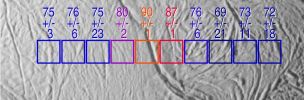
Enceladus-PIA07794.jpgEnceladus' surface temperatures (2)59 visiteEnhanced thermal emission is seen in the vicinity of the prominent "Tiger Stripe" fissures discovered by the imaging cameras.
In these images, the excess emission is most strongly seen in the left-most composite Infrared Spectrometer field of view, which includes a fissure near the end of one of the Tiger Stripes. The peak temperatures, 86 and 90 Kelvin (such as about -305 and -298 Fahrenheit) respectively, are averages over the Composite Infrared Spectrometer field of view, and other composite Infrared Spectrometer data suggest that much higher temperatures, up to at least 145 Kelvin (such as -199 Fahrenheit), occur in narrow zones a few hundred meters wide along the Tiger Stripe fissures.
The 1st image is centered near long. 135° W. and lat. 65° S. and each square from the composite infrared spectrometer field of view is about 17,5 Km (approx. 10,9 miles) across.
The 2nd image was taken nearly 3 times closer to Enceladus and is centered near long. 120° W, lat. 82° S.Mar 10, 2006
|
|
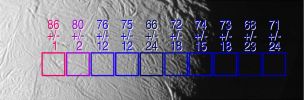
Enceladus-PIA07793.jpgEnceladus' surface temperatures (1)57 visiteThe exciting mystery of an active South Polar Region on Saturn's icy moon Enceladus continues to unfold as scientists make the correlation between geologically youthful surface fractures and unusually warm temperatures.
This view shows excess heat radiation from cracks near the moon's South Pole. These warm fissures are the source of plumes of dust and gas seen by multiple instruments on the Cassini spacecraft during its flyby of Enceladus on July 14, 2005, as described in a series of papers in the March 10, 2006, issue of the journal Science. This image shows two arrays of temperature readings across the surface of Enceladus, as measured by the Cassini Composite Infrared Spectrometer (CCIS), superimposed on images of the surface taken simultaneously by the Imaging Science Subsystem. Surface temperatures in Kelvin, derived from the intensity of infrared radiation detected by the composite infrared spectrometer, are shown along with their formal uncertainties, although true uncertainties for temperatures below about 75 Kelvin (minus 325 degrees Fahrenheit) are not easily described by a single number.
Mar 10, 2006
|
|

The Rings-PIA08129.jpgThe "sharp" G-Ring63 visiteThis contrast-enhanced view of Saturn's faint G-Ring shows its extremely sharp inner edge and more diffuse outer boundary. Using its large high-gain antenna as a shield, the Cassini spacecraft flew through the Region interior to the G-Ring during insertion into Saturn orbit. The spacecraft was struck many times by the fine icy particles that populate the Region between the F and G Rings.
The image was taken in visible light with the Cassini spacecraft narrow-angle camera on Jan. 19, 2006, at a distance of approx. 1,2 MKM (such as about 700.000 miles) from Saturn. The image scale is about 7 Km (approx. 4 miles) per pixel.Mar 09, 2006
|
|

Saturn-PIA08130.jpgIs that a "Vertical Relief"?!?76 visiteOccasional views like this one, showing "vertical relief" in Saturn's cloud tops, help the streamers and swirls of gas seem more like a three dimensional structure than a smooth surface. As on Saturn's solid moons, vertical relief is easiest to view near the Terminator, and makes visible the shading of deeper cloud tops by high altitude bands.
The image was taken in visible light with the Cassini spacecraft narrow-angle camera on Jan. 23, 2006, at a distance of approx. 2.7 MKM (about 1,7 MMs) from Saturn. Resolution in the original image was 16 Km (about 10 miles) per pixel. The image has been magnified by a factor of two and contrast-enhanced to aid visibility.Mar 09, 2006
|
|

Enceladus-PIA08128.jpgIn-transit over Saturn's Terminator...56 visiteEnceladus hangs like a single bright pearl against the golden-brown canvas of Saturn and its icy Rings. Visible on Saturn is the Region where daylight gives way to dusk (--> crepuscolo). Above, the Rings throw thin shadows onto the Planet.
Images taken using red, green and blue spectral filters were combined to create this natural color view.
The images were taken using the Cassini spacecraft wide-angle camera on Jan. 17, 2006 at a distance of approx. 200.000 Km (about 100.000 miles) from Enceladus.
The image scale is approx. 10 Km (about 6 miles) per pixel.Mar 07, 2006
|
|

Japetus-PIA08125.jpgJapetus57 visiteSunlight strikes the terminator (the boundary between day and night) Region on Saturn's moon Iapetus at nearly horizontal angles, making visible the vertical relief of many features.
This view is centered on terrain in the Southern Hemisphere of Iapetus. Lit terrain visible here is on the moon's Leading Hemisphere.
In this image, a large, central-peaked crater is notable at the boundary between the dark material in Cassini Regio and the brighter material on the Trailing Hemisphere.
The image was taken in visible light with the Cassini spacecraft narrow-angle camera on Jan. 22, 2006, at a distance of approx. 1,3 MKM (such as about 800.000 miles) from Iapetus and at a Sun-Iapetus-spacecraft, or phase, angle of 67°. Resolution in the original image was 8 Km (about 5 miles) per pixel. The image has been magnified by a factor of two and contrast-enhanced to aid visibility.Mar 03, 2006
|
|
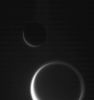
Tethys&Titan-PIA08124.jpgDancing in the dark58 visiteGhostly details make this dark scene more than just a beautiful grouping of two Saturn moons: Tethys and Titan.
In Titan's thick and inflated atmosphere, the detached high haze layer can be seen, as well as the complex Northern Polar "hood". Images like this one can help scientists make definitive estimates of the altitudes to which the high haze extends.
The faint vertical banded pattern is a type of noise that usually is removed during image processing.
Since this image was processed to enhance the visibility of details in Titan's atmosphere as well as in the faint G-Ring, the vertical noise was also enhanced.
This view was obtained in visible light with the Cassini spacecraft narrow-angle camera on Jan. 19, 2006, at a distance of approx. 2,4 MKM (such as about 1,5 MMs) from Titan and 1 MKM (about 600.000 miles) from Tethys. The image scale is 14 Km (about 9 miles) per pixel on Titan and 6 Km (about 4 miles) per pixel on Tethys.Mar 02, 2006
|
|

Mimas&Saturn-PIA08122.jpgThe King and I...59 visiteA small and battered reminder of the Solar System's violent youth, the ice moon Mimas hurtles around its gas giant parent, Saturn.
With its "poor dimensions" (Mimas is only about 397 Km across), this little moon is dwarfed by the immensity of Saturn (the Ringed Gas Planet is more than 150 times as wide as Mimas).
Mimas is seen here against the night side of Saturn and Saturn itself is faintly lit by sunlight reflecting off its Rings.
The image was taken in visible light with the Cassini spacecraft narrow-angle camera on Jan. 20, 2006, at a distance of approx. 1,4 MKM (such as about 900,000 miles) from Mimas and at a Sun-Mimas-spacecraft, or phase, angle of 145°. Image scale is about 9 Km (approx. 5 miles) per pixel.Feb 28, 2006
|
|

Tethys-N00051464.jpgTethys56 visitecaption originale:"N00051464.jpg was taken on February 25, 2006 and received on Earth February 26, 2006. The camera was pointing toward Tethys that, at the time, was approximately 152.812 Km away.
The image was taken using the UV1 and CL2 filters.
This image has not been validated or calibrated".
Nota: un frame davvero splendido, che ci mostra non solo la "tessitura" della superficie di Tethys (curiosamente lineare, almeno in apparenza), ma anche i dettagli di alcuni rilievi le cui immagini chiare e ravvicinate (ma davvero "chiare"!) farebbero sicuramente la felicità di tanti Studiosi di Scienze Planetarie. Ed ora guardate bene: siete certi che l'origine dei crateri che vediamo sia proprio - senza alcun dubbio - "da impatto"?...Feb 27, 2006
|
|
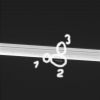
The Rings-N00051339.jpgHiding in the Rings?57 visitePortate l'immagine sino al full-size e poi verificate anche Voi:
Cerchiatura Bianca n. 1: si tratta di un clump, di un difetto dell'immagine (photoartifact) o di una shepherd moon non ancora catalogata?
Cerchiatura Bianca n. 2: evidentemente si tratta di una luna "mossa", ma quale luna di Saturno si esprime fotograficamente lasciando due strisce, per giunta disallineate?
Cerchiatura Bianca n. 3: secondo noi un'altra luna (o comunque un corpo celeste di qualche tipo) si intuisce appena, quasi del tutto eclissato dagli Anelli.
Feb 25, 2006
|
|

Rhea-PIA08121.jpgThe incoherent surface of Rhea58 visiteThis intense false-color view highlights and enhances color variations across the cratered and cracked surface of Saturn's moon Rhea.
To create the false-color view, ultraviolet, green and infrared images were combined into a single black and white picture that isolates and maps regional color differences. This "color map" was then superposed over a clear-filter image. The origin of the color differences is not yet understood, but it may be caused by subtle differences in the surface composition or grain sizes making up the icy soil.
This view shows terrain on the trailing hemisphere of Rhea. North is up.
The images were taken using the Cassini spacecraft narrow-angle camera on Jan. 18, 2006, at a distance of approx. 268.000 Km (about 166.000 miles) from Rhea and at a Sun-Rhea-spacecraft, or phase, angle of 115°. Image scale is about 2 Km (roughly 1,2 miles) per pixel.Feb 25, 2006
|
|
| 2245 immagini su 188 pagina(e) |
 |
|
|
|
|
115 | |
|
|
|
|





