| |

| Ultimi arrivi - Saturn: the "Ringed Beauty" and His Moons |
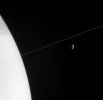
Rhea&Saturn-PIA08132.jpgCrescent Rhea57 visiteCaption NASA originale:"Shadow-striped Saturn and its exquisitely thin Rings occupy the near-field view in this Cassini image, while a crescent moon Rhea hangs in the distance.
A couple of bright pixels at the center of the image mark the location of the tiny moon Pan (only 26 Km, or 16 miles across).
The image was taken in visible light with the Cassini spacecraft narrow-angle camera on Feb. 3, 2006, at a distance of approx. 4,1 MKM (2,5 MMs) from Saturn and 4,6 MKM (2,9 MMs) from Rhea. The image scale is 28 Km (approx. 17 miles) per pixel on Rhea".Mar 17, 2006
|
|

Saturn-N00054985.jpgThe "Sea of Clouds" near Saturn's Terminator56 visiteCaption originale:"N00054985.jpg was taken on March 13, 2006 and received on Earth March 15, 2006. The camera was pointing toward Saturn that, at the time, was approximately 2.562.202 Km away, and the image was taken using the RED and CL2 filters. This image has not been validated or calibrated".Mar 16, 2006
|
|

Mimas-PIA08135.jpgOverlapping Planets57 visiteCaption originale:"Mimas briefly slipped in front of Tethys while the Cassini spacecraft looked on and captured the event in this series of images.
The images were taken in visible light with the Cassini spacecraft narrow-angle camera on Feb. 11, 2006, at a distance of approx. 3,7 MKM (such as about 2,3 MMs) from Mimas and 4,1 MKM (such as about 2,5 MMs) from Tethys. Resolution in the original images was approx. 22 Km (about 14 miles) per pixel on Mimas and approx. 25 Km (about 16 miles) per pixel on Tethys.
The images have been magnified by a factor of two".Mar 15, 2006
|
|
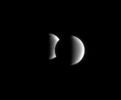
Tethys&Dione-PIA08134.jpgCrossing Spheres58 visiteCaption originale:"Dione steps in front of Tethys for a few minutes in an occultation - or "mutual event". These events occur frequently for the Cassini spacecraft when it is orbiting close to the Ring-Plane.
The image was taken in visible red light with the Cassini spacecraft narrow-angle camera on Feb. 10, 2006, at a distance of approx. 3,7 MKM(such as about 2,3 MMs) from Dione and approx. 4 MKM (about 2,5 MMs) from Tethys. Resolution in the original image was about 22 Km (approx. 14 miles) per pixel on Dione and about 24 Km (approx. 15 miles) per pixel on Tethys.
The image has been magnified by a factor of two.Mar 15, 2006
|
|

Enceladus&Rhea-PIA08133.jpgEnceladus and Rhea, divided by the Rings58 visiteCaption originale:"Rhea and Enceladus hover in the distance beyond Saturn's Ring-Plane. Enceladus (left, 505 Km - about 314 miles - wide), bathed in icy particles from Saturn's E-Ring, appears noticeably brighter than Rhea (right, 1528 Km - about 949 miles - wide).
The image was taken in visible light with the Cassini spacecraft narrow-angle camera on Feb. 8, 2006, at a distance of approx. 4,3 MKM (such as about 2,7 MMs) from Enceladus and 4,6 MKM (about 2,9 MMs) from Rhea.
The image scale is approx. 26 Km (roughly 16 miles) per pixel on Enceladus and about 28 Km (roughly 17 miles) per pixel on Rhea.Mar 13, 2006
|
|

Saturn-N00052964.jpgVertical relief, Cosmic Ray or UFO?75 visiteCerchiatura Bianca: si tratta del solito (e banalissimo) photoartifact; di una curiosa nuvola "a colonna" (detta anche "vertical relief"), oppure di un Raggio Cosmico catturato "al volo" (uno dei tanti...), o magari di un oggetto di altra natura (un luminosissimo UFO?), colto durante un suo passaggio sulle nuvole di Saturno e ad una distanza imprecisata da Cassini?Mar 11, 2006
|
|

Saturn-PIA08131.jpgThe "Little Eye" of Saturn56 visiteCaption NASA originale:"This interesting vortex in Saturn's atmosphere is surrounded by a halo of bright clouds that extend away toward the East and West. Storms like this one seem to be bright at all wavelengths at which Cassini observes them.
The image was taken in visible light with the Cassini spacecraft narrow-angle camera on Jan. 24, 2006, at a distance of approx. 2,9 MKM (about 1,8 MMs) from Saturn. The image scale is roughly 17 Km (approx. 11 mi) per pixel".
Nota: le grandi tempeste di Saturno (come quelle di Giove), se abbiamo capito bene quello che dice la NASA, appaiono "brillanti" su tutte le lunghezze d'onda. Attenzione: noi sappiamo che le nuvole, in generale, riflettono molto bene la luce del Sole e che quindi (come ci insegna il caso di Venere) aumentano l'albedo visuale di qualsiasi corpo celeste il quale ne sia dotato. Tuttavia noi pensiamo che la luminosità a cui la NASA abbia fatto riferimento in questo caso NON sia quella che abbiamo appena cercato di esprimere (e cioè una maggiore/migliore riflessione della luce in arrivo dal Sole): a nostro parere quanto detto dalla NASA in sede di commento al frame in oggetto potrebbe e dovrebbe significare che le tempeste che occorrono sui Giganti Gassosi (forse anche Urano e Nettuno; certamente Giove e Saturno) esprimono un certo quantitativo di energia il quale viene colto anche sotto forma di luce (che poi si tratti di semplici lampi o di qualcosa di diverso e di più complesso, non lo sappiamo).
Per ora...Mar 11, 2006
|
|

Enceladus-PIA07800f-2.jpgEnceladus (3) - detail mgnf and HR99 visiteEncelado è dunque "vivo e vegeto" e, dalla sua gelida superficie, in area Sud Polare, ciclopici geysers spruzzano (ma lo fanno continuativamente o di quando in quando?) fango, vapore e cristalli di ghiaccio d'acqua verso lo spazio che circonda questa piccola Luna.
Alla NASA, come potete vedere nel Modello "Cold Geyser", sono convinti che queste "fontane" trovino la loro origine in un sottosuolo NON attivo - in senso geologico - ma "caldo" (per motivi ancora da chiarire), il quale agirebbe come una sorta di "miccia" (o iniettore) su grandi sacche d'acqua (le cosiddette water pockets, contenenti acqua allo stato liquido, a circa 0°C, ed in pressione) le quali, una volta giunte ad ebollizione, spingono fanghi, cristalli d’acqua e vapore acqueo attraverso degli stretti condotti (vents) che, dalle profondità del pianeta, arrivano sino alla superficie (posta sul fondo delle Tiger Stripes) e quindi si aprono verso lo spazio circum-enceladiano, consentendo lo sfogo di quanto emerso e mantenendo l’intero sistema in un sostanziale equilibrio.
Ora, anche ammettendo che questo modello esplicativo delle "Fontane di Encelado" abbia una qualche attendibilità e sostanza, ci domandiamo: dato che Encelado è una luna molto piccola e che le sue "riserve d'acqua" (water-pockets) devono essere – logicamente – molto piccole, non è irragionevole supporre che tali geysers abbiano una vita – tutto sommato – molto breve e che, una volta finita l'acqua, finirà anche il fenomeno delle fontane di fango, ghiaccio e vapore. La logica direbbe questo.
Tuttavia, a quanto si deduce osservando la superficie di Encelado (la quale sembra proprio "fresca e giovane") dobbiamo invece supporre che un siffatto fenomeno stia andando avanti da ere.
Deduzioni (e domande): allora l'acqua delle water-pockets di Encelado si riforma, nel tempo?
E, se si (come la logica ci farebbe supporre), quest'acqua da dove viene?
Forse l’intero Encelado si sta “sciogliendo”, precipitando i ghiacci di superficie nel sottosuolo dove vengono scaldati, quindi liquefatti ed infine “sparati” nello spazio?
Oppure i geysers di Encelado si sono attivati "recentemente", ed è solo per questo che essi stanno vivendo questa stagione di splendore?
E se la risposta a questo ultimo quesito fosse "si", che cosa avrebbe innescato il riscaldamento delle viscere del pianeta?
Forse un'attività solare anomala e particolarmente intensa (la stessa che, secondo alcuni, sta aiutando Marte a scaldarsi)?
O magari la causa del fenomeno è nelle ondate di radiazioni che arrivano costantemente da Saturno?
I Giganti Gassosi, in fondo, in qualità di “stelline mancate”, non potrebbero operare come “riscaldatori” dei minuscoli corpi che li circondano?
Non è in fondo questa la costruzione che ha fatto pensarea molti Scienziati e Ricercatori – sin dagli Anni ’80 – che alcune Lune Gioviane potrebbero essere “mantenute in vita” proprio dall’energia termica (e non solo) che gli perviene dal loro Pianeta-Genitore e non certo dal Sole (troppo lontano)?
Conclusione: creare “modelli” interpretativi dei fenomeni anomali è, come avete notato, relativamente semplice. Analizzare le implicazioni proprie di ciascun modello, invece, non lo è affatto.
Noi, in fondo, possiamo anche permetterci, di tanto in tanto, di “inventarci un modello” e di proporlo (anche se non siamo scienziati, abbiamo comunque una testa e qualche capacità di ragionamento logico); ma quando ci accorgiamo che i nostri modelli, in fondo, hanno le stesse (purtroppo deboli e fortemente speculative) basi dei modelli NASA...Allora un pizzico di perplessità ci coglie.
Non credete?!?
Mar 10, 2006
|
|

Enceladus-PIA07800f-1~0.jpgEnceladus (2) - detail mgnf and HR58 visiteThe global mosaic of Enceladus was created from 21 false-color frames taken during the Cassini spacecraft's close approaches to Enceladus on March 9 and July 14, 2005. Images taken using filters sensitive to ultraviolet, visible and infrared light (spanning wavelengths from 338 to 930 nnmts) were combined to create the individual frames.
The mosaic is an orthographic projection centered at 46,8° South Lat. and 188° West Long. and has an image scale of 67 mt (about 220 feet) per pixel. The original images ranged in resolution from 67 mt per pixel to 350 mt were taken at distances ranging from 11.100 to 6.300 Km from Enceladus.Mar 10, 2006
|
|

Enceladus-PIA07800-br500.jpgEnceladus (1)59 visiteA masterpiece of deep time and wrenching gravity, the tortured surface of Saturn's moon Enceladus and its fascinating ongoing geologic activity tell the story of the ancient and present struggles of one tiny world. This is a story that is recounted by imaging scientists in a paper published in the journal Science on March 10, 2006.
The enhanced color view of Enceladus seen here is largely of the Southern Hemisphere and includes the South Polar terrain at the bottom of the image.
Ancient craters remain somewhat pristine in some locales, but have clearly relaxed in others. Northward-trending fractures, likely caused by a change in the moon's rate of rotation and the consequent flattening of the moon's shape, rip across the southern hemisphere. The South Polar terrain is marked by a striking set of 'blue' fractures and encircled by a conspicuous and continuous chain of folds and ridges, testament to the forces within Enceladus that have yet to be silenced.Mar 10, 2006
|
|
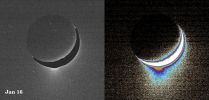
Enceladus-PIA07801.jpgEnceladus' active South Pole (2)58 visiteThese images were taken with the Cassini spacecraft narrow-angle camera at a distance of approximately 209.400 Km (about 130.100 miles) from Enceladus at a phase angle of 148°. The image scale is about 1,3 Km (0,8 mi) per pixel.
The mosaic is an orthographic projection centered at 46,8° South Lat. and 188° West Long. and has an image scale of 67 mt (about 220 feet) per pixel. The original images ranged in resolution from 67 mt per pixel to 350 mt (about 1.150 feet) per pixel and were taken at distances ranging from 11.100 to 61.300 Km from Enceladus.Mar 10, 2006
|
|
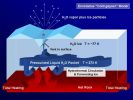
Enceladus-PIA07799.jpgEnceladus' Geysers Model59 visiteAs Saturn's active moon Enceladus continues to spew icy particles into space, scientists struggle to understand the mechanics of what is going on beneath the fractured south polar terrain. This graphic illustrates key aspects of the model proposed by the Cassini imaging science team in a paper published in the journal Science on March 10, 2006.
The model shows how proposed underground reservoirs of pressurized liquid water above 273 degrees Kelvin (0° Celsius) could fuel geysers that send jets of icy material into the skies above the moon's south pole. In the graphic, the vent to the surface pierces one of the "tiger stripe" fractures seen in Cassini views of the Southern Polar Terrain. Temperatures increase with depth.
Some combination of internal radioactive decay and flexing--perhaps concentrated within the tiger stripe fractures and brought about by the particular characteristics of Enceladus' orbit--is implicated as the source of the heat creating the liquid reservoirs. However, it is not yet clear how the deep interior of Enceladus functions, nor whether the moon is fully differentiated (separated into layers, with rock at the center and ice outside). Mar 10, 2006
|
|
| 2245 immagini su 188 pagina(e) |
|
|
|
|
|
114 | |
|
|
|
|
|
|





