| Ultimi arrivi - Saturn: the "Ringed Beauty" and His Moons |

Rhea-N00055767.jpgMoments of Rhea (7)59 visitenessun commentoMar 26, 2006
|
|

Rhea-N00055757.jpgMoments of Rhea (6)70 visiteCerchiature Bianche: due bizzarri crateri esagonali (quello di Sx sembra un esagono quasi regolare...).
Il Prof. Hoagland, parlando di Giapeto, per un rilievo simile si sbilanciò parlando di "...simmetrie evidenti... - ergo di - ...chiare origini artificiali...".
Tuttavia, sui pentagoni e gli esagoni di Rhea (addirittura - come questi - più regolari e definiti del rilievo Giapetiano) nonchè su alcune (curiose) linee che la attraversano per Km e Km (linee - apparentemente - lisce e dritte come autostrade), Hoagland non ha detto nulla.
Sarà perchè, forse, non se n'è accorto...Mar 26, 2006
|
|

Rhea-N00055743.jpgMoments of Rhea (5)58 visitenessun commentoMar 26, 2006
|
|

Rhea-N00055739.jpgMoments of Rhea (4)58 visitenessun commentoMar 26, 2006
|
|

Rhea-N00055725.jpgMoments of Rhea (3)56 visitenessun commentoMar 26, 2006
|
|

Rhea-N00055723.jpgMoments of Rhea (2)64 visitenessun commentoMar 26, 2006
|
|

Rhea-N00055720.jpgMoments of Rhea (1)65 visitenessun commentoMar 26, 2006
|
|

Saturn-PIA08140.jpgRestless Atmosphere (1)59 visiteThis atmosphere close-up shows bright clouds in Saturn's Northern Hemisphere being sheared apart. The clouds at the bottom of the image are tilted and stretched because the wind at those lower latitudes is moving much faster to the East than the wind at the higher latitudes near the top of the image, hence the shear.
This appearance suggests that these bright eddies are passive tracers of the atmosphere's motion - they appear, probably as a result of upwelling due to convection from below, and then they are sheared apart.
The image was taken in visible light with the Cassini spacecraft narrow-angle camera on Feb. 16, 2006, at a distance of approximately 3,3 MKM (about 2 MMs) from Saturn. The image scale is roughly 19 Km (about 12 miles) per pixel.Mar 25, 2006
|
|

Saturn-PIA08141.jpgRestless Atmosphere (2)57 visiteSaturn's atmosphere comes alive with a multitude of dark vortices swirling through the Southern Hemisphere.
Vortices are long-lived features that are part of the general circulation of Saturn's atmosphere. Vortices are thought to be caused by the shear between Eastward- and Westward-flowing jets - the alternating bands flowing past each other in the atmosphere. The vortices can last for months or years and probably grow by merging with other vortices until a few dominate a particular zone of wind shear between two jets. The vortex at upper right is one of the largest vortices on Saturn.
The image was taken with the Cassini spacecraft narrow-angle camera on Feb. 16, 2006 at a distance of approximately 3,2 MKM (about 2 MMs) from Saturn. The image scale is about 19 Km (approx. 12 miles) per pixel.Mar 25, 2006
|
|
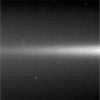
The Rings-GRing-N00055772.jpgN00055772: the motion of Cassini56 visiteData:"N00055772.jpg was taken on March 21, 2006 and received on Earth March 22, 2006. The camera was pointing toward Saturn's G-Ring that, at the time, was approximately 749.522 Km away.
The image was taken using the CL1 and CL2 filters. This image has not been validated or calibrated".Mar 24, 2006
|
|

Rhea-N00055690.jpgRhea and a "streak of light"59 visiteCerchiatura Bianca: un (nuovo) "streak" di luce bianca e molto intensa il quale, laddove non fosse il solito photoartifact, potrebbe concretare una interessante Anomalìa.
In realtà, la "striscia" in questione non ci pare proprio un photoartifact ed inoltre essa non dovrebbe neppure essere la semplice evidenza di un corpo celeste (un'altra luna di Saturno, ad esempio) il quale è rimasto non solo sovraesposto, ma anche strisciato (o "mosso") a causa della (eccessiva) durata della ripresa fotografica in rapporto alla velocità della Sonda . Per altro, anche osservando altri frames della Serie "N" - ad esempio N00055772 - la nostra sensazione è che il moto di Cassini, dal punto di vista dell'Osservatore e rispetto a Rhea, è ORIZZONTALE (da Sx a Dx) mentre lo streak è invece VERTICALE!
Deduzione logica: lo streak rappresenta un oggetto reale, situato ad una distanza indefinita da Cassini, il quale si sta muovendo rapidamente mentre asseconda una traiettoria incongrua rispetto a quella di Cassini.
Un "UFO", insomma...Mar 24, 2006
|
|

Janus&Titan-N00055802.jpgPassing-by... (3)58 visiteData:"N00055802.jpg was taken on March 21, 2006 and received on Earth March 22, 2006. The camera was pointing toward janus that, at the time, was approximately 723.396 Km away.
The image was taken using the CL1 and CL2 filters". Mar 24, 2006
|
|
| 2245 immagini su 188 pagina(e) |
 |
|
|
|
|
112 | |
|
|
|
|





