| Ultimi arrivi - Saturn: the "Ringed Beauty" and His Moons |

Saturn-PIA08161.jpgCrescent Moons (2)60 visiteCaption NASA originale:"Three of Saturn's moons are captured with the Planet in this exquisite family portrait. At top, Saturn is bedecked with the shadows of its innermost rings.
Tethys appears at lower right, closest to Cassini. Janus (181 Km, or about 113 miles across) and Mimas (397 Km, or about 247 miles across) are on the far side of the immense Ringed Planet.
Mimas is just about to slip behind Saturn.
The image was taken in visible light with the Cassini spacecraft narrow-angle camera on March 13, 2006, at a distance of approx. 2,7 MKM (such as about 1,6 MMs) from Saturn. The image scale is about 17 Km (approx. 11 miles) per pixel on Janus and Mimas, and 14 about Km (such as about 9 miles) per pixel on Tethys".Apr 20, 2006
|
|

Saturn-PIA08159.jpgCrescent Moons (1)62 visiteCaption NASA originale:"The tilted crescent of Saturn displays lacy cloud bands here along with a bright Equatorial Region and threadlike ring shadows on the Northern Hemisphere. Three moons are visible here: Mimas (397 Km, or about 247 miles across) at left and faint, is aligned with the Ring-Plane. At right are Rhea (1.528 Km, or about 949 miles across, at top) and Tethys (1.071 Km, or 665 miles across, below Rhea).
The image was taken in polarized infrared light with the Cassini spacecraft wide-angle camera on March 11, 2006, at a distance of approximately 2,8 MKM (approx. 1,8 MMs) from Saturn.
The image scale is roughly 166 Km (about 103 miles) per pixel".Apr 20, 2006
|
|

Dione&Janus-PIA08158.jpgSaturn, Dione and Janus55 visiteCaption originale:"The Cassini spacecraft looks toward the Saturnian horizon as Dione and Janus glide past.
A few craters are visible on Dione, while Janus is slightly blurred due to its motion during the exposure. The Rings appear essentially edge-on in this view, as the Cassini spacecraft continues its recent activities close to the Ring-Plane.
The image was taken with the Cassini spacecraft narrow-angle camera on March 10, 2006, using a filter sensitive to wavelengths of infrared light centered at 750 nnmts. The image was acquired at a distance of approx. 2,9 MKM (about 1,8 MMs) from Saturn.
The image scale is approx. 17 Km (roughly 11 miles) per pixel".Apr 17, 2006
|
|

Saturn-PIA08156.jpgCat's Eyes on Saturn!58 visiteCaption originale:"Bright, high altitude clouds, like those imaged here, often appear more filamentary or streak-like than clouds imaged at slightly deeper levels in Saturn's atmosphere. This view also shows one of the many sp-called 'Cat's Eye' vortices that swim through the Southern Latitudes.
The image was taken in polarized infrared light with the Cassini spacecraft narrow-angle camera on March 7, 2006, at a distance of approx. 2,9 MKM (about 1,8 MMs) from Saturn. The image scale is about 17 Km (roughly 10 miles) per pixel".Apr 13, 2006
|
|

Saturn-PIA08155.jpgRestless Upper Atmosphere...61 visiteCaption originale:"Streamers, swirls and vortices roll across the dynamic face of Saturn.
Unlike Earth, where most of the weather is driven by the Sun, Saturn's storms and circulation are driven in part by internal heating. Amazingly, the Planet is still contracting (ever so slightly) from its formation, more than 4,5 BY (Billion Years) ago. This gravitational contraction liberates energy in the form of heat.
The image was taken in polarized infrared light with the Cassini spacecraft narrow-angle camera on March 7, 2006, at a distance of approx. 2,9 MKM (1,8 MMs) from Saturn.
The image scale is about 17 Km (roughly 10 miles) per pixel".Apr 13, 2006
|
|
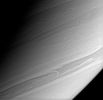
Saturn-PIA08153.jpgSaturnian Clouds58 visiteLong, thin streamers of cloud arc gracefully across this view of Saturn's Southerly Latitudes.
Analysis of images like this should lead scientists to a new understanding of cloud height variations on this complex gas giant world.
The image was taken in polarized green light with the Cassini spacecraft narrow-angle camera on March 7, 2006, at a distance of approx. 2,9 MKM (about 1,8 MMs) from Saturn. The image scale is 17 Km (about 10 miles) per pixel.Apr 11, 2006
|
|

Saturn-PIA08154.jpgOne "Eye" of Saturn!59 visiteGaseous Saturn rotates quickly - once every approx. 10,8 hours - and its horizontal cloud bands rotate at different rates relative to each other. These conditions can cause turbulent features in the atmosphere to become greatly stretched and sheared, creating the beautiful patterns that the Cassini spacecraft observes. This turbulence and shear is particularly notable at those boundaries where the different bands slide past each other.
Vortices like the one seen here are long-lived dynamical features that are part of the general circulation of Saturn's atmosphere. They are counterparts to the East-West flowing jets and can last for months or years. They probably grow by merging with other vortices until a few dominate a particular shear zone between two jets.
This image was taken in polarized infrared light with the Cassini spacecraft narrow-angle camera on March 7, 2006, at a distance of approximately2,9 MKM (such as about 1,8 MMs) from Saturn. The image scale is 17 Km (about 10 miles) per pixel.Apr 11, 2006
|
|

Japetus-N00056325.jpgDarker than the Night!57 visiteCaption originale:"N00056325.jpg was taken on April 07, 2006 and received on Earth April 08, 2006. The camera was pointing toward Japetus that, at the time, was approximately 923.304 Km away.
The image was taken using the CL1 and CL2 filters. This image has not been validated or calibrated".Apr 08, 2006
|
|

The Rings-PIA08036~0.jpgThe Rings, 26 Taurus and reddish Hydrogen56 visiteThis image is a false-color ultraviolet view of Saturn's B-Ring (center) and A-Ring (right), separated by a large gap known as the Cassini Division.
It shows a bright horizontal streak, created by a series of time lapse images involving a star named 26 Taurus.
The image was made over a 9-hour period as the star drifted behind the Rings. The opacity of the outer A-Ring is most pronounced on its inner edge, indicating more ring debris is present there. The Encke Gap, much smaller than the Cassini Division, is visible near the outer edge of the A-Ring. The B-Ring is significantly more opaque than the A-Ring, indicating a greater density of ring material when imaged from above.
The sky behind the Rings glows red in the ultraviolet wavelengths from the hydrogen gas that fills the Solar System.
The images were processed from data taken by the ultraviolet imaging spectrograph aboard the Cassini spacecraft in May 2005.Apr 06, 2006
|
|

Saturn-PIA08151.jpgSaturn's Southern Restlesness58 visiteThis view of high Southern Latitudes on Saturn shows very linear clouds at top, usually indicative of stable prevailing winds, and two turbulent, swirling features farther South. It is possible that these features merged some time after this image was taken.
The image was taken with the Cassini spacecraft narrow-angle camera on March 6, 2006, using a filter sensitive to wavelengths of infrared light centered at 750 nnmts. The image was acquired at a distance of approximately 2,8 MKM (about 1,8 MMs) from Saturn. The image scale is approx. 16 Km (roughly 10 miles) per pixel.Apr 06, 2006
|
|

Enceladus&Dione-PIA08150.jpgCrowded Saturnian Skies...56 visiteAs our robotic emissary to Saturn, the Cassini spacecraft is privileged to behold such fantastic sights as this pairing of two moons beyond the Rings. The bright, narrow F-Ring is the outermost ring structure seen here.
In this scene, bright Enceladus begins to slip in front of more distant Dione. Enceladus is closer to Saturn than Dione, and orbits the planet at greater velocity. Thus, the smaller moon eventually passed the larger one, as seen from the Cassini spacecraft, and continued on its way.
The image was taken with the Cassini spacecraft narrow-angle camera on March 3, 2006, using a filter sensitive to wavelengths of ultraviolet light centered at 338 nnmts and at a distance of approx. 2,6 MKM (about 1,6 MMs) from Enceladus and 2,7 MKM (such as about 1,7 MMs) from Dione. The view was taken from a phase angle (Sun-moon-spacecraft angle) of 139°; about the same angle with respect to both moons. Image scale is about 16 Km (roughly 10 miles) per pixel on Enceladus and Dione.Apr 06, 2006
|
|

Tethys-PIA08149.jpgPenelope is always waiting...61 visiteCaption NASA originale:"This dramatic close-up of Tethys shows the large crater Penelope lying near center, overprinted by many smaller, younger impact sites. Three smaller impact features of roughly similar size make a line left of Penelope that runs North-South: (from bottom) Ajax, Polyphemus and Phemius.
Features on Tethys are named for characters and places from "The Iliad" and "The Odyssey". The largest impact structure on Tethys is named Odysseus.
This view is toward the Saturn-facing Hemisphere on Tethys and North is up.
This image was taken in polarized ultraviolet light with the Cassini spacecraft narrow-angle camera on Feb. 25, 2006 at a distance of approximately 165.000 Km (about 103.000 miles) from Tethys and at a Sun-Tethys-spacecraft, or phase, angle of 23°.
Image scale is about 984 meters (approx. 3.227 feet) per pixel".Apr 05, 2006
|
|
| 2245 immagini su 188 pagina(e) |
 |
|
|
|
|
109 | |
|
|
|
|





