| Ultimi arrivi - Saturn: the "Ringed Beauty" and His Moons |
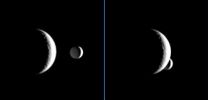
Rhea&Enceladus-PIA08180.jpgHiding...59 visiteCaption NASA originale:"Enceladus briefly passes behind the crescent of Rhea in these images, which are part of a so-called "mutual event" (such as an "eclipse") sequence taken by Cassini.
These sequences help scientists refine our understanding of the orbits of Saturn's moons.
The images were taken one minute apart, as smaller Enceladus darted behind Rhea as seen from the Cassini spacecraft's point of view.
The images were taken in visible light with the Cassini spacecraft narrow-angle camera on April 14, 2006, at a distance of approx. 3,4 MKM (such as about 2,1 MMs) from Rhea and 4,1 MKM (about 2,5 MMs) from Enceladus. The image scale is approx. 20 Km (about 13 miles) per pixel on Rhea and 24 Km (roughly 15 miles) per pixel on Enceladus".Mag 18, 2006
|
|

Epimetheus-PIA08178.jpgThe "Runners"...again!56 visiteJanus and Epimetheus continue to separate, following their orbital swap in January 2006. Until 2010, Janus will remain the innermost of the pair, whose orbits around Saturn are separated by only about 50 Km (such as approx. 31 miles) on average.
Epimetheus appears just right of the bright A-Ring ansa, or edge, while Janus is seen near the upper right. The faint F-Ring extends across the image and Janus appears directly between its near and far edges.
The image was taken in visible light with the Cassini spacecraft narrow-angle camera on April 16, 2006, at a distance of approx. 3,7 MKM (such as about 2,3 MMs) from Saturn. The image scale is approx. 22 Km (about 14 miles) per pixel on both Janus and Epimetheus.Mag 16, 2006
|
|
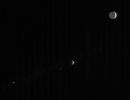
Enceladus&C.-PIA08182.jpgMoons...59 visiteCaption NASA proginale:"Four of Saturn's many and varied moons crowd this single frame from Cassini.
All of the moons are illuminated by the Sun, which is out of the frame to the right. "Saturnshine", or reflected light from the planet (out of frame to the lower left), partly illuminates three of the moons, such as Tethys (1.071 Km, or 665 miles across, at upper right), Janus (181 Km, or 113 miles across, at lower left) and Epimetheus (116 Km, or 72 miles across, below and left of center).
Enceladus (505 Km, or 314 miles across) is much farther in the distance in this view, and shows merely a slim crescent below center.
The image was taken in visible light with the Cassini spacecraft narrow-angle camera on April 17, 2006, at a distance of approx. 3,7 MKM (such as about 2,3 MMs) from Saturn. The image scale is approx. 27 Km (about 17 miles) per pixel on Tethys, 21 Km (13 miles) per pixel on Enceladus, and 22 Km (14 miles) per pixel on Janus and Epimetheus".Mag 15, 2006
|
|

Japetus-PIA08177.jpgThe darkest moon is there...58 visiteA distant glimpse of Japetus reveals details within the dark terrain of the Cassini Regio, including an impact basin at top that is roughly 400 Km (about 250 miles) wide.
Researchers remain unsure about the mechanism that has darkened the Leading Hemisphere.
This view looks toward the Southern Hemisphere on the leading side of Japetus (1.468 Km, or about 912 miles across). North is up.
The image was taken in visible light with the Cassini spacecraft narrow-angle camera on April 4, 2006, at a distance of approx. 1,4 MKM (such as about 900.000 miles) from Japetus.
The image scale is roughly 9 Km (about 6 miles) per pixel.Mag 13, 2006
|
|
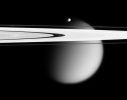
Saturn&Titan-PIA07786.jpgSo close and yet so far...59 visiteThe Cassini spacecraft delivers this stunning vista showing small, battered Epimetheus and smog-enshrouded Titan, with Saturn's A and F Rings stretching across the scene. The prominent dark region visible in the A-Ring is the Encke Gap, in which the moon Pan and several narrow ringlets reside. Moon-driven features that mark the A-Ring are easily seen to the left and right of the Encke Gap. The Encke Gap is about 325 Km (approx. 200 miles) wide. Pan is approx. 26 Km (about 16 miles) across. In an optical illusion, the narrow F-Ring, outside the A-Ring, appears to fade across the disk of Titan. A couple of bright clumps can be seen in the F-Ring. Epimetheus is approx. 116 Km (about 72 miles) across and giant Titan is roughly 5.150 Km (about 3.200 miles) across.
The image was taken in visible light with the Cassini spacecraft narrow-angle camera on April 28, 2006, at a distance of approx. 667.000 Km(about 415.000 miles) from Epimetheus and 1,8 MKM (about 1,1 MMs) from Titan. The image captures the illuminated side of the rings. The image scale is 4 kilometers (2 miles) per pixel on Epimetheus and 11 kilometers (7 miles) per pixel on Titan.Mag 13, 2006
|
|

Saturn&Titan-N00060957.jpgSo close and yet so far...58 visitenessun commentoMag 13, 2006
|
|

Saturn-PIA08176.jpgThe "night-side" of Saturn (natural colors)58 visiteThis rare color view of Saturn's night side shows how the Rings dimly illuminate the Southern Hemisphere, giving it a dull golden glow. Part of the Northern dark side is just visible at top - the illumination it receives being far less than the South.
The unlit side of the Rings is shown here. The portion of the Rings closest to Cassini is within the dark shadow of Saturn; the bright distant portion is outside the Planet's shadow.
A crescent Tethys appears below the rings at left.
Images taken using red, green and blue spectral filters were combined to create this color view. The images were taken with the Cassini spacecraft narrow-angle camera on April 2, 2006, at a distance of approx. 3,8 MKM (about 2,4 MMs) from Saturn and 3,5 MKM (about 2,2 MMs) from Tethys. The image scale is about 23 Km (14 miles) per pixel on Saturn.
Cerchiatura Rossa: probabile evidenza di una "Luna Pastore" (Pandora?) o di un "clump" di notevoli dimensioni (optiamo per la "Shepherd Moon").Mag 12, 2006
|
|

Mimas-W00014998.jpgA bright "slice" of Mimas...55 visitenessun commentoMag 09, 2006
|
|
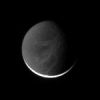
Dione-PIA08174.jpgIn the Light of Saturn...58 visiteCaption NASA originale:"The wispy fractured terrain on Dione is illuminated here by the so-called "Saturnshine", such as the dim reflected light from the planet.
The region pictured on Dione is on the moon's Saturn-facing Hemisphere. North is up.
The image was taken in polarized green light with the Cassini spacecraft narrow-angle camera on March 24, 2006, at a distance of approximately 2,2 MKM (such as about 1,4 MMs) from Dione and at a phase angle of 162°. Resolution in the original image was about 13 Km (approx. 8 miles) per pixel. The image has been magnified by a factor of two and contrast-enhanced to aid visibility".Mag 09, 2006
|
|
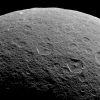
Rhea-PIA08173.jpgOld Rhea...57 visiteCaption NASA originale:"Cassini looks down upon Rhea, whose cratered surface was already ancient before any complex life developed on Earth. The terrain seen here has probably changed little in the past billion years (!). This view shows terrain on the Saturn-facing Hemisphere of Rhea. North is up.
The image was taken in visible light with the Cassini spacecraft narrow-angle camera on March 21, 2006 at a distance of approximately 94.000 Km (such as about 59.000 miles) from Rhea and at a phase angle of 109°. The image scale is about 558 mt (approx. 1.832 feet) per pixel".Mag 09, 2006
|
|

Dione-N00060593.jpgIn the darkness...57 visitenessun commentoMag 07, 2006
|
|

Daphnis-PIA08171.jpgDaphnis56 visiteThis splendid view offers a detailed look at the faint Rings within the Cassini Division as well as a rare glimpse of the "Keeler Gap Moon", Daphnis. The small, ring embedded moon is a bright unresolved speck above center, near the outer edge of the A ring.
Discovered in Cassini images in 2005, Daphnis is a mere 7 Km (a little less than 4 miles) across.
The image was taken in visible light with the Cassini spacecraft narrow-angle camera on March 20, 2006, at a distance of approx. 483.000 Km (such as about 300.000 miles) from Saturn. The image scale on the sky at the distance of Daphnis is about 2 Km (a little more than 1 mile) per pixel.Mag 05, 2006
|
|
| 2245 immagini su 188 pagina(e) |
 |
|
|
|
|
107 | |
|
|
|
|





