| Ultimi arrivi - Saturn: the "Ringed Beauty" and His Moons |

Enceladus-PIA08500.jpgWhat's inside Enceladus?63 visiteCaption originale:"This graphic illustrates the interior of Saturn's moon Enceladus. It shows warm, low-density material rising to the surface from within, in its icy shell (yellow) and/or its rocky core (red). A NASA-funded study says Enceladus might have rolled or rotated itself to place this area of low density at the south pole. This finding is in the June 1, 2006, issue of the journal Nature.
This graphic uses parts of visible-light images taken by the Cassini spacecraft camera that have been modified for the purpose of showing the interior structure. Cassini's cameras captured a giant plume blasting icy particles into space".Mag 31, 2006
|
|
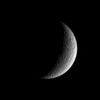
Rhea-PIA08186.jpgRhea: so "old" and yet so "beautiful...89 visiteCaption NASA:"Rhea displays a prominent scar in this view from Cassini. A large and ancient impact basin can be seen at upper right. The giant feature occurs within a terrain that appears rugged and which likely is saturated with other smaller craters.
Rhea is Saturn's second-largest moon at 1.528 Km (about 949 miles) across. This view shows terrain on the moon's Trailing Hemisphere.
North is up.
The image was taken in polarized ultraviolet light with the Cassini spacecraft narrow-angle camera on April 24, 2006 at a distance of approx. 2 MKM (such as about 1,2 MMs) from Rhea and at a Sun-Rhea-spacecraft, or phase, angle of 117°. Resolution in the original image was approx. 12 Km (about 7 miles) per pixel. The image has been magnified by a factor of two and contrast-enhanced to aid visibility".Mag 27, 2006
|
|
Tethys-N00061934.jpgTethys, mysterious but...overexposed!63 visiteCaption originale:"N00061934.jpg was taken on May 23, 2006 and received on Earth May 24, 2006. The camera was pointing toward Tethys that, at the time, was approximately 509.689 Km away.
The image was taken using the CL1 and CL2 filters".Mag 26, 2006
|
|

Saturn-W00015420.jpgSea of Clouds (4)59 visiteCaption NASA:"W00015420.jpg was taken on May 22, 2006 and received on Earth on May 23, 2006. The camera was pointing toward Saturn that, at the time, was approximately 270.920 Km away.
The image was taken using the CB2 and CL2 filters".Mag 24, 2006
|
|
Saturn-W00015419.jpgSea of Clouds (3)58 visiteCaption NASA:"W00015419.jpg was taken on May 22, 2006 and received on Earth on May 23, 2006. The camera was pointing toward Saturn that, at the time, was approximately 270.522 Km away.
The image was taken using the MT2 and CL2 filters".Mag 24, 2006
|
|
Saturn-W00015418.jpgSea of Clouds (2)56 visiteCaption NASA:"W00015418.jpg was taken on May 22, 2006 and received on Earth on May 23, 2006. The camera was pointing toward Saturn that, at the time, was approximately 270.460 Km away.
The image was taken using the CB2 and CL2 filters".Mag 24, 2006
|
|

Saturn-W00015413.jpgSea of Clouds (1)107 visiteCaption NASA:"W00015413.jpg was taken on May 22, 2006 and received on Earth on May 23, 2006. The camera was pointing toward Saturn that, at the time, was approximately 269.602 Km away.
The image was taken using the CB2 and CL2 filters".Mag 24, 2006
|
|
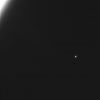
Earth-N00061732-c.jpgEarth and Moon...maybe? (1)62 visiteLa nostra impressione è che, in questo frame (apparentemente del tutto insignificante) ci sia una ripresa - molto suggestiva - della nostra Terra (e della Luna).
Ci sbagliamo? Forse no. La NASA, purtroppo, non ci è di aiuto e questa è la caption che riserva al frame:"N00061732.jpg was taken on May 22, 2006 and received on Earth on the same date. The camera was pointing toward Saturn that, at the time, was approximately 384.937 Km away.
The image was taken using the BL1 and CL2 filters".Mag 24, 2006
|
|

Earth-N00061732-detmgnf.jpgEarth and Moon...maybe? (2)60 visitedettaglio del frame precedenteMag 24, 2006
|
|

Rhea-N00061862.jpgCrescent Rhea (2)63 visiteCaption NASA originale:"N00061862.jpg was taken on May 22, 2006 and received on Earth May 23, 2006. The camera was pointing toward Rhea that, at the time, was approximately 262.677 Km away.
The image was taken using the CL1 and GRN filtersMag 24, 2006
|
|

Rhea-N00061849.jpgCrescent Rhea (1)58 visiteCaption NASA originale:"N00061849.jpg was taken on May 22, 2006 and received on Earth May 23, 2006. The camera was pointing toward Rhea that, at the time, was approximately 265.985 Km away.
The image was taken using the CL1 and UV3 filters". Mag 24, 2006
|
|

Japetus-PIA08164.jpgThe unusual colors of Japetus60 visiteThese two views of Iapetus primarily show terrain in the Southern part of the moon's dark Leading Hemisphere - the side of Iapetus that is coated with dark material. The bright South Pole of Iapetus is visible, along with some terrain (at the bottom) that lies on the bright Trailing Hemisphere.
The dark terrain known as Cassini Regio is uniformly dark between the equator and about 30° South Lat. From there down to about 50 to 60° South Lat., the dark material looks "patchy" because south-facing crater walls are bright (being largely devoid of the dark material). South of this Region, only some northward-facing crater walls are still dark, while the bright terrain has a somewhat reddish color.
Beyond 90° South, the reddish color becomes white. The Region at the bottom of the color view presented here shows this "color boundary" in the bright terrain, which also marks the boundary between the Leading and Trailing Hemispheres.
The monochrome image on the left was taken using a filter sensitive to wavelengths of infrared light centered at 930 nanometers. The image was obtained with the Cassini spacecraft narrow-angle camera on April 8, 2006, at a distance of approximately 866,000 kilometers (538,000 miles) from Iapetus and at a Sun-Iapetus-spacecraft, or phase, angle of 88 degrees. The image scale is 5 kilometers (3 miles) per pixel.
The color view on the right was created by combining images taken in ultraviolet, green and infrared spectral filters. The images were acquired with the Cassini spacecraft narrow-angle camera on April 9, 2006, at a distance of approximately 692,000 kilometers (430,000 miles) from Iapetus and at a Sun-Iapetus-spacecraft, or phase, angle of 101 degrees. The image scale is 4 kilometers (2.5 miles) per pixel.
Mag 23, 2006
|
|
| 2245 immagini su 188 pagina(e) |
 |
|
|
|
|
106 | |
|
|
|
|





