| |

| Ultimi arrivi - Saturn: the "Ringed Beauty" and His Moons |
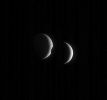
Rhea&Dione-PIA08203.jpgRocky Sisters58 visiteTwo Saturnian moons meet in the sky: Dione departs after crossing the face of Rhea for several minutes.
Dione, at right, has a notably smoother-looking surface than Rhea, thus suggesting the former has been modified more recently.
The image was taken in visible light with the Cassini spacecraft narrow-angle camera on May 14, 2006 at a distance of approx. 2,7 MKM (such as about 1,7 MMs) from Dione and 3,1 MKM (about 1,9 MMs) from Rhea.
The phase angle is about 134° on both moons, while the image scale is about 16 Km (such as roughly 10 miles) per pixel on Dione and about 18 Km (11 miles) per pixel on Rhea.Giu 22, 2006
|
|
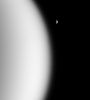
Rhea and Titan-PIA08204-br500.jpgOff the "smog"...68 visiteDuring a recent flyby of Titan, the Cassini spacecraft looked beyond the utterly overcast moon and spied clear, distant Rhea in the blackness.
Titan (5,150 kilometers, or 3,200 miles across) is two-and-a-half times smaller than Earth and much less massive. This circumstance causes its atmosphere to extend to much higher altitudes above the surface than does Earth's. The Cassini spacecraft is unable to fly much closer than about 1000 kilometers (600 miles) above Titan's surface -- much closer, and the spacecraft would experience excessive torques from the atmosphere that could interfere with its ability to track the target. By contrast, the International Space Station orbits Earth at an altitude of about 350 kilometers (220 miles).
The bright, fresh crater on Rhea (1,528 kilometers, or 949 miles across) appears near the center of the moon's crescent.
The image was taken in visible-light with the Cassini spacecraft wide-angle camera on May 20, 2006, at a distance of approximately 53,000 kilometers (33,000 miles) from Titan and 873,000 kilometers (543,000 miles) from Rhea. Image scale is 320 meters (1,050 feet) per pixel on Titan and 5 kilometers (3 miles) per pixel on Rhea.
Giu 22, 2006
|
|

Enceladus and Titan-PIA07787-br500.jpgColors of the Saturnian System: Enceladus and Titan56 visiteMany denizens of the Saturn System wear a uniformly gray mantle of darkened ice, but not these 2 moons: the brightest body in the Solar System, Enceladus, is contrasted here against Titan's smoggy, golden murk. Ironically, what these 2 moons hold in common gives rise to their stark contrasting colors. Both bodies are, to varying degrees, geologically active. For Enceladus, its Southern Polar Vents emit a spray of icy particles that coats the small moon, giving it a clean, white veneer. On Titan, yet undefined processes are supplying the atmosphere with Methane and other chemicals that are broken down by sunlight. These chemicals are creating the thick yellow-orange haze that is spread through the atmosphere and, over geologic time, falls and coats the surface. The thin, bluish haze along Titan's limb is caused when sunlight is scattered by haze particles roughly the same size as the wavelength of blue light, or around 400 nnmts. Giu 22, 2006
|
|

The Rings-PIA06175_modest.jpgThe Rings (full view) in natural colors57 visiteCaption NASA originale:"Saturn's most prominent feature, its dazzling Ring System, takes center stage in this stunning natural color mosaic which reveals the color and diversity present in this wonder of the Solar System. Gaps, gravitational resonances and wave patterns are all present and the delicate color variations across the System are clearly visible.
This mosaic of 6 images covers a distance of approximately 62.000 Km along the ring plane, from a radius of 74.565 Km to 136.780 Km from the Planet's center.
This view is from Cassini's vantage point beneath the ring plane. The rings are tilted away from Cassini at an angle of about 4°.
Images taken using red, green and blue spectral filters were used to create this natural color mosaic. The images were acquired using the Cassini spacecraft narrow angle camera on Dec. 12, 2004, at a distance of approximately 1,8 MKM (1,1 MMs).
The image scale is 10,5 Km per pixel". Giu 22, 2006
|
|
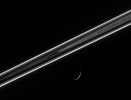
The Rings&Dione-PIA08201.jpgLike Neon-Lights...55 visiteCaption originale:"The dark side of the Ring-Plane glows with scattered light, including the luminous F-Ring, which shines like a rope of brilliant neon.
Below, Dione (1.126 Km, or 700 miles across) presents an exquisitely thin crescent.
The image was taken using a spectral filter sensitive to wavelengths of infrared light centered at 930 nanometers and it was acquired with the Cassini spacecraft narrow-angle camera on May 3, 2006 at a distance of approx. 1,8 MKM (about 1,1 MMs) from Dione and at a phase angle of 160°. Image scale is roughly 11 Km (about 7 miles) per pixel".Giu 17, 2006
|
|
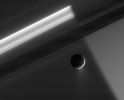
Enceladus-PIA08199.jpgEnceladus' "Jets"!58 visiteCaption NASA originale:"An enhanced close-up view shows at least two distinct jets spraying a mist of fine particles from the South Polar Region of Enceladus. The particles in the plume scatter Sunlight most effectively at high Sun-Enceladus-spacecraft angles, or phase angles, making the plumes appear bright.
This image shows the night side of Saturn and the active moon against dark sky.
Some artifacts due to image compression and cosmic rays striking the camera's detector remain as "noise" in the image.
The image was acquired in polarized green light with the Cassini spacecraft narrow-angle camera on May 4, 2006 at a distance of approx. 2,1 MKM (about 1,3 MMs) from Enceladus and 2,3 MKM (about 1,4 MMs) from Saturn. The image was taken at a Sun-Enceladus-spacecraft, or phase, angle of 159°. Image scale is roughly 13 Km (about 8 miles) per pixel".Giu 15, 2006
|
|
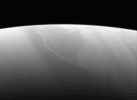
Saturn-PIA08198.jpgNightflight over Saturn58 visiteCaption NASA originale:"Saturn's atmosphere produces beautiful and sometimes perplexing features. Is the bright feature below center a rare crossing of a feature from a zone to a belt, or is it an illusion created by different cloud layers at different levels? The answer is not always easy to determine.
The image was taken using a spectral filter sensitive to wavelengths of infrared light centered at 938 nanometers.
The image was acquired with the Cassini spacecraft narrow-angle camera on May 12, 2006 at a distance of approx. 2,9 MKM (about 1,8 MMs) from Saturn and at a Sun-Saturn-spacecraft, or phase, angle of 145°. Image scale is roughly 17 Km (about 10 miles) per pixel".Giu 13, 2006
|
|

Enceladus-PIA08197.jpgIcy Plumes in the Ring-Shine57 visiteCaption NASA originale:"The plumes of Enceladus continue to gush icy particles into Saturn orbit, making this little moon one of a select group of geologically active bodies in the solar system.
Enceladus (505 Km, or 314 miles across) is seen here against the night side of Saturn. The extended exposure time used to image the plumes also makes the Southern Hemisphere, illuminated by Ring-Shine, appear bright.
The image was acquired in visible light with the Cassini spacecraft narrow-angle camera on May 4, 2006 at a distance of approx. 2,1 MKM (about 1,3 MMs) from Enceladus and 2,3 MKM (about 1,5 MMs) from Saturn. The image was taken at a Sun-Enceladus-spacecraft, or phase, angle of 159°. Image scale is roughly 13 Km (such as about 8 miles) per pixel on Enceladus".Giu 13, 2006
|
|
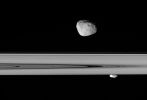
Janus&Prometheus-PIA08192.jpgJanus and Prometheus75 visiteSaturn's moons Janus and Prometheus look close enough to touch in this stunningly detailed view.
From just beneath the Ring-Plane, Cassini stares at Janus on the near side of the Rings, and Prometheus on the far side. The image shows that Prometheus is more elongated than Janus.
The view takes in the Cassini Division (about 4800 Km, or approx. 2980 miles wide), from its outer edge to about halfway across its width.
The image was taken in visible light with the Cassini spacecraft narrow-angle camera on April 29, 2006 at a distance of approx. 218.000 Km (such as about 135.000 miles) from Janus and approx. 379.000 Km (such as about 236.000 miles) from Prometheus. Image scale is about 1 Km (roughly 0,6 mile) per pixel on Janus and about 2 Km (a little more than 1 mile) per pixel on Prometheus.Giu 05, 2006
|
|

Saturn-PIA08190.jpgThrough the Rings...58 visiteCaption NASA originale:"The dark shadows that drape Saturn's Northern Latitudes are split by 3 familiar bright gaps. From bottom to top, Sunlight passes through the broad Cassini Division (4.800 Km - or about 2.980 miles - wide), the Encke Gap (325 Km - or about 200 miles - wide) and (barely visible) the Keeler Gap (42 Km - or about 26 miles - wide).
It is unlikely that the shadows cast by Saturn's Rings have much of an effect on the large-scale movements of the atmosphere. The dynamic clouds of this Gas Giant are driven by processes going on much deeper inside the Planet, where Sunlight does not penetrate.
The image was taken using a spectral filter sensitive to wavelengths of infrared light centered at 752 nanometers. The image was acquired with the Cassini spacecraft wide-angle camera on April 28, 2006 at a distance of approximately 377.000 Km (about 234.000 miles) from Saturn. Image scale is roughly 19 Km (such as about 12 miles) per pixel".Giu 02, 2006
|
|
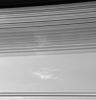
Saturn-PIA08191.jpgClouds of Saturn58 visiteCaption NASA originale:"The soft, sweeping shadows of Saturn's C-Ring cover bright patches of clouds in the Planet's Atmosphere. The shadow-throwing rings stretch across the view at bottom.
The dark inner edge of the B-Ring is visible at top.
The image was taken using a spectral filter sensitive to wavelengths of infrared light centered at 752 nanometers. The image was acquired with the Cassini spacecraft wide-angle camera on April 28, 2006 at a distance of approximately 340.000 Km (about 211,000 miles) from Saturn. Image scale is roughly 17 Km (about 10 miles) per pixel".Giu 02, 2006
|
|

Rhea-PIA08189.jpgBright "Splat", Bright "Ice"...57 visiteCaption originale:"Rhea's crater-saturated surface shows a large bright blotch, which was likely created when a geologically recent impact sprayed bright, fresh ice ejecta over the moon's surface. The rim of the great Tirawa impact basin can be seen near the top of the image. The giant feature is approx. 360 Km (about 220 miles) across.
This equatorial view captures Rhea's Leading Hemisphere. North is up and rotated 40° to the right.
The image was taken in visible red light with the Cassini spacecraft narrow-angle camera on April 28, 2006 at a distance of approx. 481.000 Km (about 299.000 miles) from Rhea and at a Sun-Rhea-spacecraft, or phase, angle of 23°.
Image scale is approx. 3 Km (about 2 miles) per pixel".Mag 31, 2006
|
|
| 2245 immagini su 188 pagina(e) |
|
|
|
|
|
105 | |
|
|
|
|
|
|





