| Ultimi arrivi - Saturn: the "Ringed Beauty" and His Moons |

Rhea-N00063467.jpgVoyagers... (1)60 visiteDue frames che ritraggono Rhea e, molto probabilmente, Tethys (ma non ne siamo affatto certi), mentre si "rincorrono" attraverso lo Spazio di Saturno.
Frames bellissimi e suggestivi che ci aiutano, se non altro, ad immaginare che cosa vuol dire "vivere" in uno Spazio popolato non da una sola Luna, ma da decine di Corpi Celesti che si rincorrono e si incrociano in una sorta di Carosello senza fine.
Caption originale:"N00063467.jpg was taken on July 04, 2006 and received on Earth July 04, 2006. The camera was pointing toward Rhea that, at the time, was approximately 1.358.319 Km away. The image was taken using the CL1 and CL2 filters".Lug 06, 2006
|
|
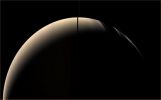
Saturn-PIA08213-br500.jpgThe "Ringed Beauty"!58 visitenessun commentoLug 05, 2006
|
|

Atlas from Voyager2.jpgAtlas, from Voyager 2 (extra detail mgnf)68 visiteUn buon super detail-mgnf per evidenziare la forma (curiosa) della mini-luna Saturniana Atlas, sino ad ora mai ripresa in maniera soddisfacente dalle Sonde che sono passate (o sono tuttora in transito) nello Spazio di Saturno.
Il frame è stato portato a stretch estremi dal nostro Tecnico delle Immagini ed il risultato è più che decoroso; tuttavia, proprio perchè lo stretch estremo crea o concorre nella creazione di anomalìe ed artefatti, non commentiamo i dettagli "strani" che questo frame ora pare evidenziare.
O meglio: li commenteremo se anche Voi li vedrete e chi chiederete conto di essi...Lug 03, 2006
|
|

Rhea-N00063370.jpgRhea and the Rings60 visiteCaption originale:"N00063370.jpg was taken on July 01, 2006 and received on Earth July 01, 2006. The camera was pointing toward Rhea that, at the time, was approximately 1.170.687 Km away.
The image was taken using the RED and CL2 filters".Lug 03, 2006
|
|

Hyperion-N00063147-2.jpgHyperion and a "Bright Companion" (2 - detail mgnf)73 visiteOsservate attentamente questo stretch estremo del frame precedente: l'effetto che osservate, a nostro avviso, è un effetto di saturazione, ossìa un artefatto che emerge quando l'oggetto fotografato (o una sua parte) é/sono troppo luminoso/i.
Su Marte, in svariati casi (dalle immagini degli Heat-Shields, a quelle di alcune componenti dei Rover illuminate direttamente dal Sole), il risultato della saturazione si esprimeva nel cd. "effetto goccia". Qui, nello spazio di Saturno, l'effetto della saturazione ci sembra molto simile a quanto si vede su Marte. Anzi: forse esso è ancora più eclatante.
Domanda: che cosa sarà mai, dunque (ed ovviamente ammettendo che la nostra costruzione sia almeno in parte esatta), quell'oggetto semi-cancellato, ma in parte ancora visibile - ad ore 9 della traccia luminosa - che si trova ad una distanza imprecisata dalla Sonda Cassini, e nelle vicinanze di Hyperion?Lug 03, 2006
|
|

Hyperion-N00063147-1.jpgHyperion and a "Bright Companion" (1 - context image)68 visiteUn'immagine bella ed ambigua: Hyperion, the "tumbling moon", sembra essere in compagnia di un altro oggetto il quale, forse perchè molto (si direbbe "troppo", a giudicare dal risultato fotografico ottenuto) luminoso, è stato "washed away".
Ma attenzione: il washing è stato solo parziale! Qualcosa, infatti, sembra che la si riesca a vedere...Lug 03, 2006
|
|
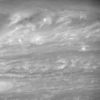
Saturn-PIA08212.jpgSaturnian Clouds57 visiteCaption NASA originale:"Cassini images of Saturn's dynamic atmosphere, like this detailed view, will be combined with data from the spacecraft's two infrared-sensing instruments (the Visible and Infrared Mapping Spectrometer - VIMS - and the Composite Infrared Spectrometer - CIS) to measure correlations among cloud features at many altitudes and infer heat flow across the Planet.
The numerous small, white blobs generally indicate disturbed and turbulent regions.
The image was taken with the Cassini spacecraft wide-angle camera on May 22, 2006 at a distance of approx. 331.000 Km (such as approx. 206.000 miles) from Saturn. The image was obtained using a spectral filter sensitive to wavelengths of infrared light centered at 752 nanometers. Image scale is roughly 16 Km (just 10 miles) per pixel".Lug 03, 2006
|
|
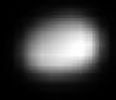
Polydeuces-PIA08209.jpgPolydeuces (extra detail mgnf)58 visiteThis magnified view shows tiny Polydeuces, a moon that was discovered by the Cassini spacecraft and is a mere 3 Km (a little less than 2 miles) across. Along with much larger Helene (32 Km, or 20 miles across), Polydeuces orbits Saturn at the same distance as large, icy Dione (which is 1.126 Km, or 700 miles across).
Because this body was only recently discovered and is so small, scientists presently know precious little about it. Further observations by Cassini may yield additional insights about its nature and composition.
The image was taken with the Cassini spacecraft narrow-angle camera on May 22, 2006 at a distance of approx. 73.000 Km (about 45.000 miles) from Polydeuces and at a phase angle of 41°. The image was obtained using a spectral filter sensitive to wavelengths of infrared light centered at 752 nanometers. Scale in the original image was about 434 mt (appx. 1423 feet) per pixel. The image has been magnified by a factor of 4 and contrast-enhanced to aid visibility.Giu 30, 2006
|
|

Rhea-PIA08208.jpgCrescent Rhea (Super HR)58 visiteCaption NASA originale:"Rhea's devastated surface creates a jagged terminator as mountains and crater rims break-up the line between day and night. Terrain on Rhea's night side is dimly lit by reflected light from Saturn.
The view looks toward the Southern Hemisphere on the moon's trailing side. North on Rhea is up.
The image was taken in visible green light with the Cassini spacecraft narrow-angle camera on May 22, 2006 at a distance of approximately 263.000 Km (about 164.000 miles) from Rhea and at a phase, angle of 138°. Image scale is approx. 2 Km (about 1,4 mile) per pixel".Giu 28, 2006
|
|

Rhea&Saturn-PIA07806.jpgRhea and Saturn in natural colors58 visiteCaption NASA originale:"The slim crescent of the moon Rhea glides silently onto the featureless, golden face of Saturn. In an interplay of contrast and shadow, the moon goes dark against the Planet, and then its crescent suddenly brightens as it slips in front of Saturn's night side.
This view looks down onto the unlit side of Saturns Rings, which cast soft, linear shadows onto the Planet's Northern Hemisphere.
The image was acquired by the Cassini spacecraft wide-angle camera on March 21, 2006, at a distance of approx. 221.000 Km (about 137.000 miles) from Rhea. The image scale is approx. 13 Km (about 8 miles) per pixel".Giu 27, 2006
|
|

Pan-PIA08320.jpgPan through the Rings57 visiteCaption originale:"Saturn's small, walnut-shaped moon, Pan, embedded in the Planet's Rings.
This image was taken in visible light with the Cassini spacecraft narrow-angle camera on April 29, 2006, at a distance of approximately 209.000 Km (about 130,000 miles) from Pan.
The image scale is approx. 1 Km per pixel".Giu 27, 2006
|
|

Janus and Enceladus-PIA08207.jpgJanus and Enceladus58 visiteCaption originale:"Wrinkled and cracked Enceladus hangs in the distance as the pitted ring moon Janus, at right, rounds the outer edge of the F-Ring. Enceladus is remarkable for its actively venting South Polar Region, while Janus is known for its orbital swap with the moon Epimetheus. The bright core of the F-Ring is perhaps 50 Km wide and contains numerous clumps and kinks.
Dimmer, flanking ringlets on either side of the core wind into a tight spiral structure, discovered in Cassini images.
The image was taken in visible light with the Cassini spacecraft narrow-angle camera on May 21, 2006, at a distance of approx. 565.000 Km (such as about 351.000 miles) from Janus; 702.000 Km (about 436.000 miles) from Enceladus and 530.000 Km (approx. 329.000 miles) from Saturn.
Image scale is roughly 3 Km (about 2 miles) per pixel on Janus and approx. 4 Km (a little more than 2 miles) per pixel on Enceladus".Giu 26, 2006
|
|
| 2245 immagini su 188 pagina(e) |
 |
|
|
|
|
104 | |
|
|
|
|





