| Ultimi arrivi - Saturn: the "Ringed Beauty" and His Moons |

Rhea-N00064799-A.jpgMoments of Rhea (1) - context image60 visitenessun commentoAgo 19, 2006
|
|

The Rings-PIA08243.jpgThe Huygens "Gap"55 visiteCaption NASA:"The sharp outer boundary of Saturn's B-Ring, which is the bright ring region seen to the right in this image, is maintained by a strong resonance with the moon Mimas. For every two orbits made by particles at this distance from Saturn, Mimas makes one orbit.
The moon's repeated gravitational tugs force ring particles away from this region.
The dark region is called the "Huygens Gap" and it includes the bright, eccentric Huygens Ringlet, also visible here near center".Ago 16, 2006
|
|

Saturn-PIA08242.jpg"Flat and Ringless" Saturn...58 visiteCaption NASA originale:"Saturn's low density and fast rotation combine to give it its characteristic oblate shape. The dramatic crescent seen here demonstrates how the Ringed Planet is much wider at the equator than at the poles.
The Rings (seem to) disappear near the center into the darkness of the Planet's shadow.
The image was taken in visible light with the Cassini spacecraft wide-angle camera on July 11, 2006 at a distance of approx. 2,9 MKM (such as about 1,8 MMs) from Saturn and at a Sun-Saturn-spacecraft, or phase, angle of 163°.
Image scale is approx. 169 Km (about 105 miles) per pixel".Ago 15, 2006
|
|

Rings-PIA08241.jpgDifferent Light, Different Brightness, Different Motion...69 visiteCaption NASA:"This close-up view of the inner A-Ring shows intriguing variations in brightness along the direction of the Ring motion - from top to bottom. Close examination reveals dark regions that appear to widen and then narrow, and thin bright regions that disappear altogether.
Variations in brightness are to be expected in the direction of increasing orbital distance from Saturn, but variations along the azimuthal (or circumferential) direction are unusual, as they should be smoothed out quickly by ring particle motion.
Note: the faint "doughnut" left of center and the dark area in the lower right corner are imaging artifacts.
The image was taken in visible light with the Cassini spacecraft narrow-angle camera on July 23, 2006 at a distance of approx. 285.000 Km (about 177.000 miles) from Saturn. Image scale is about 1 Km (0,6 mile) per pixel".Ago 12, 2006
|
|

Saturn-N00063521-04.jpgSaturnian "Shooting Star" and a Shooting Star from Earth185 visiteIl raffronto fra queste immagini ci sembra una prova sufficiente per poter rivendicare, come Lunar Explorer Italia - e diremmo definitivamente - la paternità di questa piccola (ma, secondo noi, splendida e significativa) scoperta: la prima Stella Cadente colta nello spazio di un mondo diverso dalla Terra!
Peccato che la NASA non abbia niente da dire...Ago 11, 2006
|
|

Hyperion-PIA08240.jpgPink Hyperion...75 visiteCaption NASA originale:"Unlike most of the dull grey moons in the Solar System, Hyperion's color is a rosy tan (---> Light Pink), as this view shows.
The origin of the moon's unusual hue is not known. Some scientists suspect the color comes from falling debris from moons further out.
A similar origin has been suggested for the dark reddish material on Saturn's moon Iapetus.
Images taken using red, green and blue spectral filters were combined to create this natural color view. The images were taken in visible light with the Cassini spacecraft narrow-angle camera on June 28, 2006 at a distance of approx. 291.000 Km (about 181.000 miles) from Hyperion. Image scale is roughly 2 Km (a little more than 1 mile) per pixel".Ago 11, 2006
|
|
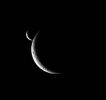
Rhea & Enceladus-PIA08237.jpgAfter the occultation...58 visiteCaption NASA originale:"Two slim crescents smile toward the Cassini spacecraft following an occultation event.
Taken only 5 minutes after Enceladus first approached the limb of Rhea, this view shows the bright little moon emerging from behind the larger moon's crescent.
The image was taken in visible light with the Cassini spacecraft narrow-angle camera on July 4, 2006 at a distance of approx. 1,4 MKM (about 800.000 miles) from Rhea and approx. 1,9 MKM (about 1,2 MMs) from Enceladus. The view was obtained at a Sun-moon-spacecraft, or phase, angle of about 142° relative to both moons.
Image scale is about 8 Km (5 miles) per pixel on Rhea and approx. 11 Km (about 7 miles) on Enceladus".Ago 09, 2006
|
|

Rhea-PIA08239.jpgRhea behind the Rings (natural colors)93 visiteCaption NASA originale:"The Rings cannot hide the ragged, icy crescent of Rhea, here imaged in color by the Cassini spacecraft: The second-largest moon of Saturn shines brightly through gaps in the Rings.
Rhea lies beyond the dim, unlit side of the Rings. A diffuse clump of material lies in the F-Ring, on the side nearest to Cassini.
Images taken using red, green and blue spectral filters were combined to create this natural color view, which approximates the scene as it might appear to human eyes. The view was acquired with the Cassini spacecraft narrow-angle camera on July 1, 2006 at a distance of approx. 1,2 MKM (about 700.000 miles) from Rhea and at a Sun-Rhea-spacecraft, or phase, angle of 118°. Image scale is roughly 7 Km (about 4 miles) per pixel".Ago 09, 2006
|
|
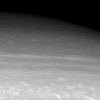
Saturn-PIA08232.jpgHigh Northern Latitudes58 visiteCaption NASA originale:"This infrared view looks toward middle to High Northern Latitudes on Saturn, revealing entrancing meanders in the clouds. The cloud patterns transition from puffier looking in the South - possibly a region of shear - to smoother oval shapes in the North.
Cassini's view of high latitudes will improve beginning in late July 2006 as the spacecraft's orbit leaves the Ring-Plane and is cranked up to higher inclinations.
The image was taken with the Cassini spacecraft wide-angle camera using a spectral filter sensitive to wavelengths of infrared light centered at 939 nanometers. The view was obtained on June 30, 2006 at a distance of approx. 336.000 Km (about 209.000 miles) from Saturn. Image scale is roughly 16 Km (about 10 miles) per pixel".Lug 31, 2006
|
|

Pan-PIA08230.jpgInside "Encke"...56 visiteCaption NASA originale:"Hiding within the Encke Gap is the small moon Pan, partly in shadow and party cut off by the outer A-Ring in this view. Similar to Atlas, Pan appears to have a slight ridge around its middle; and like Atlas, Pan's orbit also coincides with a faint ringlet. Pan is 26 Km(about 16 miles) across.
The image was taken in visible light with the Cassini spacecraft narrow-angle camera on June 30, 2006 at a distance of approximately 269.000 Km (such as about 167.000 miles) from Pan. Image scale is roughly 2 Km(approx. 5.259 feet) per pixel".Lug 27, 2006
|
|

Saturn-W00016667.jpgSaturn in the Night...60 visiteCaption NASA originale:"W00016667.jpg was taken on July 26, 2006 and received on Earth July 26, 2006. The camera was pointing toward Saturn that, at the time, was approximately 1.492.885 Km away.
The image was taken using the MT3 and IRP0 filters.
This image has not been validated or calibrated". Lug 27, 2006
|
|

Sky-N00064410.jpgThe "Big Streak" is just a "bad picture"?57 visiteCaption NASA originale:"N00064410.jpg was taken on July 26, 2006 and received on Earth July 26, 2006. The camera was pointing toward Saturn's E-Ring that, at the time, was approximately 1,4 MKM away.
The image was taken using the CL1 and CL2 filters.
This image has not been validated or calibrated".
Nota: non ci sembra che la fotocamera di Cassini stesse inquadrando il debole Anello "E" di Saturno. Questo frame, a nostro avviso, è il prodotto di uno scatto casuale ed effettuato impiegando parametri errati i quali si sono risolti in una immagine mossa (come le "strisce ondulate" - che riteniamo essere stelle - dimostrano ampiamente) e, di fatto, impossibile da spiegare.
L'inclinazione del notevole streak di luce bianca (Big Streak) visibile ad ore 9 del frame - un'inclinazione incongrua rispetto a quella degli streaks lasciati dalle altre stelle riprse - ci dimostra che questo "Big Streak" non dovrebbe essere dipeso dal fatto di Cassini (che scatta mentre si muove in maniera repentina), bensì dal SUO (autonomo) movimento RISPETTO a Cassini.
Gli altri puntini che costellano l'immagine sono dei photoartifacts (noise).Lug 27, 2006
|
|
| 2245 immagini su 188 pagina(e) |
 |
|
|
|
|
101 | |
|
|
|
|





