| Ultimi arrivi - Deep Sky Objects |

CC-Abell 2125 and C 153.jpgCosmic-scale events inside galaxy clusters174 visite"L'intervento umano sulla Natura, almeno per come lo intendiamo noi in questo secolo, è più improntato e volto ad affermare la capacità dell'uomo di modificarla e di piegarla ai propri voleri, piuttosto che di consentirne uno sviluppo armonico ed in sintonia con le necessità umane.
Insomma: l'uomo che interviene sulla Natura non lo fa attraverso un atto d'Amore, di Equilibrio e di Rispetto.
Lo fa attraverso un atto di Violenza"
(Edwin R. Van Den Broeck)Set 06, 2004
|
|

NGC-0247-PIA04922_modest.jpgNGC 247 - Irregular Galaxy85 visite"...Under the stars, the lonely figure walked homeward across a nameless land. Behind him, the river flowed softly to the sea, winding through the fertile plains on which, more than a thousand centuries ahead, Yaan's descendants would build the Great City they were to call Babylon..."
Arrthur C. Clarke - "Encounter in the Dawn"Set 05, 2004
|
|

BB-Out Of Dust-Planet_s Birth-PIA05988_modest.jpgBirth of a new planet around "Coku-Tau 4"261 visiteIn this artist's conception, a possible newfound planet spins through a clearing in a nearby star's dusty, planet-forming disc. This clearing was detected around the star CoKu Tau 4 by NASA's Spitzer Space Telescope. Astronomers believe that an orbiting massive body, like a planet, may have swept away the star's disc material, leaving a central hole. The possible planet is theorized to be at least as massive as Jupiter; a graceful ring, much like Saturn's, spins high above the planet's cloudy atmosphere.Set 04, 2004
|
|

Gliese 436-Extrasolar Planet.jpgA new planet orbiting "Gliese 436"178 visiteA 30 Anni Luce di distanza da noi, nella Costellazione del Leone, si trova questa piccola stella (di dimensioni pari a circa 4/10mi del nostro Sole) chiamata Gliese 436; a circa 4.100.000 Km da essa, orbita un pianeta di massa simile a quella di Nettuno.
Non sappiamo ancora nulla di questo oggetto, ma una cosa l'abbiamo (probabilmente) capita: la Terra è tutt'altro che un fenomeno raro (o unico) dell'Universo. Siamo solo una particella di un organismo infinito. Che sia giunta la fine dell'antropocentrismo?Set 03, 2004
|
|
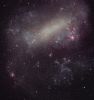
Large Magellan Cloud.jpgThe "Large Cloud of Magellan"146 visite"...Parlando dei viaggi nel tempo - a prescindere dal fatto che si possa o non possa arrivare a farli -, io credo che l'uomo che riesce a conoscere il suo futuro, finisca con il non aver più un futuro. Vivrà (se vivrà...) per fare o non fare quello che il suo "futuro", non più ignoto, gli avrà "suggerito" di fare o non fare.
E' così, credimi: se togli all'Uomo il "Mistero", non gli fai un favore: riesci solo a rubargli la Speranza..."
P.C. Floegers - "In the Paradox"Set 02, 2004
|
|

55 Cancri-2.jpg55 Cancri and one of its planets306 visiteThe combined efforts of three observatories (Hobby-Eberly, Lick, and HST) have led to the discovery of a new planet orbiting the star known as "55 Cancri," only 40 light years away.
This planet (the fourth in the system) appears to have the mass of Neptune, but orbits very close to its parent star, in an orbit even smaller than that occupied by Mercury in our system.
We believe that such a situation should result in the absolute instability of this planet's orbit and, perhaps, of the entire system it surrounds.Set 01, 2004
|
|

NGC-0246-SST-PIA06755_modest.jpgNGC 246 - The "Skull (Planetary) Nebula"99 visite"...Quandoquidem et illi peccant, quos minime putes, et qui non peccant, impugnantur fraudibus..."
(Fedro)
"...Sovente i veri colpevoli sono coloro che meno pensi (lo potrebbero essere) e, altrettanto spesso, gli innocenti sono vittime delle ingiustizie..."Ago 31, 2004
|
|

BH-Black-Hole_in_3D.jpgBlack-Hole in 3D158 visiteThis three-dimensional illustration shows how the rotating space around a black hole twists up the magnetic field in the plasma falling toward the black hole. The black sphere at the center of the figure is the black hole itself, and the yellow region around it represents the area where space is being twisted. The red tubes depict magnetic field lines threading this twisting space, while the green ones show magnetic field lines which have not yet entered that space. Ago 29, 2004
|
|

BH-Black-Hole.jpgComputer simulation of a Black-Hole from start to finish126 visitePlasma is falling slowly toward the black hole in a (at the upper left). The plasma has a magnetic field, shown by the white lines. It picks up speed as it falls toward the hole in b (at the upper right), c (lower left) and d (lower right). However, the rotating black hole twists up space itself (and the magnetic field lines) and ejects electromagnetic power along the north and south poles above the black hole. The red and white color shows the immense electromagnetic power output, which eventually will pick up particles and form squirting jets.Ago 29, 2004
|
|

He2-90-HST-PIA04214_modest.jpgHe2-90 - HST113 visite"...Se io fossi capace di vedere, oltre le Notti, ed oltre i Giorni, che fanno la Vita;
Se fossi capace di sentire, le Grida del Passato i Sussurri dell'Avvenire, e le Parole del Presente;
Se ci fosse un Cielo, grande abbastanza per coprirmi;
Se ci fosse un Sole, rosso e caldo ad illuminarmi e
Se ci fosse un Angelo, grande e forte, pronto ad abbracciarmi;
Volerei via con Lui,
Se ci fosse, volerei via con Lui..."
Paolo C. Fienga - "Prière du Matin"Ago 29, 2004
|
|
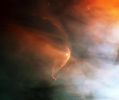
Bow-Shock on M42-HST-PIA04227_modest.jpgBow-shock in Orionis - HST1580 visiteNamed for the crescent-shaped wave a ship makes as it moves through water, a "bow-shock" can form in space when two gas streams collide. In this case, the young star, LL Orionis, emits a vigorous wind, a stream of charged particles moving rapidly outward from the star. Our own Sun has a less energetic version of this wind that is responsible for auroral displays on the Earth. The material spewed from LL Ori collides with slow-moving gas evaporating away from the center of the Orion nebula, located to the lower right of the image. The surface where the two winds collide is seen as the crescent-shaped bow shock. Unlike a water wave from a ship, this interstellar bow shock is three-dimensional. The filamentary emission has a distinct boundary on the side facing away from LL Ori, but is diffuse on the side closest to the star, a trait common to many bow shocks. Ago 28, 2004
|
|

Ant Nebula-HST-PIA04216_modest.jpgAnt Nebula - HST212 visite"...Nella necessità di codificare, classificare e schematizzare tutto quello che vediamo, c'è la nostra incapacità di vedere le cose per ciò che esse sono realmente..."
Paolo Catello FiengaAgo 28, 2004
|
|
| 1039 immagini su 87 pagina(e) |
 |
|
|
|
|
78 | |
|
|
|
|








