| Ultimi arrivi - Deep Sky Objects |

Microquasars.jpgMicro-Quasar in Cassiopeia and IC 1805101 visiteMicroquasars (MQ), bizarre binary star systems, generating high-energy radiation and blasting out jets of particles at nearly the speed of light, live in our Milky Way galaxy. The energetic microquasar systems seem to consist of a very compact object, either a neutron star or a black hole, formed in a supernova explosion but still co-orbiting with an otherwise normal star. And now, using a very long array of radio telescopes, astronomers are reporting that at least 1 MQ (LSI+61 303) can be traced back to its probable birthplace, within a cluster of young stars in the constellation Cassiopeia. About 7.500 LY from Earth, the star cluster and surrounding nebulosity are shown in the deep sky image above. The cluster stars are identified by yellow boxes and circles.
A yellow arrow indicates the common apparent motion of the cluster stars; the green one shows the deduced motion of the microquasar system and the red arrow depicts the microquasar's motion relative to the star cluster itself.
Set 16, 2004
|
|

Fox Fur Nebula.jpgThe "Fox Fur" Nebula163 visite"...Miraturque nihil, nisi quod Libitina sacravit..."
(Orazio)
"Nulla viene ammirato (pur se meritevole), finché Libitina non gli conferisce Dignità..."
*Libitina: Dea dei funerali, nel cui Tempio si prelevava l'occorrente per i servizi funebri e si custodivano i cosiddetti "Registri dei Morti"
(oggi diremmo: le persone non si apprezzano fintanto che non sono morte)
Set 15, 2004
|
|
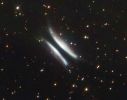
Gomez_s Hamburger - HST.jpgProtoplanetary Nebula - "Hamburger"145 visiteUn commento a questa immagine si impone: questa nebulosa protoplanetaria è stata chiamata "hamburger" - si, proprio come i panini di Mc Donald's... -. Un elevatissimo quantitativo di oggetti relativi allo spazio ed ai pianeti in generale ed a Marte in particolare viene quotidianamente battezzato usando una nomenclatura - quando va bene - "oscura" e, quando va male, "ridicola" sino ai limiti dell'offensivo. Ci siamo spesso chiesti il perchè di questo (per lo meno "curioso") approccio ai Misteri dell'Universo e, alla fine, ci siamo convinti che l'attribuzione di nomi ridicoli costituisca un modo di esorcizzare quello che non riusciamo a comprendere, in tutto o in parte, facendolo ricadere sotto una realtà che deve essere "nota" ed "innocua". Noi non sappiamo se questo modo di ragionare sia giusto o no, ma una cosa è certa: alle volte si esagera. La nebulosa "Hamburger", secondo noi, fa parte della casistica in cui si è esagerato nella semplificazione, ottenendo il risultato della "banalizzazione".
O no?!?..Set 15, 2004
|
|

Eta Carinae.jpgEta Carinae91 visite"...Black Hole: una stella collassata, per alcuni; un'anomalia del Cosmo, per altri. Una simpatica definizione diceva che il Buco Nero è una sorta di "Aspirapolvere Cosmico", capace di risucchiare ogni genere di corpo fisico al suo interno, incluso ciò che noi chiamiamo "Tempo".
Nel complesso di definizioni, comunque - e nella loro diversità - è sempre emerso un punto comune, che è questo: NULLA, una volta afferrato, può sfuggire al Black Hole.
Ebbene io credo, con ciò creando un paradosso, che se un uomo venisse catturato da uno di questi oggetti, qualcosa potrebbe comunque riuscire a scappare all'immensa attrazione di un siffatto "Aspirapolvere Cosmico".
Cosa?
Ma è semplicissimo: esso non potrebbe mai trattenere un qualsiasi "pensiero" proveniente da questo ipotetico uomo, prigioniero del suo eterno ed invincibile abbraccio gravitazionale..."
Paolo Catello FiengaSet 15, 2004
|
|

Fomalhaut.jpgFomalhaut Dust Disk Indicates Planets308 visiteFomalhaut, actually the 17th brightest star in the night sky, is a mere 22 LY away but only a fraction of the age of our Sun. Recent observations in far infrared light (...) indicate a dust disk surrounding Fomalhaut that has both a hole in the center and a warped edge. Now the hole in the center indicates that dust has fallen onto interior planets - possibly like the Earth - while the warp at the edge indicates the gravitational pull of a planet like Jupiter or Saturn. Set 15, 2004
|
|

The Sky-PIA04203_modest.jpgThe Sky and 95.851.753 stars with Ks 13.5123 visiteWhat appears most prominently is the Galactic plane and the Galactic bulge. As you can see, the plane is cut by dark dust lanes, clouds and several dusty regions. You can clearly see the 2 Magellanic Clouds (note the prominent bar and incipient spiral structure of the Large Cloud). Near the Small Magellanic Cloud is the globular cluster 47 Tucanae. Cutting almost north-south through one side of the bulge is the dwarf Sagittarius Galaxy which, along with the Clouds, is a Milky Way's satellite Galaxy.Set 12, 2004
|
|

NGC-6543-1.jpgNGC 6543 "Cat's Eye"114 visite"Se un gatto ci guarda, allora ci sentiamo osservati, scrutati, forse - talvolta - anche pesati e valutati. Reggere lo sguardo intenso di un gatto è difficile ed anche le azioni più ordinarie sono svolte in modo diverso, quando sappiamo che un gatto ci osserva.
Noi, invece, possiamo fissare un gatto a lungo, cercando di infastidirlo o di farci notare, ma lui continuerà a leccarsi il pelo o ad osservare una mosca che danza sulla finestra o a riposare: i nostri giudizi, per il gatto, non hanno peso alcuno"
Paolo C. FiengaSet 10, 2004
|
|

Sagittarius Region.jpgThe beautiful "Sagittarius Region" with NGC 6559, M 8 and M 20156 visite"And God shall wipe away all tears from their eyes; and there shall be no more death, neither sorrow, nor crying, neither shall there be any more pain: for the former things are passed away"
Revelation 21:4
Set 09, 2004
|
|

NGC-4038_and_NGC-4039_(2).jpgNGC 4039 and NGS 4038 - The "Antennae" Colliding Galaxies102 visiteThe image was taken by Spitzer's infrared array camera and is a combination of infrared light ranging from 3.6 microns (shown in blue) to 8.0 microns (shown in red). The dust emission (red) is by far the strongest feature in this image. Starlight was systematically subtracted from the longer wavelength data (red) to enhance dust features. The two nuclei, or centers, of the merging galaxies show up as white areas, one above the other. The brightest clouds of forming stars lie in the overlap region.Set 08, 2004
|
|
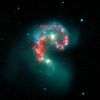
NGC-4038_and_NGC_4039-1.jpgNGC 4039 and NGS 4038 - The "Antennae" Colliding Galaxies81 visiteThis false-color image composite from NASA's Spitzer Space Telescope reveals hidden populations of newborn stars at the heart of the colliding "Antennae" galaxies. These 2 galaxies are located around 68 million light-years away and have been merging together for about the last 800 M years. The latest SST observations provide a snapshot of the tremendous burst of star formation triggered in the process of this collision, particularly at the site where the 2 galaxies overlap.Set 08, 2004
|
|

BH-Black-Hole_Torus.jpgBlack-Hole Torus235 visite"...All'interno delle Galassie Attive - e, più precisamente, al loro centro - noi riteniamo (ma sarebbe meglio dire "speculiamo") che possa trovarsi un Buco Nero di massa enorme.
Le Galassie Attive più comuni appartengono alla Classe Seyfert (ST) e si dividono in S-T1 ed S-T2: le prime (nello spettro visibile) sono luminosissime mentre le seconde, invece, appaiono piuttosto flebili.
Perché?
Forse perchè, nelle ST-2, il Buco Nero centrale è circondato da un anello di materia oscura..."
Set 08, 2004
|
|

NGC-2403+Supernova_(HD).jpgNGC 2403 + Supernova (HST)82 visite"...Supponiamo che l'Universo sia, effettivamente, curvo.
Questa possibile configurazione riguarda, se così possiamo esprimerci, la 'forma' dell'Universo stesso, non certo la sua estensione.
Vorrei dunque capire perché, ogniqualvolta parliamo di Universo curvo, ci sentiamo automaticamente autorizzati a parlare di 'Universo Limitato'? Non esistono, forse, delle 'curve' che sono, per loro stessa natura, infinite?!?..."
Paolo C. Fienga - "Appunti di Filosofia della Scienza"Set 07, 2004
|
|
| 1039 immagini su 87 pagina(e) |
 |
|
|
|
|
77 | |
|
|
|
|








