| Ultimi arrivi - Deep Sky Objects |

NGC-1499-00.jpgNGC 1499 - The "California Nebula"113 visite"...Vivere come ci pare e piace non costa nulla, poichè il prezzo di questa scelta lo paghiamo con qualcosa che non esiste: la Felicità..."
(dal film "C'eravamo tanto amati")Mar 10, 2005
|
|
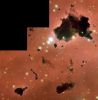
IC_2944-PIA04223.jpgIC 2944 - Thackeray's Globules (HST)97 visite"...I want to go on living even after Death..."
Anne Frank - "Diary" (April 4, 1944)Mar 09, 2005
|
|

Fomalhaut-PIA04942.jpgFomalhaut and its "Dust Disk"125 visiteCaption NASA originale:"The NASA SST has obtained the first infrared images of the dust disc surrounding Fomalhaut, the 17th brightest star in the sky. Planets are believed to form from such a flattened disc-like cloud of gas and dust orbiting a star very early in its life. The Spitzer telescope was designed in part to study these circumstellar discs, where the dust particles are so cold that they radiate primarily at infrared wavelengths. Located in the constellation Piscis Austrinus, the parent star and its putative planetary system is found at a distance of 25 light-years. The 70-micron image (lower left) clearly shows an asymmetry in the dust distribution, with the southern lobe one-third brighter than the northern. Such an unbalanced structure could be produced by a collision between moderate-sized asteroids in the recent past (releasing a localized cloud of dust) or by the steering effects of ring particles by the gravitational influence of an unseen planet".Mar 07, 2005
|
|

Dying Star-PIA04277.jpgA "dying star" from HST96 visite"...Life is a great surprise. I do not see why Death should not be an even greater one..."
Vladimir NabokovMar 07, 2005
|
|

HD-44179-The_Red_Rectangle-PIA04533.jpgHD44179: The "Red Rectangle" - HST138 visite"I've never read a political poem that's accomplished anything. Poetry makes things happen, but rarely - if ever - what the poet wants"
Howard NemerovMar 07, 2005
|
|
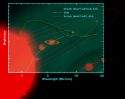
Graph-PIA07336.jpgA Brown-Dwarf's planetary system and the Solar System146 visiteThis artist's conception shows the relative size of a hypothetical brown dwarf-planetary system (below) compared to our own solar system. A brown dwarf is a cool or "failed" star, which lacks the mass to ignite and shine like our Sun. NASA's SST set its infrared eyes on an extraordinarily low-mass brown dwarf called OTS 44 and found a swirling disc of planet-building dust. At only 15 times the mass of Jupiter, OTS 44 is the smallest known brown dwarf to host a planet-forming, or protoplanetary, disc.
Astronomers believe that this unusual system will eventually spawn planets. If so, they speculate that OTS 44's disc has enough mass to make one small gas giant and a few Earth-sized rocky planets. Examples of these possible planets are depicted at the bottom of this picture, circling a low-mass brown dwarf. Above, the bodies of our own Solar System have been drawn to the same scale. In each system, the terrestrial planets have been enlarged and the distances between them and their parent bodies scaled down.Mar 07, 2005
|
|
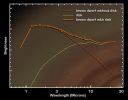
Graph-PIA07337.jpgOTS 44: another "failed" star136 visiteThis graph of data from NASA's SST shows that an extraordinarily low-mass brown dwarf, or "failed star," is circled by a disc of planet-building dust. The brown dwarf, called OTS 44, is only 15 times the mass of Jupiter, making it the smallest known brown dwarf to host a planet-forming disc.
SST was able to see this unusual disc by measuring its infrared brightness. Whereas a brown dwarf without a disc (red dashed line) radiates infrared light at shorter wavelengths, a brown dwarf with a disc (orange line) gives off excess infrared light at longer wavelengths. This surplus light comes from the disc itself and is represented here as a yellow dotted line. Actual data points from observations of OTS 44 are indicated with orange dots. These data were all acquired by using SST's infrared array camera.Mar 07, 2005
|
|
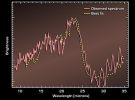
Graph-PIA07395.jpgLooking back...129 visiteThis graph, or spectrum, shows the light from a dusty, distant galaxy (invisible to optical telescopes) that is located 11 BLY away. NASA's SST was able to capture the light from it by using heat-seeking infrared eyes. Spectra are created when a spectrograph spreads light out into its basic parts, like a prism turning sunlight into a rainbow. The spectra contain the signatures of molecules that contribute to an object's light. In this case, the galaxy's spectrum reveals the fingerprint for silicate dust (large dip at right), a planetary building block like sand, only smaller. This particular fingerprint is important because it helps to determine how far away the galaxy lies as well as how much the galaxy's light had stretched ("redshifted") during its journey to SST's eyes. Because the universe is expanding, a galaxy's light will shift toward reddish wavelengths as it moves away from us. This galaxy has a redshift of 1,95, meaning that its light travelled for 11 BY before 'hitting" SST's eyes. The presence of the silicate fingerprint is also significant because it implies that galaxies were ripe for planetary formation 11 billion years ago - back to a time when the universe was 3 billion years old. The universe is currently believed to be 13.5 billion years old. This is the furthest back in time that silicate dust has been detected around a galaxy.Mar 07, 2005
|
|

NGC-1427A_-_HST.jpgNGC 1427A - HST84 visite"Honores iniuriaeque vulgi in promiscuo habendae: nec his dolendum, nec illis gaudendum"
(Tacito)
"I plausi e le offese che arrivano dalle masse devono valutarsi in maniera simile: (poichè) delle seconde, non ci si deve offendere; (e) dei primi, non bisogna gioire"Mar 04, 2005
|
|

NGC-2170-2.jpgNGC 2170 - Diffuse Nebula or Supernova Remnant (RN type) in Monoceros 115 visite"Il binomio Vita=Consapevolezza, tanto caro non solo alla Vostra Scienza, ma anche a molte Religioni Umane, è errato e fuorviante. Lo è poichè esistono infinite forme di Vita, nell'Universo, che prescindono dalla consapevolezza, almeno nel senso in cui la intendete Voi, e cioè "Coscienza di sè" e del proprio "essere". Coscienza di esistere. La Vita non ha bisogno di queste costruzioni pseudo-scientifiche e vagamente mistiche. La Vita, sulla Terra e nel resto dell'Universo, è solo un fatto: essa esiste. Se foste capaci di vedere oltre le costruzioni erette dal senso comune e dalla razionalità (gli orrendi limiti che avete imposto alla vostra capacità di comprendere), allora - forse - non rifiutereste a priori l'idea che l'intero Creato è "vivo"!
Già. Ma se foste capaci di superare quei limiti, come fareste a deantropocentrizzare il "vostro" Universo? Come spiegare agli uomini che non siete gli Eletti, nè i Padroni del Cielo e della Terra; nè le prove viventi di un Pensiero Divino fatto solo per voi?..."
P.C. Floegers - "Conversations"Mar 03, 2005
|
|

NGC-1531_and_NGC-1532.jpgNGC 1531 and 1532 - Interacting Galaxies79 visite"Le maggiori difficoltà che incontriamo, a livello scientifico, allorchè tentiamo di comprendere alcuni fenomeni, non derivano soltanto dalla complessità dei temi affrontati, ma anche da un errore di prospettiva. La comprensione dei fenomeni dell'Universo, infatti, presuppone anche la consapevolezza che non tutto può essere spiegato usando solo le nostre facoltà logiche ed intuitive: l'umana capacità di comprendere è grande ma non è infinita, mentre la Natura che investighiamo lo è. Ad esempio: la Scienza Convenzionale rifiuta l'idea stessa di un possibile contatto fra la nostra Civiltà ed una Civiltà Aliena e questa risposta viene data speculando su concetti propri della nostra Cultura - Scientifica ed Umanistica - quali il Tempo e la Distanza. Questi due concetti esprimono dei limiti: limiti propri della nostra Specie, in questa fase evolutiva.
Ma cosa spinge i Maestri della nostra Scienza Convenzionale a ritenere che questi limiti sìano validi in tutto l'Universo?"
P. C. Floegers - "Conversations"Mar 01, 2005
|
|

M2-9 Planetary Nebula.jpgThe "M2-9 Planetary Nebula" (HST)150 visite"...Omnis feret omnia tellus..."
(Virgilio)
"...Ogni terra produrrà ogni specie di frutti..." Feb 27, 2005
|
|
| 1039 immagini su 87 pagina(e) |
 |
|
|
|
|
67 | |
|
|
|
|








