| Ultimi arrivi - Deep Sky Objects |

CygnusX1.jpgCygnus X-1 and Cygnus OB399 visiteDa "NASA - Picture of the Day" del 2 Aprile 2005:"The formation of a Black Hole from the collapsing core of a massive star is thought to be heralded by a spectacular supernova explosion. Such an extremely energetic collapse is also a leading explanation for the mysterious cosmic Gamma-Ray bursts. But Researchers now suggest that the Milky Way's most famous black hole, Cyg X-1, was born when a massive star collapsed without any supernova explosion at all. Their dynamical evidence is summarized in this color image of a region in Cygnus, showing Cyg X-1 and a cluster of massive stars (yellow circles) known as Cygnus OB3. Arrows compare the measured direction and speed of Cyg X-1 and the average direction and speed of the massive stars of Cyg OB3. The similar motions indicate that Cyg X-1's progenitor star was itself a cluster member and that its path was not altered at all when it became a Black Hole. In contrast, if Cyg X-1 were born in a violent supernova it would have likely received a fierce kick, changing its course. If not a supernova, could the formation of the Cyg X-1 black hole have produced a dark gamma-ray burst in the Milky Way? ".Apr 02, 2005
|
|
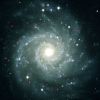
M 74~1.jpgUltraluminous X-Ray sources in M 74108 visiteDa "NASA - Picture of the Day" del 30.03.2005:"In visual appearance, M74 is a nearly perfect face-on spiral galaxy, about 30 million LY away toward the constellation Pisces. The red blotches seen in this composite view are ultraluminous x-ray sources (ULXs) mapped by the Chandra X-ray Observatory. The ULXs are so called because they actually do radiate 10 to 1.000 times more x-ray power than "ordinary" x-ray binary stars, which harbor a neutron star or stellar mass black hole. In fact, watching these ULXs change their x-ray brightness over periods of 2 hours or so, astronomers conclude that ULXs could well be intermediate mass black holes - black holes with masses 10.000 times or so greater than the Sun, but still much less than the million solar mass black holes which lurk in the centers of large spiral galaxies. How did these intermediate mass black holes get there? One intriguing suggestion is that they are left over from the cores of much smaller galaxies that are merging with spiral galaxy M74".Mar 30, 2005
|
|
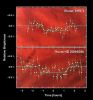
PlanetsLight-PIA07491.jpgThe language of "Planetary Light"70 visiteThis graph of data from NASA's SST shows changes in the infrared light output of 2 star-planet systems located hundreds of LY away. The data were taken while the planets, called HD 209458b and TrES-1, disappeared behind their stars in what is called a "secondary eclipse." The dip seen in the center of each graph represents the time when the planets were eclipsed, and tells astronomers exactly how much light they emit.
Why a secondary eclipse? When a planet transits, or passes in front of, its star, it partially blocks the light of the star. When the planet swings around behind the star, the star completely blocks its light. This drop in total light can be measured to determine the amount of light coming from just the planet.
Why infrared? In visible light, the glare of a star overwhelms its planetary companion and the little light the planet reflects. In infrared, a star shines less brightly and its planet gives off its own internal light, or heat radiation, making the planet easier to detect. By observing these secondary eclipses at different infrared wavelengths, astronomers can obtain the planet's temperature, and, in the future, they may be able to pick out chemicals sprinkled throughout a planet's atmosphere. The technique also reveals whether a planet's orbit is elongated or circular".Mar 29, 2005
|
|

VisibleandInvisible-PIA07490.jpgBlinded by the Light...130 visite"...Grande solacium est cum Universo rapi..."
(Seneca)
"…E' di grande conforto sapere che la nostra natura mortale è condivisa da tutto quanto esiste nell'Universo…"Mar 27, 2005
|
|

Simeis 147-1.jpgSimeis 147 - Supernova remnant134 visite"...Placeat homini quicquid Deo placuit..."
(Seneca)
"...Che l'uomo accetti ciò che a Dio piacque..."Mar 24, 2005
|
|

Puppis A.jpgPuppis A - supernova remnant95 visite"...Qui nescit tacere nescit et loqui..."
(Seneca)
"...Chi non è capace di tacere, non sa neppure parlare..."Mar 23, 2005
|
|

NGC-6960-1.jpgNGC 6960 - Veil Nebula126 visite"...Nescire, quid ante quam natus sis acciderit, id est semper esse puerum..."
(Cicerone)
"...Sarà sempre fanciullo colui il quale riesca ad ignorare tutto quanto accadde prima della sua nascita..."
(sentenza ironica per additare coloro che, non sapendo nulla del passato e della storia, non possono dire di saper nulla nemmeno di loro stessi)Mar 23, 2005
|
|

NGC-2736-0.jpgNGC 2736 - the "Pencil Nebula" (inside "Vela Nebula")72 visite"...Tu pensi che conoscere il futuro sia un dono meraviglioso, capace di cambiare la tua Vita e di trasformarla in qualcosa di diverso: qualcosa di formidabile e di solo tuo.
E su qualcosa hai ragione: conoscere il futuro cambia la tua Vita e la trasforma in qualcosa di diverso.
Ma su qualcosa sbagli.
Conoscere il futuro ti rende prigioniero. Prigioniero di un Destino già scritto, ma che sei capace di accettare solo se ti piace.
Se ti piace, allora quel Destino lo agogni. Lo culli. Lo aspetti con ansietà e trepidazione.
Ma se non ti piace, allora la Vita - TUTTA la tua Vita! - diventa un incubo.
Un continuo guardare l'orologio ed un continuo domandarsi se ne valeva la pena. La pena.
La pena di fare cosa? ... Di fare le cose che sono state fatte? O forse di non farle? Di dire le cose dette o forse di non dirle?
Valeva forse la pena, di conoscere il futuro?
Valeva forse la pena, di camminare su questa Terra?
Valeva forse la pena, di vivere questa Vita?!?..."
P.C. Floegers - "In the Paradox" Mar 23, 2005
|
|

Westerlund Star Cluster.jpgWesterlund Star Cluster85 visite"…Sebbene la mia esperienza e la Scienza, di cui sono devoto servitore da anni ed anni, mi suggeriscano di non credere, sono costretto ad ammettere che un'eventuale 'non esistenza' di Dio sarebbe, fra le tragedie dell'Umanità e del Cosmo, di certo la più grande…"
Paolo Catello FiengaMar 23, 2005
|
|

NGC-2266.jpgNGC 2266 - Open Star Cluster76 visiteDa "NASA - Picture of the Day" del 19 Marzo 2005:" The New General Catalog of star clusters and nebulae really isn't so new. In fact, it was published in 1888 - an attempt by J. L. E. Dreyer to consolidate the work of astronomers William, Caroline and John Herschel along with others into a useful single, complete catalog of astronomical discoveries and measurements. Dreyer's work was successful and is still important today as this famous catalog continues to lend its "NGC" to bright clusters, galaxies and nebulae. Take for example this star cluster known as NGC 2266 (item number 2.266 in the NGC compilation). It lies about 10.000 LY distant in the constellation Gemini and represents an open or galactic cluster. With an age of about 1 BY, NGC 2266 is old for a galactic cluster. Its evolved red giant stars are readily apparent in this gorgeous three-color image".Mar 19, 2005
|
|
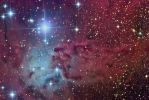
S Mon~0.jpgNGC 2264 - S Mon and the "Fox-Fur Nebula"126 visite"...Questa Società non ha centri di potere e non possiede alcun tipo di organizzazione nel senso terrestre del termine poichè, pur esistendo gli - ed essendo fatta da - individui, non esiste ciò che noi chiamiamo "coscienza individuale".
Ogni singolo "partecipante" (è una brutta espressione, ma è la più appropriata in un tale contesto) di questa Civiltà esiste solo in quanto 'parte di un tutto'; in quanto porzione - necessaria, ma non indispensabile - di un "corpo maggiore" al quale egli accede e con il quale si confonde e si annulla.
Noi non sappiamo se questo tipo di architettura psicologica e sociale sia originaria oppure se sia, in qualche modo, derivata da una serie di 'esperimenti organizzativi' precedenti.
Non sappiamo se sia una "scelta", oppure una "necessità".
Ciò che sappiamo è che questa Civiltà esiste da almeno cinque miliardi di anni terrestri e la sua "coscienza", se così possiamo chiamarla, si estende sino ai confini dell'Universo..."
P.C. Floegers - "Cronache di Viaggio"Mar 14, 2005
|
|

Accretion Disc Sim..jpgAccretion Disk's Computer Simulation343 visiteSebbene apparentemente familiare, quest'immagine potrebbe rivelarsi ingannevole: non stiamo contemplando, infatti, la struttura "a mulinello" di una lontana galassia, bensì le onde d'urto spiraliformi di un cosiddetto "Disco di Accrescimento", in una versione virtuale e tridimensionale.
Il "Disco di Accrescimento" non è altro che del materiale in rapida orbita intorno ad un corpo centrale estremamente compatto quale può essere, ad esempio una Nana Bianca, o una Stella a Neutroni oppure un Buco Nero.
Questi "Dischi", di regola, si formano all'interno di Sistemi Stellari Binari costituiti da una stella che "cede" materiale (donor) ed un "corpo" dotato di immensa capacità attrattiva che, invece, tale materiale lo assorbe (receiver).
Il prodotto tangibile di questa interazione (alla fine "distruttiva" per la stella donante) si manifesta attraverso la creazione di potenti sorgenti di Raggi-X (forse generate dallo stesso "Disco di Accrescimento") le quali, talvolta, vengono captate dai nostri radio-telescopi.Mar 12, 2005
|
|
| 1039 immagini su 87 pagina(e) |
 |
|
|
|
|
66 | |
|
|
|
|








