| Ultimi arrivi - Deep Sky Objects |
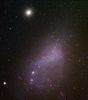
SmallMagellanCloud.jpgSmall Magellanic Cloud, NGC 362 and 47 Tucanae83 visiteDa "Astronomy Picture of the Day" del 17 Giugno 2005:"Portuguese navigator Ferdinand Magellan and his crew had plenty of time to study the southern sky during the first circumnavigation of planet Earth.
As a result, two celestial wonders easily visible for southern hemisphere skygazers are known as the Clouds of Magellan. These cosmic clouds are now understood to be dwarf irregular galaxies, satellites of our larger spiral Milky Way Galaxy. The Small Magellanic Cloud pictured above actually spans 15.000 LY or so and contains several hundred million stars. About 210.000 LY distant in the constellation Tucana, it is the forth closest of the Milky Way's known satellite galaxies, after the Canis Major and Sagittarius Dwarf galaxies and the Large Magellanic Cloud. This gorgeous view also includes two foreground globular, star clusters NGC 362 (top left) and 47 Tucanae. Spectacular 47 Tucanae is a mere 13.000 LY away and seen here to the right of the Small Magellanic Cloud".Giu 17, 2005
|
|

SNR-Cassiopeia_A-SST.jpgCassiopeia A from Spitzer Space Telescope136 visite"...Words...Words like 'Infinity,' or 'God,' 'Eternity,' 'Spirit,' and so on, many others, for which equivalents exist in almost every language in the world, are not the expression of an Idea at all.
They simply express the effort to arrive at this Idea...They express the maximum possible effort to define a concept whose definition is impossible...."
(Traduzione)
"...Parole...Parole come 'Infinito', oppure 'Dio', 'Eternità', 'Spirito' e così via tante altre ancora, di cui esistono equivalenti in quasi tutte le lingue del Mondo, non sono affatto l'espressione di un'Idea.
Esse si limitano ad esprimere lo sforzo di arrivare, a questa Idea...Esse esprimono il massimo sforzo possibile per giungere a definire un concetto la cui definizione è impossibile..."
E.A. Poe - "Eureka"Giu 15, 2005
|
|

Gliese 876.jpgGliese 876 and an alien Planetary System277 visite"...La capacità di ospitare Forme di Vita e di Intelligenza Consapevole non è ovviamente una caratteristica nè una prerogativa unica del nostro mondo, della nostra splendida Terra.
L'unica prerogativa del nostro Pianeta è quella di ospitare delle Forme di Vita che, nella loro immensa arroganza (davvero 'unica', senza dubbi...), si ritengono, in qualche modo, un'eccezione dell'Universo..."
P.C. Floegers - "In the Paradox"
Caption NASA originale:"Is our Earth unique? In continuing efforts to answer this question, astronomers have now discovered an Earth-like planet orbiting a distant normal star. Previously over 150 gas-giant planets like Jupiter had been so discovered. Slight, fast, but regular wobbles of nearby small M-dwarf star Gliese 876 showed evidence for a planet with a likely mass slightly higher than a minimum six times the mass of Earth. The planet's small mass indicates that it is likely terrestrial in nature, similar in composition to the inner planets of our Solar System. If indeed made predominantly of rock, the planet's surface gravity would not even be able to contain the gasses of a Jupiter-like planet. The newly discovered planet would not make a good vacation spot for humans, however, as it orbits so close that the surface temperature probably tops a searing 200 degrees Celsius. The system is illustrated in the above drawing as seen from a hypothetical moon orbiting one of the two Jupiter-like planets already known. The newly discovered terrestrial-like planet is depicted in the insert. Gliese 876 lies only 15 light-years away and is visible with binoculars toward the constellation of Aquarius".Giu 14, 2005
|
|

N63A-2-SR.jpgN63A - Supernova Remnant139 visiteWhat has this supernova left behind? As little as 2.000 years ago, light from a massive stellar explosion in the Large Magellanic Clouds (LMC) first reached planet Earth. The LMC is a close galactic neighbor of our Milky Way Galaxy and the rampaging explosion front is now seen moving out - destroying or displacing ambient gas clouds while leaving behind relatively dense knots of gas and dust. What remains is one of the largest supernova remnants in the LMC: N63A. Many of the surviving dense knots have been themselves compressed and may further contract to form new stars. Some of the resulting stars may then explode in a supernova, continuing the cycle. Pictured above is a close-up of one of the largest remaining knots of dust and gas in N63A taken by the orbiting Hubble Space Telescope. N63A spans over 25 light years and lies about 150.000 LY away toward the southern constellation of Dorado.Giu 08, 2005
|
|

NGC-3718-1.jpgNGC 3718, NGC 3729 and Hickson Group 56A72 visite"...Una Società dove le derive emozionali e le smanie di potere dei Gruppi di Comando - politici od economici - sono da sole in grado di stabilire ed imporre, con il plauso della Collettività, i 'Modelli Individuali' da imitare ed i 'Valori Comuni' di riferimento, è una Società malata, marcia e senza più alcuna speranza, ormai pronta a soccombere a causa della sua stessa insipienza..."
Paolo Catello FiengaGiu 07, 2005
|
|

UFO-2-PIA07250.jpgFar distant galaxies and a UFO in front of the GALEX telescope! (2)102 visite"...Hoc volo, sic iubeo, sit pro ratione voluntas..."
(Giovenale)
"...Questo voglio, così giudico e che la mia volontà sia legge..."
(nota: questo motto venne espresso davanti a Luigi XI - un autentico cultore di questo 'Trittico della Volontà - da parte di Carlo il Temerario il quale, a sua volta, anteponeva ad ogni ragione o decenza il suo volere, quale che fosse - De Barante "Histoire des Ducs de Bourgogne")Giu 05, 2005
|
|

UFO-1-PIA07250.jpgFar distant galaxies and a UFO in front of the GALEX telescope! (1)99 visiteCaption NASA originale:"Galaxies aren't the only objects filling up the view of NASA's Galaxy Evolution Explorer. Since its launch in 2003, the space telescope (originally designed to observe galaxies across the universe in ultraviolet light) has discovered a festive sky blinking with flaring and erupting stars, as well as streaking asteroids, satellites and space debris. One such streaking object - possibly an Earth-orbiting satellite - can be seen here flying across the telescope's sight.
This probable satellite appears during the last 5' of a 13,5' observation. It looks elongated because each picture frame containing the moving object is 19" long. Faint ghost images on either side of the source are detector artifacts caused by the object's extreme brightness. These 'Bonus Objects' are being collected in to Public Catalogues for other Astronomers to study".
Bonus Objects. Un nuovo modo di classificare gli UFO? Un frame intrigante ed un commento ufficiale asciutto, ma possibilista: qualcosa si muove?!?Giu 05, 2005
|
|

Eta Carinae - SST.jpgEta Carinae - SST134 visite"...Saepe etiam sub palliolo sordido Sapientia est..."
(Cecilio Stazio)
"...Sovente l'Intelligenza può trovarsi anche sotto un vecchio abito..."Giu 02, 2005
|
|

WhiteDwarf.jpgWhite Dwarf153 visite"...Urbes constituit aetas, hora dissolvit. Momento fit cinis, diu silva..."
(Seneca)
"…Un lungo tempo ci volle per creare le citta, un istante per distruggerle. Ed in un istante la secolare foresta, divenne cenere…"
(Una considerazione sul Tempo 'consumatore di tutte le cose' - incluse le grandi opere della Natura e dell'Uomo? Non pensiamo.
Secondo noi si tratta dell'efficace descrizione di una catastrofe, tanto subitanea, quanto inaspettata. Forse la cronaca delle conseguenze dell'impatto di una meteora? Forse Seneca ci racconta, a modo suo, di un'altra "Tunguska", occorsa più di duemila anni orsono...)Giu 01, 2005
|
|

Sagittarius~0.jpgThe "Sagittarius' Dwarf Tidal Stream"122 visiteDa "NASA - Picture of the Day" del 29 Maggio 2005:"Recent 'Wide Field Images' and analyses indicate that our home galaxy is actually still in the process of devouring one of its closer satellite neighbors.
This unfortunate neighbor, the Sagittarius Dwarf Galaxy, is now seen to be part of a larger Sagittarius Tidal Stream, a loose filament of stars, gas, and possibly dark matter that entangles the Milky Way. Speculation also holds that the Sagittarius Dwarf was once pulled through the Milky Way disk very close to our Sun's current location. An important resulting realization is that galaxies contain a jumble of clumps and filaments of both dim and dark matter".
Che sia questo residuo di onda mareale - o forse si tratta di un corpo oscuro 'dimenticato'? - la causa delle strane ed apparentemente inspiegabili accelerazioni e decelerazioni del Voyager, ormai giunto agli estremi confini dell'area di influenza mareale del Sole?
O forse non è poi così facile riuscire a "mollare gli ormeggi solari"?...Mag 29, 2005
|
|

IC-4678.jpgIC 4678 - Sagittarius Region129 visite"...If Watson and Crick had not discovered the nature of DNA, one can be virtually certain that other scientists would eventually have determined it.
With Art - whether painting, music or literature - it is quite different.
If Shakespeare had not written 'Hamlet', no other playwright would have done so..."
Lewis Wolpert - "The Unnatural Nature of Science"Mag 24, 2005
|
|

Barnard-072-SNAKE-NEBULA.jpgBarnard 72 - The "Black Snake Nebula"160 visiteCaption NASA originale:"Dark nebulae snake across a gorgeous expanse of stars in this wide-field view toward the constellation Ophiucus and the center of our Milky Way Galaxy. In fact, the central S-shape seen here is well known as the "Snake Nebula". It is also listed as Barnard 72 (B72), one of 182 dark markings of the sky cataloged in the early 20th century by astronomer E. E. Barnard. Unlike bright emission nebulae and star clusters, Barnard's nebulae are interstellar dark clouds of obscuring gas and dust. Their shapes are visible in cosmic silhouette only because they lie in the foreground along the line of sight to rich star fields and glowing stellar nurseries near the plane of our Galaxy. Many of Barnard's dark nebulae are themselves likely sites of future star formation. Barnard 72 is a few light years across and about 650 light years away".Mag 21, 2005
|
|
| 1039 immagini su 87 pagina(e) |
 |
|
|
|
|
63 | |
|
|
|
|








