| Ultimi arrivi - Deep Sky Objects |

Eta Carinae - HST-1.jpgEta Carinae (HR-HST)81 visite"...Si charta cadit, tota scientia vadit..."
(anonimo medioevale)
"...Se la carta cade, la scienza evade..."
Frase fortemente ironica usata per indicare coloro che non sono capaci né di improvvisare, né di "spiccicare quattro parole" su un qualsiasi tema senza essere dotati di note, cartelle ed appunti vari, per lo più preparati da altri. Mar 26, 2006
|
|

NGC-2237_and_NGC-2244-03.jpgNGC 2237 - The "Rosette Nebula", and Globular Star Cluster NGC 224478 visite"...Ho visto sedere il povero e l'affamato alla mensa del ricco, ed essere sfamati. Ho potuto osservarli, mentre mangiavano, e bevevano, e si saziavano: ho potuto fare questo.
Ma né il povero, né l'affamato, anche se ricevettero cibo a sazietà, mentre erano seduti alla mensa del ricco, li ho visti - realmente - grati e felici..."
"...Le uniche gioie altrui che possiamo dire di condividere realmente, sono quelle che noi già possediamo o che non ci interessa possedere..."
Paolo C. FiengaMar 24, 2006
|
|
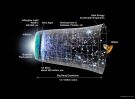
Timeline.jpgThe Timeline of the Universe83 visiteThe Universe is expanding gradually, now, but its initial expansion was almost impossibly rapid as it likely grew from quantum scale fluctuations in a trillionth of a second. In fact, this cosmological scenario - known as "Inflation" - is now reported to be further quantified by an analysis of 3 years of data from the WMAP Spacecraft. WMAP's instruments detect the Cosmic Microwave Background Radiation - such as the afterglow light from the early Universe. WMAP's amazing success in exploring the first trillionth of a second and favoring specific inflationary scenarios, lies in its ability to make unprecedented, precise measurements of the properties of the Microwave Background. The subtle properties are distilled from conditions in the early Universe and related to its first moments of existence. Schematically, this diagram traces the 13,7 BY (plus a trillionth of a second) history of the Universe from the quantum scale to the formation of stars, galaxies, planets and WMAP itself.Mar 23, 2006
|
|

Coma Cluster.jpgThe "Coma Cluster"74 visite"...Afflictis longae, celeres gaudentibus..."
(Indovinello - "Sono lunghe per i sofferenti; brevi per coloro che si divertono")Mar 21, 2006
|
|

Binary Brown Dwarf System-2.jpgBinary "Brown Dwarf" System98 visite"...Ingenium mala saepe movent..."
(Ovidio)
"...Sovente sono le difficoltà a spingere l'inventiva..."Mar 17, 2006
|
|
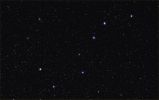
Big Dipper-1.jpgBig Dipper88 visite"...Solem e Mundo tollere videntur qui Amicitiam e Vita tollunt..."
(Cicerone)
"...Coloro che vogliono bandire l'Amicizia dalla Vita sono le stesse persone che vorrebbero cancellare il Sole dal Giorno..."
Caption originale:"A well-known asterism in Northern Skies, The Big Dipper is easy to recognize even when viewed upside down. Part of the larger constellation of Ursa Major, the bright dipper stars above are named Dubhe, Merak, Phecda, Megrez, Alioth, Mizar/Alcor and Alkaid.
Of course, stars in any given constellation are unlikely to be physically related. But surprisingly, most of the Big Dipper stars do seem to be headed in the same direction as they plough through space, a property they share with other stars spread out over an even larger area across the sky. Their measured common motion suggests that they all belong to a loose, nearby star cluster, thought to be on average only about 75 LY away and up to 30 LY across. The cluster is more properly known as the Ursa Major Moving Group".Mar 17, 2006
|
|

NGC-3324-2.jpgNGC 3324 - Tthe "Keyhole Nebula", and NGC 3372, the "Great Carina Nebula"74 visite"...Dum Fortuna favet, parit et taurus vitulum..."
(Binder)
"...Quando la Sorte è propizia, un toro può anche partorire un vitello..."Mar 16, 2006
|
|
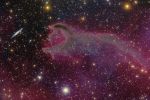
CG-4.jpgCometary Globule (CG) - 4110 visite"...Esistono molte forme di Consapevolezza. Ci sono dei momenti, in cui si è più sensibili, in cui il proprio intuito è più vasto e profondo. Uno dei poteri dell’Arte è rendere più grande e profonda, in modi diversi, la Consapevolezza di una persona, che si tratti di Consapevolezza Estetica, Morale o Mistica. Questa è una funzione anche della Scienza e della Filosofia: favorire forme di Consapevolezza intellettuale più ampie e profonde. Una persona ha degli stati d’animo, o degli umori, nei quali la Consapevolezza sembra espandersi e farsi più comprensiva, accogliente, generosa, sensibile e anche particolareggiata, mentre in altre occasioni sembra restringersi. L’educazione andrebbe considerata come educazione alla Consapevolezza, e non solo come l’insegnamento delle varie professioni.
Ogni contatto umano ha il potenziale di cambiare la Consapevolezza, perché ci s’imbatte in una concezione ed una costruzione del mondo diverse dalla propria..."
Oliver Sacks
Caption originale:"The odd looking "creature" in the center of the above photo is a gas cloud known as a cometary globule. This globule, however, has ruptured. Cometary globules are typically characterized by dusty heads and elongated tails. These features cause cometary globules to have visual similarities to comets, but in reality they are very much different. Globules are frequently the birthplaces of stars, and many show very young stars in their heads. The reason for the rupture in the head of this object is not completely known. The galaxy to the left of center is huge, very far in the distance, and only placed near CG4 by chance superposition".Mar 14, 2006
|
|

Z machine_sandia_big-1.jpgThe Heart of a Star...On Earth: the Z Machine139 visiteWhy is this plasma so hot? Physicists aren't sure. What is known for sure is that the Z Machine running at Sandia National Laboratories created a plasma that was unexpectedly hot. The plasma reached a temperature in excess of two billion Kelvin (!), making it arguably the hottest human made thing ever in the history of the Earth and, for a brief time, hotter than the interiors of stars. The Z Machine experiment, pictured above, purposely creates high temperatures by focusing 20 million amps of electricity into a small region further confined by a magnetic field. Vertical wires give the Z Machine its name. During the unexpected powerful contained explosion, the Z machine released about 80 times the world's entire electrical power usage for a brief fraction of a second. Experiments with the Z Machine are helping to explain the physics of Solar flares, design more efficient nuclear fusion plants, test materials under extreme heat, and gather data for the computer modeling of nuclear explosions. Mar 13, 2006
|
|

Centaurus A-SST-1.jpgCentaurus A - SST (HR)74 visite"...Nusquam tuta Fides..."
(Virgilio)
"...La Fede non è al sicuro in alcun luogo..."Mar 04, 2006
|
|

AE Aurigae and IC 405.jpgAE Aurigae and IC 405150 visite"...Mi diverte leggere le riflessioni di coloro che cercano nei Complotti Globali e nelle Società Segrete i responsabili della costante rovina del nostro Mondo.
Mi diverte perché queste persone, se solo avessero un filo di sensibilità (e dovrei dire di intelligenza) in più, riuscirebbero anche a capire che, quando qualcosa non funziona intorno a loro, prima di guardare altrove e - magari - "puntare il dito verso i fantasmi", dovrebbero dimostrare di possedere almeno un minimo di senso critico, di coraggio e di buon senso, e quindi iniziare con il guardarsi dentro..."
Paolo Catello Fienga - "Scritti di Cronaca e Sociale"Feb 28, 2006
|
|

GRB-060218.jpgA "Transient" Gamma Ray Burst (GRB-060218)110 visiteSomething is happening in a small portion of the sky toward the constellation of Aries and telescopes around the globe are tracking an unusual Transient there as it changes day by day. No one is sure what it will do next. The entire space mystery began on Feb. 18 when the Earth-orbiting Swift Satellite noticed an unusual Transient began to glow dimly in Gamma Rays. Dubbed GRB-060218, the object is a type of GRB but the way its brightness changes is very unusual. Since detection, GRB-060218 has been found to emit light across the whole electromagnetic spectrum, including radio waves and visible light. Above: Sx -> the Sloan Digital Sky Survey image of the field of GRB-060218 well prior to its Swift trigger and Dx -> the same field, taken by the orbiting Swift Satellites' UV-Telescope after the Swift trigger.
The oddball GRB is visible in the center of the right image. Subsequent observations found a redshift for the transient of z=0.033, showing it to be only about 440 MLY away, relatively nearby, compared to typical GRBs. Whether GRB 060218 represents a new type of gamma ray burst, a new type of supernova, or an unusual link between the GRBs and supernovas has become an instant topic of research.Feb 27, 2006
|
|
| 1039 immagini su 87 pagina(e) |
 |
|
|
|
|
48 | |
|
|
|
|








