| Ultimi arrivi - Deep Sky Objects |

M-42_and_M-78.jpgSouthern Orion: from the "Belt" to the "Witch"71 visite"...Nec minor est Virtus, quam quaerere, parta tueri; Casus illic inest, hoc artis opus erit..."
(Ovidio)
"...Il conservare le cose richiede una Virtù non minore di quella che serve per crearle e per metterle assieme; tuttavia, se nella creazione e nell'unione delle cose, il Caso può essere di proficuo aiuto, per la loro appropriata conservazione occorre senz'altro il Sapere..." (trad. libera)MareKromiumApr 08, 2008
|
|

NGC-2808-1.jpgNGC 2808 - Omega Centauri (Globular Star Cluster)75 visite"...In culpa est animus, qui se non effugit unquam..."
(Orazio)
"...Un animo consapevole non può sfuggire a sè stesso..." (trad. libera)
Nota per i Lettori: ho tradotto "in culpa" come se stesse a significare "nella consapevolezza".
Non è una svista, ma una semplice interpretazione personale.MareKromiumApr 05, 2008
|
|

NGC-2808-The_Region.jpgLooking towards the Centaurus Region77 visite"...Vetera extollimus, recentium incuriosi..."
(Tacito)
"...Magnifichiamo l'antichità e trascuriamo l'attualità..."
Nota: oggi, A.D. 2026, Luglio 31, mi pare che si faccia esattamente l'opposto. E pure male.MareKromiumApr 05, 2008
|
|

HD-189733b.jpgHD-189733b - Exoplanet in Vulpecula79 visite"...Saepe condita luporum fiunt rapinae vulpium..."
(Proverbio Medioevale)
"...Sovente le volpi riescono a sottrarre anche le prede nascoste dai lupi..." (trad. libera)MareKromiumApr 05, 2008
|
|

HD-189733b-PIA10364.jpgHD-189733b - Exoplanet in Vulpecula72 visite"...Vulpes non capitur muneribus..."
(Proverbio Medioevale)
"...L'astuzia non si lascia vincere (non la si può corrompere) dai (con) regali..." (trad. libera)MareKromiumApr 05, 2008
|
|
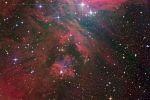
SpaceWaterfall.jpgOrion's Waterfall (NGC 1999 and HH Objects 222 and 401)77 visite"...Non duce Tempus eget..."
(Lucano)
"...Il Tempo non ha bisogno di qualcuno che lo guidi..." (trad. libera)MareKromiumApr 03, 2008
|
|

Gravitational_Lensing-01.jpgGravitational Lensing and "Light Distortion"72 visite"...Noi continuiamo a definire, reputare e trattare il Tempo e lo Spazio come ed in quanto Misure Lineari.
Questo, a mio parere, equivale a dire che non solo le nostre basi sono fatiscenti, ma altresì che noi non abbiamo la minima idea di che cosa il Tempo e lo Spazio siano effettivamente...
Comunque sia, dobbiamo aspettare.
La Verità, nella Vita come nella Scienza, alla fine si automanifesta e si dimostra da sola, nonostante tutto e tutti..."
Paolo C. Fienga (appunti)MareKromiumMar 31, 2008
|
|
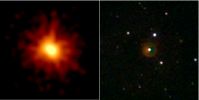
GRB-080319b_Swift_2panel.jpgGRB-080391B82 visite"...Habet et musca splenem et formica bilem..."
(Binder)
"...Anche le creature più piccole hanno i loro istanti di grande collera..." (trad. libera)MareKromiumMar 28, 2008
|
|

NGC-3576.jpgNGC 3576 - Star Forming Region71 visite"...The Earth is the Lord's and all that is in it,
The World, and those who live in it;
For He has founded it on the Seas,
And established it on the Rivers..."
- Psalm 24:1-2MareKromiumMar 27, 2008
|
|
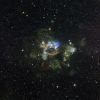
N-44.jpgThe N44 Complex74 visite"...I commune with my heart in the night; I meditate and search my Spirit..."
- Psalm 77:6MareKromiumMar 27, 2008
|
|

HD-189733b-1.jpgExtra-Solar Planet HD 189733b71 visiteNASA's Hubble Space Telescope (HST) has made the first detection ever of an organic molecule in the atmosphere of a Jupiter-sized planet orbiting another star. This breakthrough is an important step in eventually identifying signs of life on a planet outside our Solar System.
The molecule found by Hubble is Methane, which under the right circumstances can play a key role in prebiotic chemistry — the chemical reactions considered necessary to form life as we know it.
This discovery proves that Hubble and upcoming space missions, such as NASA's James Webb Space Telescope, can detect organic molecules on planets around other stars by using spectroscopy, which splits light into its components to reveal the "fingerprints" of various chemicals.
"This is a crucial stepping stone to eventually characterizing prebiotic molecules on planets where life could exist," said Mark Swain of NASA's Jet Propulsion Laboratory (JPL), Pasadena, Calif., who led the team that made the discovery. Swain is lead author of a paper appearing in the March 20 (2008) issue of Nature.
The discovery comes after extensive observations made in May 2007 with Hubble's Near Infrared Camera and Multi-Object Spectrometer (NICMOS). It also confirms the existence of water molecules in the planet's atmosphere, a discovery made originally by NASA's Spitzer Space Telescope in 2007. "With this observation there is no question whether there is water or not — water is present", said Swain.
The planet now known to have Methane and water is located 63 Light-Years away in the constellation Vulpecula. Called HD 189733b, the planet is so massive and so hot it is considered an unlikely host for life. HD 189733b, dubbed a "hot Jupiter", is so close to its parent star it takes just over two days to complete an orbit. These objects are the size of Jupiter but orbit closer to their stars than the tiny innermost planet Mercury in our solar system.
HD 189733b's atmosphere swelters at 1700 degrees Fahrenheit, about the same temperature as the melting point of Silver.
Though the star-hugger planet is too hot for life as we know it, "this observation is proof that spectroscopy can eventually be done on a cooler and potentially habitable Earth-sized planet orbiting a dimmer red dwarf–type star," Swain said. The ultimate goal of studies like these is to identify prebiotic molecules in the atmospheres of planets in the "habitable zones" around other stars, where temperatures are right for water to remain liquid rather than freeze or evaporate away.
The observations were made as the planet HD 189733b passed in front of its parent star in what astronomers call a transit. As the light from the star passed briefly through the atmosphere along the edge of the planet, the gases in the atmosphere imprinted their unique signatures on the starlight from the star HD 189733.
The astronomers were surprised to find that the planet has more Methane than predicted by conventional models for "hot Jupiters".
"This indicates we don't really understand exoplanet atmospheres yet," said Swain. "These measurements are an important step to our ultimate goal of determining the conditions, such as temperature, pressure, winds, clouds, etc., and the chemistry on planets where life could exist. Infrared spectroscopy is really the key to these studies because it is best matched to detecting molecules", said Swain.
Swain's co-authors on the paper include Gautam Vasisht of JPL and Giovanna Tinetti of University College, London/European Space Agency.MareKromiumMar 23, 2008
|
|

HD-189733b-2.jpgExtra-Solar Planet HD 189733b77 visite"...The eye, is the lamp of the body. So, if your eye is healthy, your whole body will be full of light..."
- Matthew, 6:22MareKromiumMar 23, 2008
|
|
| 1039 immagini su 87 pagina(e) |
 |
|
|
|
|
21 | |
|
|
|
|








