| Ultimi arrivi - Mars Spirit Anomalies and Maps |
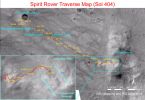
ZO-T-MERA_Traverse_Map_Sol_404-A408R1_br2.jpgThe "march" of Spirit up to Sol 404232 visiteCaption NASA originale:"NASA's Mars Exploration Rover Spirit drove a total of 4.143 meters (about 2,57 miles) between its landing in January 2004 and its 404th Sol (Feb. 20, 2005). This map on an image taken by the Mars Orbiter Camera on NASA's Mars Global Surveyor shows the course the Rover drove during that time. The Rover has recently been approaching a ridge overlooking "Tennessee Valley" on the north flank of "Husband Hill".Feb 26, 2005
|
|

ZZ-ZZ-ZZ-Silver Anomaly-Spirit_Legacy_L256-A392R1.jpgThe "Silver Anomaly" or the "Real Heat-Shield"!799 visiteDallo "Spirit Legacy Panorama" (pubblicato sul Sito NASA "Mars Exploration Rover" il giorno 9 Febbraio 2005) ecco l'Anomalia Argentea che avevamo incontrato molti mesi fa, mentre Spirit era ancora in viaggio verso il Cratere Bonneville e che, a nostro parere, rappresenta la più grande INCONGRUENZA in cui la NASA è incorsa (a proposito di Marte) in tempi recenti: questo è lo Scudo Termico (n.b.: qualcuno di noi ipotizza che possa anche trattarsi della Back-Shell ma noi diciamo NO, è impossibile: guardate le Mappe e vedrete che back-shell e paracadute sono da tutt'altra parte!!!). Mesi fa noi provammo a sentire la NASA, ma non ottenemmo risposta alcuna e l'Anomalia Argentea venne costantemente ignorata. A questo punto, noi crediamo che l'oggetto adagiato sul bordo del Cratere Bonneville NON sia lo Scudo Termico, bensì qualcosa di diverso e, probabilmente, il Dr Feltri ha ragione: il NASA-bluff (uno dei tanti) è forse stato scoperto. Ora ci chiediamo: perchè? Perchè tutte queste bugie dalle gambe brutte e corte?Feb 10, 2005
|
|
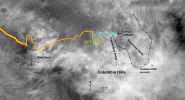
ZO-SPIRIT-SOL354_MERA_MOC-A357R1.jpgApproaching an "overlook"217 visiteThe path of NASA's Mars Exploration Rover Spirit through the rover's 354th martian day, or sol (Dec. 31, 2004), plus some future travel options, are indicated on this map of the "Husband Hill" region of the "Columbia Hills" within Mars' Gusev Crater. The rover team plans to send Spirit to a vantage point dubbed "Larry's Lookout" for views to help in deciding whether to dip into "Tennessee Valley."
The base image for the map was taken by the Mars Orbiter Camera aboard NASA's Mars Global Surveyor. Gen 04, 2005
|
|
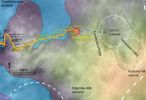
ZN-SOL343-Spirit_travmap_GeoDEM_2-A350R1.jpgThe path of Spirit up to Sol 343233 visiteCaption NASA originale:"As NASA's Mars Exploration Rover Spirit continues to explore the "Columbia Hills" within Gusaev Crater, scientists are planning to take a closer look for layered rocks in a steep valley straight ahead before directing the rover to turn south toward the summit of "Husband Hill." Two of the geologic formations the six-wheeled robotic geologist has discovered during 2004 are shown here. One is labeled "Columbia Hills material," representing bedrock of the higher slopes and peaks, and one is labeled "transition zone material," representing rocks that are gradational in character and composition between the hills to the east and the plains to the west. The map also shows Spirit's line of travel through the rover's 344th Sol (Dec. 21, 2004), beginning on the left edge at about the 182nd Sol (July 7, 2004)".Dic 29, 2004
|
|
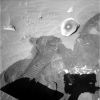
VA-SOL337-2N156285226EFF9952P1811R0M1.jpgCoated stone: natural or artificial? (2)383 visitevedi commento al frame che precedeDic 16, 2004
|
|

VA-SOL337-2N156285226EFF9952P1811L0M1.jpgCoated stone: natural or artificial? (1)664 visiteQuesta è una possibile Anomalia di superficie: guardate la pietra a forma vagamente rettangolare che si trova sulla Sinistra del frame, accanto ad un mucchietto di ciottoli. Non servono occhi eccezionali nè complesse elaborazioni fotografiche per vedere subito che questa "pietra" sembra evidenziare i residui di un rivestimento ormai quasi completamente distrutto, nonchè una curiosa incisione semi-circolare sul suo lato superiore Sn (Dx del sasso per chi guarda) al di sotto della quale si intravedono due scalfitture parallele che, con un modestissimo ingrandimento dell'immagine, sembrano ricordare molto da vicino dei geroglifici. Fantasia? Forse, ma questa immagine ci deve far riflettere. Esaminatela anche Voi e, se volete, diteci che cosa ne pensate...Dic 16, 2004
|
|

ZB-Landing Area-Proto Image-R1502643merA_1mA.jpgLanding Area and main features - cPROTO Image268 visiteUn'immagine ad altissima definizione, ripresa dal Mars Global Surveyor, che ci fa vedere l'area del Cratere Bonneville e tutte le componenti di Spirit (back-shell, paracadute, scudo termico, Lander e Rover), nonchè il "solco" lasciato dalle sue ruote durante la marcia. Fate attenzione: l'immagine è stata ripresa usando la tecnica definita "c-PROTO" la quale ci consente una risoluzione del frame pari a 50 cm per pixel.
Ebbene, nonostante questa spettacolare performance fotografica a noi sembra che nel frame manchi qualcosa. Che cosa? Ci riferiamo all'oggetto "anomalo" che abbiamo definito "Silver Sphere", lo ricordate?!? Ma dove è andato a finire?!?Dic 11, 2004
|
|
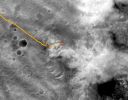
ZM-SOL324_travMOC-A332R1.jpgSpirit's Route in Black and White227 visiteCaption NASA originale:"The Mars Orbital Camera on NASA's Mars Global Surveyor spacecraft took this image of the topography traversed by NASA's Mars Exploration Rover Spirit in months prior to the rover's 318th Sol (Dec. 4, 2004). The yellow line traces the rover's path up to and across the "West Spur" of the Columbia Hills".Dic 08, 2004
|
|

ZL-SOL324_travDEM-A332R1_br2.jpgDigital Elevation Map of Spirit's Trek207 visiteCaption NASA originale: "The blue area represents the basaltic plains on the floor of Gusaev Crater, about 20 meters below the Rover's present location. Spirit crossed those plains for several months after landing to the west, off the left edge of this image. The greenish-blue area is the "West Spur" of the "Columbia Hills," which Spirit reached on sol 156 (June 11, 2004). Since then, Spirit has been gradually ascending the slopes of the "West Spur" in an east-northeasterly direction. Southeast of the Rover's current position is a brighter green area that represents an abrupt increase in slope where the "West Spur" meets the steeper flanks of the "Columbia Hills." The yellow and red areas represent the highest slopes and peaks. A steep valley east of the Rover's location appears, from orbiter images, to have layered outcrops. Scientists are directing the Rover to a ridge overlooking the valley to get a better look at what lies ahead".Dic 08, 2004
|
|

ZR-At the base of the Hills-01-JR-01-husband-A147R1.jpgAt the base of the Hills426 visiteSi tratta di una buona immagine in falsi (?) colori della base delle Columbia Hills, pochi Soles prima dell'inizio dell'ascesa verso alcuni layered crops (tra cui il "Martian Mound" di cui abbiamo già accennato al frame precedente).
C'è un punto interrogativo sul dato (fornito dalla NASA) relativo alla "non veridicità" dei colori i quali, invece, a noi sembrano assolutamente realistici e plausibili. Ma si sa: in questi tempi e su alcuni temi (Marziani e non...), l'unico approccio percorribile, dato che non si riesce ad avere certezze, è quello "logico ed intuitivo". Noi lo sposiamo, tutte le volte in cui ci sembra una scelta onesta (oltre che possibile) ed anche quando esso è l'unica via percorribile.
Voi che ne dite?Ott 22, 2004
|
|

ZZ-Z-Temp. at Bonn. Crat..jpgTemperatures at Bonneville Crater during the Martian Day252 visiteUna mappatura delle temperature approssimative del Cratere Bonneville a diverse ore del giorno. E' un documento da leggere in relazione a quanto visto sia a proposito delle temperature medie di Marte, sia con riguardo ad una simile mappatura fatta per il Cratere Endurance. EccoVi una porzione della caption NASA originale:"...The times of the subsequent frames are 11:49 a.m., 1:35, 2:35 and 4:39 p.m. In this color-coded map, quicker reddening during the day suggests sand or dust. (Red is about 270 Kelvin or 27 deg. Fahrenheit or approx. -3° C). An example of this is in the shallow depression in the right foreground. Areas that stay blue longer into the day have larger rocks. (Blue indicates about 230 Kelvin or -45 deg. Fahrenheit)...".Ott 22, 2004
|
|

ZI-Spirit_traverse_sol238-A256R1.jpgSpirit "Traverse Map" up to Sol 238254 visiteUna Mappa davvero completa (anche se, purtroppo, non è stata rubricata) relativa alla "Traversata Marziana" di Spirit, dal punto di partenza e sino alle pendici delle Columbia Hills.
L'update di questa Traversata giunge sino al Sol 238, ossìa solo 6 giorni prima del radio-black-out (inizio previsto per il Sol 244) causato dal passaggio di Marte dietro al Sole (ovviamente dal punto di vista e rispetto alla posizione della Terra). EccoVi parte della versione originale di commento alla Mappa in oggetto:"...From its landing site, Spirit drove up to the rim of to the rim of Bonneville Crater (on the far left) and to the north rim of Missoula Crater. Then it commenced a long drive across the plains, deviating to avoid large hollows. Upon arrival at the base of the Columbia Hills, Spirit drove north for a short distance before beginning its ascent onto the West Spur, where it is currently located. The scale bar at lower left is 500 meters (1,640 feet). North is up".Set 22, 2004
|
|
| 275 immagini su 23 pagina(e) |
 |
|
|
|
|
15 | |
|
|
|
|








