| Ultimi arrivi - Mars Spirit Anomalies and Maps |
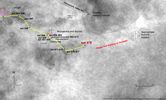
ZO-Y-MERA_A578_3.jpgSpirit's Traverse Map through Sol 578177 visitenessun commentoAgo 29, 2005
|
|

VL-12-db-2-height-B019R1_br2.jpg"Pockets of Heat" near the Martian Surface201 visiteCaption NASA originale:"This graph shows that the atmospheric temperatures above the surface of Mars at Gusev Crater, fluctuate to a significant degree. The color red denotes warmer temperatures, while blue is cooler. The red and yellow waves of color represent thermals, or "pockets of heat", which rise and fall across the surface. Also these data were acquired by the Rover's Miniature Thermal Emission Spectrometer".
Nota: con questo interessantissimo grafico la NASA ci dimostra di aver verificato sperimentalmente l'esistenza di sacche di calore che 'danzano' sulla superficie di Marte. Peccato, però, che non vengano spese parole per tentare almeno di spiegare e giustificare questo fenomeno il quale, forse, potrebbe essere la chiave di volta nella comprensione di alcune fenomenologie Marziane (a nostro parere, comunque, la 'fonte' di queste sacche di calore potrebbe/dovrebbe essere il sottosuolo di Marte).Mag 25, 2005
|
|

VI-11-db-1-temp-B019R1_br2.jpgTemperature's fluctuations at 30 and over 500 mt above Martian G.C. Datum181 visiteCaption NASA originale:"This graph shows that the air 30 mt above the surface of Mars at Gusev Crater, MER Spirit's landing site, is hotter and fluctuates in temperature to a larger degree than the air higher up at 500 meters. These data, acquired by the Rover's Miniature Thermal Emission Spectrometer, help scientists understand how the bottom layer of air closest to the surface behaves and interacts with global winds".Mag 25, 2005
|
|
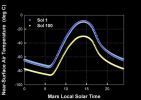
VH-temperature6-A10R1_br.jpgIs Mars very cold?!? It depends on the altitude...202 visiteCaption NASA originale:"This graph shows the predicted daily change in the atmospheric temperature 1 (one) meter above the surface of Mars at Gusev Crater. The blue curve denotes predicted values for Sol 1 (the first day of Spirit's mission) and the yellow for Sol 100 (100 days into the mission).
The light blue symbols represent temperatures for a total atmospheric dust abundance of 0,7 visible optical depth units, and the darker blue symbols for a total atmospheric dust abundance of 1,0 visible optical depth units.
Scientists use this data to ensure that Spirit stays within the right temperature range".
Nota: i valori di questo grafico, a nostro parere - e dopo aver confrontato tutti i dati (NASA ed ESA) disponibili - fanno apparire Marte decisamente più freddo di quanto non sia.
Almeno in teoria...Mag 23, 2005
|
|
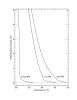
VG-temperature_profile-A12R1_br2.jpgIs Mars very cold?!? It depends on the altitude...183 visiteThis graph shows the temperature above the the surface of Mars at three different points in time: Sol 5, late afternoon; Sol 6, mid-morning; and Sol 7, early afternoon (Sol 5 occurred on the night of January 7/8, 2004). These temperature profiles were derived from data taken by the MTES onboard the Mars Exploration Rover Spirit.
By measuring the brightness of the carbon dioxide gas that makes up the Martian Atmosphere, scientists can deduce the surface temperature above Mars between 20 mt (65 feet) and 2 Km (approx. 1,2 miles).
The observations show large changes in atmospheric temperature both as a function of time of day and as a function of height near the surface.
In altre parole: la NASA dice che se tocchiamo il suolo di Marte, in pieno giorno, riceveremo una sensazione di calore (p.e.: intorno alle ore 13 MLT, durante l'Estate Marziana, la temperatura al suolo - e sempre according to NASA - potrebbe oscillare tra i 15 ed i 20°C mentre secondo noi, invece, potremmo tranquillamente stare sopra i 25/28°).
Tuttavia, basterà 'salire' di 2 metri (e cioè alzarsi, o fare un saltino) per ritrovarsi nel gelo polare! Possibile?
Ai Posteri (che cammineranno su Marte) l'ardua Sentenza!...Mag 23, 2005
|
|
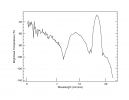
VF-spectrum-A12R1_br2~0.jpgWhat's inside the Sky of Mars? Carbon dioxide, mostly...212 visiteA view of the sky as observed by the Mini-Thermal Emission Spectrometer onboard the Mars Exploration Rover Spirit. This instrument detects the different wavelengths of infrared light emitted by an object, in this case the sky, producing a graph (called a spectrum) that reveals the presence of specific chemicals. This spectrum, taken on Sol 7 in the early afternoon (night of January 9/10, 2004), contains the signatures of carbon dioxide (15 microns), atmospheric dust (9 microns) and water vapor (6 microns). Scientists also expect to see water ice clouds in the Martian Atmosphere, but did not observe them at the time of this observation. The thermal brightness of carbon dioxide allows the atmospheric temperature as a function of height to be determined.
Carbon dioxide makes up 95% of the Martian Atmosphere".Mag 23, 2005
|
|

VF-nav4-A11R1_br.jpgWhere's Spirit? (3)216 visiteE chiudiamo la 'Ricerca di Spirit" con questa Mappa che è stata ottenuta grazie ai dati (telemetrici e fotografici - si vedano, per questi ultimi, le 3 immagini proposte nella Sezione "Walking on Mars") ottenuti dal Descent Image Motion Estimation System - o DIMES(C) - il quale, come ormai saprete, è collocato sulla 'pancia' del Lander.Mag 23, 2005
|
|
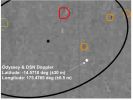
VD-nav2-A11R1.jpgWhere's Spirit? (2)220 visiteQuesto secondo frame rappresenta solo un detail mgnf della precedente Mappa radiometrica. E' importante, a nostro avviso, fare un piccolo sforzo e familiarizzare con questo tipo di mappe e con la tecnologia che esiste alle loro spalle: un giorno (e speriamo non fra un secolo!), il viaggio che porterà degli uomini su Marte si concluderà comunque in questo modo. Avremo, cioè, un'area ellittica entro la quale verrà collocato il punto stimato di landing e poi, sia usando i dati video trasmessi dalla superficie, sia incrociando le informazioni relative ai segnali (eco) emessi dal Lander durante la discesa - telemetrie - verrà determinato l'esatto landing site.
Riteniamo altresì molto probabile il ricorso a strumenti ottici - oggi in corso di sviluppo - i quali consentiranno delle verifiche visuali ed in tempo reale sia da parte della Mothership che resterà in orbita (un equivalente del CSM per i LM Apollo), sia da parte del network satellitare di cui allora disporremo intorno al Pianeta Rosso.Mag 23, 2005
|
|
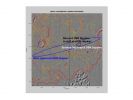
VC-nav1-A11R1.jpgWhere's Spirit? (1)210 visiteCaption NASA originale:"This map shows the estimated location of the Mars Exploration Rover Spirit within Gusev Crater, Mars. Engineers targeted Spirit for the center of the blue ellipse. Measurements taken during the Rover's descent by the Deep Space Network predicted its landing site to be the spot marked with a black dot. Later measurements taken on the ground by both the Deep Space Network and the Orbiter Mars Odyssey narrowed the predicted landing site to a spot marked with a white dot.
When initially choosing a landing site for the Rover, engineers avoided hazardous terrain outlined here in yellow and red. This map consists of data from Mars Odyssey and MGS".Mag 23, 2005
|
|
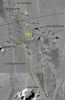
VB-SOL011-Horizon_hills_azimuths-A11R1_br2.jpgThe Martian Land around Spirit: distant hills and many craters237 visiteCaption NASA originale:"This overhead view maps the Mars Exploration Rover Spirit's approximate location in relation to nearby craters and hills. By combining images from both the cameras on MGS and DIMESC - this located on the bottom of the Rover's Lander - scientists and engineers can tell how far away the hills are from the Rover. This information would be more difficult to obtain from the panoramic images. The hills and hill ranges are marked by yellow lines and the Rover is located where the yellow lines intersect.
Black arrows locate the east hill complex, a potential Rover destination".Mag 23, 2005
|
|

ZC-mars-mera-moc-view-mar2004.jpgLanding Area and main features - cPROTO Image (approx. true colors)243 visiteVersione a colori "approssimativamente veri" del frame precedente (grazie, ancora una volta, a "Mars-Daily") ed un'annotazione da fare: come mai il relitto di orgine indubitabilmente metallica - la "Back-Shell" - luccica al Sole e, nel frame, appare (giustamente e logicamente) bianco, mentre l'altro relitto, anch'esso indubitabilmente metallico, e cioè l'"Heat-Shield", appare di forma oblunga e scuro?
Un'altra prova - forte! - che il Dr Feltri ha ragione: l'oggetto sul bordo del Cratere Bonneville NON è lo Scudo Termico...Mag 23, 2005
|
|
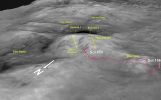
ZO-X-PIA07851_fig1.jpgColumbia Hills' Perspective View (from MGS)218 visiteCaption NASA originale:"This perspective view of a 3D terrain model shows the shape of the "Columbia Hills" landscape where NASA's Mars Exploration Rover Spirit has been working since mid-2004.
North is toward the lower left.
Husband Hill is at the center, with the Inner Basin behind it. This view is from images taken by the Mars Orbiter Camera on NASA's Mars Global Surveyor and processed into a 3D terrain model by the U.S. Geological Survey - USGS". Apr 20, 2005
|
|
| 275 immagini su 23 pagina(e) |
 |
|
|
|
|
13 | |
|
|
|
|








