| Ultimi arrivi - Curiosity and the Exploration of Gale Crater |

SOL3339.jpgSol 3339 - Postcard from Gale105 visitenessun commentoMareKromiumGen 02, 2022
|
|

SOL3344.jpgSol 3344 - Panorama183 visitenessun commentoMareKromiumGen 02, 2022
|
|

SOL0174-PIA16804.jpgSutton Inlier - Sol 174 (Absolute Natural Colors; credits for the additional process. and color.: NASA/JPL)107 visiteThe Mast Camera (MastCam) on NASA's Mars Rover Curiosity showed researchers interesting internal color in this rock called "Sutton_Inlier," which was broken by the Rover driving over it. The Mastcam took this image during the 174th Martian day, or sol, of the rover's work on Mars (Jan. 31, 2013). The rock is about 5" (12 cm) wide at the end closest to the camera. This view is calibrated to estimated "Natural" Color, or approximately what the colors would look like if we were to view the scene ourselves on Mars. The inside of the rock, which is in the "Yellowknife Bay" area of Gale Crater, is much less red than typical Martian dust and rock surfaces, with a color verging on grayish to bluish.
NASA's Jet Propulsion Laboratory, Pasadena, Calif., manages the Mars Science Laboratory Project and the mission's Curiosity rover for NASA's Science Mission Directorate in Washington. The rover was designed and assembled at JPL, a division of the California Institute of Technology in Pasadena.MareKromiumGen 02, 2022
|
|

SOL0589-NRB_449790582EDR_F0310000NCAM00262M_.jpgBright Spark in the distance (Original NASA - Mer Curiosity Frame) - Sol 589152 visiteThis image from the Navigation Camera (Navcam) on NASA's Curiosity Mars rover includes a bright spot near the upper left corner. The sun is in the same direction, west-northwest, above the frame. Bright spots appear in images from the rover nearly every week. Typical explanations for them are cosmic rays hitting the light detector or sunlight glinting from rocks.
The right-eye camera of the stereo Navcam recorded this frame during the afternoon of the 589th Martian day, or sol, of Curiosity's work on Mars (April 3, 2014), from the site where the rover reached a waypoint called "the Kimberley" by that sol's drive. An image taken by the Navcam's left-eye camera within one second of the same time (http://mars.jpl.nasa.gov/msl/multimedia/raw/?rawid=NLB_449790582EDR_F0310000NCAM00262M_&s=589) does not include a bright spot of this type. A pair of Navcam images in the same direction from the previous afternoon has a bright spot similarly located in the right-eye image http://mars.jpl.nasa.gov/msl/multimedia/raw/?rawid=NRB_449700848EDR_F0301254NCAM00252M_&s=588) but not in the left-eye image (http://mars.jpl.nasa.gov/msl/multimedia/raw/?rawid=NLB_449700848EDR_F0301254NCAM00252M_&s=588).
One possible explanation for the bright spot in this image is a glint from a rock surface reflecting the sun. Another is a cosmic ray hitting the camera's light detector, a CCD (charge-coupled device). Cosmic ray patterns in Mars rover images vary from a dot to a long line depending on the angle at which the ray strikes the detector.
NASA's Jet Propulsion Laboratory, a division of the California Institute of Technology, Pasadena, manages the Mars Science Laboratory Project for NASA's Science Mission Directorate, Washington. JPL designed and built the project's Curiosity rover and the Rover's Navcam.MareKromiumDic 30, 2021
|
|
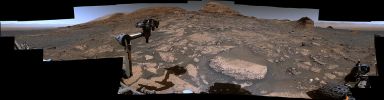
SOL3167.jpgFunny Sky... - Sol 3167151 visiteLa NASA ci dice che si tratta di "false colors" (od anche "white balanced"). Va bene. Ci credo. O forse no...
Caption NASA originale: "Images of knobbly rocks and rounded hills are delighting scientists as NASA’s Curiosity Rover climbs Mount Sharp, a 5-mile-tall (such as approx. 8-Km tall) mountain within the 96-mile-wide (such as about 154-Km wide) basin of Mars’ Gale Crater. The rover’s Mast Camera, a.k.a. MastCam, highlights those features in a panorama captured on July, 3rd, 2021 (i.e. the 3167th Martian Day, or Sol, of the Mission)".
This location is particularly exciting: Spacecraft orbiting Mars show that Curiosity is now somewhere between a Region enriched with clay minerals and one dominated by salty minerals called Sulfates. The mountain’s layers in this area may reveal how the ancient environment within Gale Crater dried up over time. Similar changes are seen across the planet, and studying this Region up close (---> da vicino) has been a major long-term goal for the mission.
"The rocks here will begin to tell us how this once-wet planet changed into the dry Mars of today, and how long habitable environments persisted even after that happened,” said Abigail Fraeman, Curiosity’s deputy project scientist, at NASA’s Jet Propulsion Laboratory in Southern California".
The "Dry Mars of today"... Mmmmmhhhhh.... Are we really sure about that?!? I am not. And You?!?MareKromiumNov 03, 2021
|
|

SOL3049-Mont_Mercou-2-pia24266-comboadjust-350.gifMont Mercou - Sol 3049 (GIF - Movie)131 visite"NASA’s Curiosity Mars rover used its Mastcam instrument to take the 32 individual images that make up this panorama of the outcrop nicknamed “Mont Mercou.” It took a second panorama, rolling sideways 13 feet (4 meters), to create a stereoscopic effect similar to a 3D viewfinder. The effect helps scientists get a better idea of the geometry of Mount Mercou’s sedimentary layers, as if they’re standing in front of the formation.
Both panoramas were taken on March 4, 2021, the 3,049th Martian day, or sol, of the mission, from a distance of about 130 feet (40 meters) from the cliff face, which is about 20 feet (6 meters) tall. They have been white-balanced so that the colors of the rock materials resemble how they would appear under daytime lighting conditions on Earth".MareKromiumGiu 03, 2021
|
|

SOL3060-pia24543-1-16.jpgMount Sharp - Sol 3060102 visitenessun commentoMareKromiumGiu 03, 2021
|
|

SOL3063-51063728632_d81f794358_o.jpgClouds - Sol 3063 (Natural Colors)141 visitenessun commentoMareKromiumGiu 03, 2021
|
|

SOL3043-1-51001818478.jpgHorizon - Sol 3043 (possible Natural Colors)137 visitenessun commentoMareKromiumApr 01, 2021
|
|

SOL3046-1.jpgCloudy Sky over Curiosity - Sol 3046 (possible Natural Colors)193 visitenessun commentoMareKromiumApr 01, 2021
|
|

SOL3063-1.jpgOutline of a Giant - Sol 3063 (possible Natural Colors)241 visitenessun commentoMareKromiumApr 01, 2021
|
|

SOL1429-29129132955_060e95f49c_k.jpgPostcard from Mars - Sol 1429 (Image-composite; credits for the additional process. and color.: Marco Faccin & Elisabetta Bonora)133 visitenesun commentoMareKromiumNov 06, 2020
|
|
| 261 immagini su 22 pagina(e) |
 |
|
|
5 | |
|
|
|
|
|
|








