| Ultimi arrivi - Mars from Orbit (from July 2009) |

Craters-Holden_Crater-PIA03694-1.jpgDeposits inside Holden Crater (1)55 visiteImage information: VIS instrument;
Latitude: -27,3° N;
Longitude: 324,5° E;
Resolution: 17 meter/pixel.
Gen 25, 2006
|
|
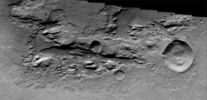
Craters-Millochau_Crater-PIA03292-1.jpgThe Floor of Millochau Crater (Original NASA/JPL/ASU b/w Frame)55 visiteOriginal caption:"The Floor of Millochau Crater has been filled by material that is now being eroded away".
Image information: VIS instrument;
Coord.: 21,1° South Lat. and 85,6° East Long.
Resolution: 17 meter/pixel.Gen 09, 2006
|
|

Dunes-PIA03291-00.jpgDefrosted Dunes (Original NASA/JPL/ASU b/w Frame)56 visiteOriginal caption:"These Dark Dunes are Frost covered for most of the year but, as Southern Summer draws to a close, the Dunes have now been almost completely defrosted".
Image information: VIS instrument;
Latitude: 66,6° South;
Longitude: 37,0° East;
Resolution: 34 meter/pixel.Gen 09, 2006
|
|

Aeolian_Features-Yardangs-Elysium-PIA03283-2.jpgYardangs in Elysium Planitia (Original NASA/JPL/ASU b/w Frame)55 visitenessun commentoGen 09, 2006
|
|

Aeolian_Features-Yardangs-Elysium-PIA03283-1.jpgYardangs in Elysium Planitia (Original NASA/JPL/ASU b/w Frame)58 visiteCaption NASA:"The multiple trends of Yardangs in this image indicate that the (Dominant) Winds in the Elysium Region have changed direction several times".
Image information: VIS instrument;
Latitude: 2,6° North Lat. and 151,2 East Long;
Resolution: 18 meter/pixel.Gen 09, 2006
|
|

Dunes-PaleoDunes-3.JPGPaleodunes (3 - Original NASA/Viking 2 Project b/w Frame)54 visitenessun commentoDic 12, 2005
|
|

Dunes-PaleoDunes-2.JPGPaleodunes (2 - Original NASA/MGS/MSSS b/w Frame)54 visiteCaption NASA:"A similar effect at a much smaller scale can be seen by examining some Sandstones and Siltstones on Earth (if conditions were right, ripples formed in either water or wind are preserved in such rocks). The first MOC view, labeled M03-00006, was taken on July 1, 1999. The second view, M07-05007, was acquired September 26, 1999. Both MOC images are illuminated from the left. The Dunefield is located East of the Apollinaris Patera volcano and North-East of Gusev Crater (at about 12,5° South Lat. and 181° West Long.)".Dic 12, 2005
|
|
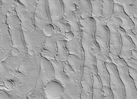
Dunes-PaleoDunes-1.jpgPaleodunes (1 - Original NASA/MGS/MSSS b/w Frame)54 visiteCaption NASA:"A pair of MGS-MOC images shows close-up views of a Sand Dunefield that was first detected by the Viking Orbiters in the late 1970's. What is surprising about the MOC images is that they reveal a dune field unlike any other thus far seen on Mars: this one has Impact Craters on its Surface, and LOTS of them! The field of parallel Ridges North of the Dunefield is a wind-eroded material named "Apollinaris Sulci". It is possible that the Dunefield shown here was once covered by this wind-eroded material and was later exhumed. Regardless, the Dunes were somehow hardened and have been exposed as hard rock on the Martian Surface long enough for many Impact Craters smaller than a few hundred meters (such as few hundred yards) across to form. These Dunes are therefore quite ancient: one might say that this is a 'fossilized' Dunefield".Dic 12, 2005
|
|
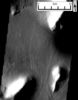
Islands.jpgThe Islands of Mars (Original NASA-2001 Mars Odyssey Orbiter b/w Frame)55 visiteNew HR images of mid-latitude Mars are revealing glacier-formed landscapes far from the Martian Poles, says a leading Mars Researcher.
Conspicuous trains of debris in valleys, arcs of debris on steep slopes and other features far from the polar ice caps bear striking similarities to glacial landscapes of Earth, says Brown University's James Head III. When combined with the latest climate models and orbital calculation for Mars, the geological features make a compelling case for Mars having ongoing climate shifts that allow ice to leave the poles and accumulate at lower latitudes.
"The exciting thing is a real convergence of these things, said Head, who will present the latest Mars climate discoveries on Sunday, 16 October, at the Annual Meeting of the Geological Society of America in Salt Lake City (Utah). "For decades people have been saying that deposits at mid and equatorial latitudes look like they are ice-created, said Head. But without better images, elevation data and some way of explaining it, ice outside of Mars' polar regions was a hard sell.
Now high-resolution images from the Mars Odyssey spacecraft's Thermal Emission Imaging System combined with images from the Mars Global Surveyor spacecraft's Mars Orbiter Camera and Mars Orbiter Laser Altimeter can be compared directly with glacier features in mountain and polar regions of Earth. The likenesses are hard to ignore.
For instance, consider what Head calls "lineated valley fill." These are lines of debris on valley floors that run downhill and parallel to the valley walls, as if they mark some sort of past flow. The same sorts of lines of debris are seen in aerial images of Earth glaciers. The difference is that on Mars the water ice sublimes away (goes directly from solid ice to gas, without any liquid phase between) and leaves the debris lines intact. On Earth the lines of debris are usually washed away as a glacier melts.
Nov 19, 2005
|
|

Chaotic_Terrain-Jani_Chaos-PIA03200.jpgFeatures of Iani Chaos (Original NASA/2001 Mars Odyssey Orbiter b/w Frame)56 visitePiccolo promemoria: quando si parla di "chaos terrain", si tratta di un'area che è stata - letteralmente - privata di sostegno sotterraneo e che quindi è "crollata su se stessa" (---> "Chaos" is typically interpreted to be a collapse terrain; it is the blocky landscape after the transport and removal of subsurface support).Nov 16, 2005
|
|
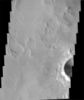
Craters-Holden_Crater-2-PIA03192.jpgHolden Crater's Dunes (2)55 visiteProsieguo del frame precedente; nessun commento.Nov 12, 2005
|
|
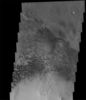
Craters-Holden_Crater-1-PIA03192.jpgHolden Crater's Dunes (1)55 visiteOriginal caption:"These dunes occur on the floor of Holden Crater".
Image information: VIS instrument;
Latitude: 25,8° S;
Longitude: 326,5° E:
Resolution: 17 meter/pixel.Nov 12, 2005
|
|
| 1003 immagini su 84 pagina(e) |
 |
|
|
|
|
|
|
|
82 | |
|





