| Ultimi arrivi - Mars from Orbit (from July 2009) |
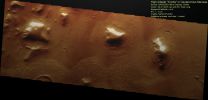
Knobs-Deuteronilus_Mensae-20080514a-PCF-LXTT.jpgHighly Reflective "Knobs" in Deuteronilus Mensae (Enhanced Natural Colors; credits for the additional process. and color.: Dr Paolo C. Fienga - Lunexit Team)56 visiteDifficile dare una spiegazione (al di là della over-saturation del frame - idea razionale ma che, a nostro avviso, in questo caso non tiene...) per giustificare l'albedo elevatissima dei lati esposti al Sole di queste colline "a ceppo" (knobs).
Il Prof. Hoagland, quando si trovò in una situazione visiva simile (a proposito della Sfinge di Cydonia), disse che l'albedo elevata poteva giustificarsi solo pensando ad un residuo di "piastrellatura vetrosa" della "Sfinge" (o "Faccia di Marte") la quale, colpita dai raggi radenti del Sole del primo mattino, brillava come un faro.
Beh, Cari Amici, che dire? Una cosa è certa: se la Sfinge brillava (e brilla) così perchè era ed è "piastrellata", allora anche queste collinette sono "piastrellate"...
Bufale e teorie bislacche a parte, Voi che dite?MareKromiumMag 15, 2008
|
|

Craters-Pollack_Crater_and_White_Rock-20020419a-PCF-LXTT.jpgPollack Crater and "White Rock" (Slightly Saturated Absolute Natural Colors; credits for the additional process. and color.: Dr Paolo C. Fienga - Lunexit Team)56 visiteCaption NASA:"White Rock is the unofficial name for this unusual landform which was first observed during the Mariner 9 Mission in the early 70's. As later analysis of additional data sets would show, White Rock is neither white nor dense rock. Its apparent brightness arises from the fact that the material surrounding it is so dark. Images from the Mars Global Surveyor MOC camera revealed dark sand dunes surrounding White Rock and on the floor of the troughs within it.
Some of these dunes are just apparent in the THEMIS image. Although there was speculation that the material composing White Rock could be salts from an ancient dry lakebed, spectral data from the MGS TES instrument did not support this claim. Instead, the White Rock deposit may be the erosional remnant of a previously more continuous occurrence of air fall sediments, either volcanic ash or windblown dust.
The THEMIS image offers new evidence for the idea that the original deposit covered a larger area.
Approximately 10 Km to the South-East of the main deposit are some tiny knobs of similarly bright material preserved on the floor of a small crater. Given that the eolian erosion of the main White Rock deposit has produced isolated knobs at its edges, it is reasonable to suspect that the more distant outliers are the remnants of a once continuous deposit that stretched at least to this location.
The fact that so little remains of the larger deposit suggests that the material is very easily eroded and simply blows away".MareKromiumApr 07, 2008
|
|
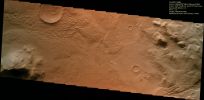
Craters-Cerulli_Crater-20080321a-PCF-LXTT.jpgFeatures of Cerulli Crater (Saturated Natural Colors; credits for the additional process. and color.: Dr Paolo C. Fienga - Lunexit Team)55 visitenessun commentoMareKromiumMar 21, 2008
|
|
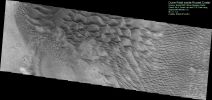
Craters-Russel_Crater-20080116a.jpgDunefield inside Russel Crater (Original NASA/2001 Mars Odyssey Orbiter b/w Frame)57 visitenessun commentoMareKromiumGen 16, 2008
|
|

Craters-Reynolds_Crater-20080115a-PCF-LXTT.jpgDunefield inside Reynolds Crater (Natural Colors; credits for the additional process. and color.: Dr Paolo C. Fienga - Lunexit Team)60 visiteCaption NASA:"These interesting dune-forms are located on the margin of Remnant Polar Deposits on the floor of Reynolds Crater".
Coord.: 74,3° South Lat. and 199,9° East Long.MareKromiumGen 15, 2008
|
|
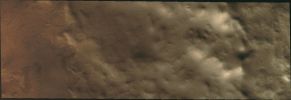
Craters-Unnamed_Crater-Southern_Latitudes-20080114a-PCF-LXTT.jpgWhen Summer "Falls"... (Absolute Natural Colors; credits for the additional process. and color.: Dr Paolo C. Fienga - Lunexit Team)54 visiteCaption NASA:"Autumn has begun in the Southern Hemisphere of Mars. As the Sun retreats northward frost will begin to accumulate. The frost-free Floor of this Unnamed Crater, with it's intricate texture, will soon be hidden. Due to Mars' orbit, the seasons are twice as long as on Earth - so it will be a full earthyear before this Crater Floor is exposed again".MareKromiumGen 14, 2008
|
|

Ophir_Chasma-IR-20071219a.jpgLandslide in Ophir Chasma (IR) - coloring: Lunexit56 visiteCaption NASA: “The large landslide that can be seen on the right side (Dx) of this InfraRed (IR) image is located in Ophir Chasma. Although the resolution is less than the one that can be obtained from an image taken in Visible Light (VL), the large size of the feature is more completely covered by the wider frame size of the THEMIS infrared camera”.
Nota Lunexit: un esempio concreto di caption NASA "non sense".
Perchè vengono scattate le fotografie in IR? Beh – e questo lo sanno anche i bambini e gli “Scienziati da Salotto”… – non certo per avere una "qualità visiva migliore" (in senso stretto) del frame, né per "coprire meglio la superficie ripresa" (in termini di area inquadrabile).
A tal ultimo proposito Vi rammentiamo che il quantum di superficie inquadrabile dipende, in buona sostanza, non solo e non tanto dall'estensione del rilievo che interessa riprendere (attenzione: per questo tipo di frames si parla di rilievi aventi dimensioni comprese fra i 4 ed gli 8 Km di estensione in lunghezza ed i 2/3 Km di estensione in larghezza, e NON di rilievi grandi quanto possono esserlo dei continenti...), né dal tipo di "imaging strip" che la camera dell'Orbiter può ottenere.
Il quantum di cui sopra dipende, essenzialmente, DALL'ALTEZZA da cui la ripresa viene effettuata e dalla capacità di magnificazione della camera che riprende (ed ecco la semplicissima regola generale: per coprire una maggiore superficie con un singolo scatto, occorre aumentare l'altezza dell'Orbiter rispetto al suolo e ridurre la capacità di magnificazione della camera che riprende).
Tutto ciò premesso, e quindi tornando al quesito originale, Vi ricordiamo che le riprese orbitali in IR si fanno, di regola, di notte (o, comunque, in ore nelle quali la luminosità della superficie e bassissima e/o tendente a zero) e per verificare se un certo rilievo EMETTE o RITIENE (e, se SI, QUANTO) CALORE.
La spiegazione NASA, nei termini in cui viene esposta nella riportata caption, quindi – a nostro umile parere –, è totalmente priva di significato.
Anzi, peggio: è fuorviante.
Ed ora provate a rileggerla...
MareKromiumDic 19, 2007
|
|

Craters-Hellespontus_Crater-Dunes-MGS-00.jpgFeatures of Hellespontus Crater (Enhanced Absolute Natural Colors; credits for the additional process. and color.: Dr Paolo C. Fienga - Lunexit Team)56 visitenessun commentoMareKromiumOtt 18, 2007
|
|
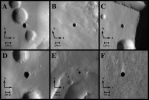
Volcanic_Features-Caverns-PIA09929-00.jpgOn the Northern Slope of Arsia Mons: candidates Cavern Entrance (1)74 visiteCaption NASA:"Seven very dark holes on the North Slope of Arsia Mons (about 9° South Lat. and 239° East Long.) have been proposed as possible cave skylights, based on day-night temperature patterns suggesting they are openings to subsurface spaces. These 6 excerpts of images taken in visible-wavelength light by the Thermal Emission Imaging System (THEMIS) camera on NASA's Mars Odyssey orbiter show the 7 openings.
Solar illumination comes from the left in each frame.
The features have been given informal names to aid comparative discussion. They range in diameter from about 100 meters (328 feet) to about 225 meters (738 feet).
The candidate cave skylights are (A) "Dena", (B) "Chloe", (C) "Wendy", (D) "Annie", (E) "Abby" (left) and "Nikki", and (F) "Jeanne."
Arrows signify North and the Direction of Illumination".MareKromiumSet 26, 2007
|
|
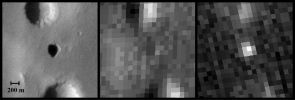
Volcanic_Features-Caverns-PIA09929-01.jpgOn the Northern Slope of Arsia Mons: candidate Cavern Entrance (Annie)56 visiteCaption NASA:"Each of the 3 images in this set covers the same patch of Martian Ground, centered on a possible cave skylight informally called "Annie" which has a diameter about double the length of a football field. The THEMIS camera on NASA's Mars Odyssey orbiter took all 3, gathering information that the hole is cooler than surrounding surface in the afternoon and warmer than the surrounding surface at night. This is thermal behavior that would be expected from an opening into an underground space.
The left image was taken in visible-wavelength light (fig. 1). The other 2 were taken in Thermal Infrared Wavelengths, indicating the relative temperatures of features in the image. The center image is from mid-afternoon. The hole is warmer than the shadows of nearby pits to the North and South, while cooler than sunlit surfaces. The thermal image at right was taken in the pre-dawn morning, about 4 M.L.T. .
At that hour, the hole is warmer than all nearby surfaces".
Nota Lunexit: ovviamente non era necessario nè uno scienziato nè un veggente per anticipare le mosse (di buon senso) della NASA, ma il fatto che i Tecnici di Pasadena abbiano effettivamente operato non solo delle riprese notturne di questa interessante Surface Feature, ma anche dei rilievi IR - come da noi suggerito ed anticipato, sebbene a proposito di un'altra (e forse più famosa) Candidate Cavern Entrance - ci ha dato, onestamente, una notevole soddisfazione!MareKromiumSet 26, 2007
|
|

Craters-Unnamed_Crater_with_possible_Oil_Lake-V07738009-PCF-LXTT-03.jpgMigrating Dunes, Dirty Waters or maybe Surfacing Hydrocarbons? (4 - Natural Colors; credits for the additional process. and color.: Dr Paolo C. Fienga - Lunexit Team)54 visitenessun commentoMareKromiumAgo 22, 2007
|
|

Craters-Unnamed_Crater_with_possible_Oil_Lake-V07738009-PCF-LXTT-04.jpgMigrating Dunes, Dirty Waters or maybe Surfacing Hydrocarbons? (5 - Natural Colors; credits for the additional process. and color.: Dr Paolo C. Fienga - Lunexit Team)54 visitenessun commentoMareKromiumAgo 22, 2007
|
|
| 1003 immagini su 84 pagina(e) |
 |
|
|
|
|
74 | |
|
|
|
|





