| Ultimi arrivi - Mars from Orbit (from July 2009) |
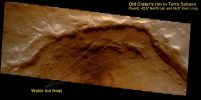
Craters-Unnamed_Crater_in_Terra_Sabaea-PCF-LXTT.jpgWhat's on the Rim? (Enhanced Natural Colors; credits for the additional process. and color.: Dr Paolo C. Fienga - Lunar Explorer Italia)56 visiteCaption NASA:"This old crater in Terra Sabaea has patterned floor material that is indicative of having a volitile component. At high latitudes the volitile is most likely ice".
MareKromiumGen 05, 2009
|
|
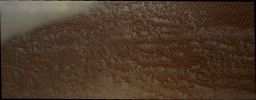
North_Polar_Features-The_Erg-PCF-LXTT-6.jpgThe "North Polar Erg" (Absolute Natural Colors; credits for the additional process. and color.: Dr Paolo C. Fienga - Lunar Explorer Italia)58 visiteCaption NASA:"This VIS image shows a small part of the North Polar Sand Sea [or Erg]. In this Region individual dunes are coalescing into large dune groups".
Coord.: 77,0° North Lat. and 309,5° East Long.MareKromiumGen 01, 2009
|
|

Channels-Drainage_Channel-MO.jpgDrainage Channel System (Natural Colors; credits for the additional process. and color.: Dr Paolo C. Fienga - Lunexit Team)58 visiteCaption NASA:"This small Channel System is located on the Outer Rim of Sytinskaya Crater".
Coord.: 43,1° North Lat. and 306,4° East Long.MareKromiumDic 29, 2008
|
|

Dunes-Terra_Tyrrhena.jpgReddish Dunes in Terra Tyrrhena (Natural Colors; credits for the additional process. and color.: Dr Paolo C. Fienga - Lunar Explorer Italia)57 visiteSource: NASA/2001 Mars Odyssey Orbiter
Coord.: 9,9° South Lat. and 98,1° East Long.MareKromiumDic 23, 2008
|
|
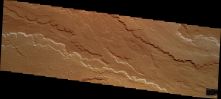
Volcanic_features-LavaFlows-Daedalia_Planum-PCF-LXTT.jpgLava Flows in Daedalia Planum (False Colors; credits: Lunar Explorer Italia)56 visiteCaption NASA:"This image shows a small portion of the extensive Lava Flows from Arsia Mons that make up Daedalia Planum".
Source: NASA/2001 Mars Odyssey Orbiter
Coord.: 21,1° South Lat. and 240,8° East Long.
MareKromiumDic 23, 2008
|
|
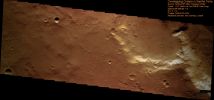
Collapse_Features-Xanthe_Terra-20080403a-PCF-LXTT.jpgSurface Features in Xanthe Terra (Enhanced Natural Colors; credits for the additional process. and color.: Dr Paolo C. Fienga - Lunexit Team)58 visitenessun commentoMareKromiumDic 22, 2008
|
|
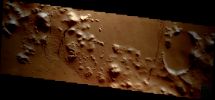
Volcanic_and_Tectonic_Features-Fissures-Cerberus_Fossae-PCF-LXTT.jpgFeatures of Cerberus Fossae: Fissures (Darkened Natural Colors; credits for the additional process. and color.: Dr Paolo C. Fienga - Lunar Explorer Italia)56 visiteSource: NASA/2001 Mars Odyssey Orbiter
Coord.: 8,9° North Lat. and 158,6° East Long. (center of the frame)
Credits: NASA/JPL/Arizona State University (ASU)
Additional process. and color.: Lunar Explorer ItaliaMareKromiumDic 11, 2008
|
|

Craters-Unnamed_Crater_with_Dark_Slope_Streaks-HC-MO-PCF-LXTT.jpgDark Slope Streaks (Saturated Natural Colors; credits for the additional process. and color.: Dr Paolo C. Fienga - Lunexit Team)56 visiteSource: NASA/2001 Mars Odyssey Orbiter
Coord.: 13,6° North Lat. and 21,2° East Long. (center of the frame)
Credits: NASA/JPL/Arizona State University (ASU)
Additional process. and color.: Lunar Explorer ItaliaMareKromiumDic 11, 2008
|
|
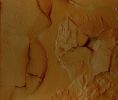
Volcanic_Regions-Elysium_Planitia-PIA11446.jpgFractured Mounds in Elysium Planitia (3D and Enhanced Natural Colors; credits: NASA and Lunar Explorer Italia)61 visiteThis stereo view shows fractured mounds on the southern edge of Elysium Planitia on Mars. It combines two images taken by the High Resolution Imaging Science Experiment (HiRISE) camera on NASA's Mars Reconnaissance Orbiter. When seen through red-green (or blue) glasses, the view appears three dimensional.
This is one example of 362 stereo views posted by the HiRISE team on Dec. 8, 2008, at http://hirise.lpl.arizona.edu/anaglyphs. This view spans an area about 6 Km (3,7 miles) wide.
The mounds on the southern edge of Elysium Planitia are typically a few kilometers or miles in diameter and about 60 meters (200 feet) tall. Fractures that crisscross their surfaces are dilational (extensional) in nature, suggesting that the mounds formed by localized uplift (meaning that they were pushed up from below).
The 3D perspective shows that the uplift is not uniform along a fracture and can favor one side.
The mounds are probably composed of solidified lava. They are contiguous with, and texturally similar to, flood lavas that blanket much of Elysium Planitia. Where dilation cracks provide cross-sectional exposure, the uplifted material is rocky.
Patches of mechanically weak and disrupted material overlie the rocky mound material. This is particularly conspicuous in the northeast corner of the image. These patches may be remnants of a layer that was once more continuous but has been extensively eroded. Smooth lava plains fill the low-lying areas between the mounds. They are riddled with sinuous pressure ridges. The entire area is covered by a relatively thin layer of dust and sand.
One of the HiRISE images used in this stereo view is catalogued as PSP_003597_1765, taken May 3, 2007, and as PSP_002542_1765, taken Feb. 10, 2007. The location is about 3° South Lat. and 168° East Long. .MareKromiumDic 09, 2008
|
|

Craters-Unnamed_Crater_in_Sirenum_Fossae-20071121a-PCF-LXTT.jpgUnnamed Crater in Sirenum Fossae (Darkened and Enhanced Absolute Natural Colors; credits for the additional process. and color.: Dr Paolo C. Fienga - Lunar Explorer Italia)69 visiteCaption NASA:"This Unnamed Crater is located in near Sirenum Fossae and some of its modifications may be related to the tectonic activity that created the Fossae System. The Floor of this Unnamed Crater has be changed drastically from its original appearance". MareKromiumDic 06, 2008
|
|
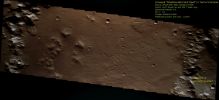
Landslides-Terra_Cimmeria-20080429a-PCF-LXTT.jpgJust a "Shadow"? (Enhanced Natural Colors; credits: Dr Paolo C. Fienga - Lunar Explorer Italia)56 visitenessun commentoMareKromiumDic 06, 2008
|
|

Channels-Unnamed_Channel_and_Chaotic_terrain_in_Terra_Sabaea-MO.jpgUnnamed Channel and Chaotic Terrain in Terra Sabaea (Natural Colors/Tri-Chromatic Version; credits: Dr Paolo C. Fienga - Lunexit Team)57 visitenessun commentoMareKromiumDic 06, 2008
|
|
| 1003 immagini su 84 pagina(e) |
 |
|
|
|
|
68 | |
|
|
|
|





