| |

| Ultimi arrivi - Mars from Orbit (from July 2009) |
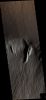
Volcanic_Features-Escarpment-OM-PIA16651-PCF-LXTT-IPF.jpgOlympus' Escarpment (Absolute Natural Colors; credits for the additional process. and color. Dr Paolo C. Fienga/Lunar Explorer Italia/Italian Planetary Foundation)62 visiteThis image, taken by the NASA - Mars Odyssey Orbiter during its 48003rd Orbit, shows us a VERY small (but still extremely interesting, as you can see by yourself) portion of the steep Escarpment existing between the Main Edifice of the Great Martian Volcano known as Olympus Mons and the surrounding Volcanic Plains (remember that an Escarpment is a - usually - steep Slope or a long Cliff that occurs from Erosion or Faulting and separates 2 (two) - relatively levelled/flat - areas/terrains which are situated at different elevations with regard to a certain, and given, Datum - such as that Point, Place or Region of a Celestial Body that is conventionally considered to be situated at Zero Altitude (the Sea Level, for instance, and as far as the Planet Earth is concerned).
Latitude: 13,9669° North
Longitude: 227,030° East
Instrument: VIS
Captured: October, 9th, 2012
The picture (which is an Original Mars Odyssey Orbiter b/w frame published on the NASA - Planetary Photojournal with the ID n. PIA 16651) has been additionally processed and then colorized in Absolute Natural Colors (such as the colors that a human eye would actually perceive if someone were onboard the NASA - Mars Odyssey Orbiter and then looked down, towards the Surface of Mars), by using an original technique created - and, in time, dramatically improved - by the Lunar Explorer Italia Team.MareKromiumGen 11, 2013
|
|
Aeolian_Features-Windstreaks-AM-PIA16513-PCF-LXTT-IPF.jpgWindstreaks on the S/W Flank of Alba Mons (Absolute Natural Colors; credits for the additional process. and color.: Dr Paolo C. Fienga/Lunar Explorer Italia/IPF)67 visiteOrbit Number: 47653
Latitude (centered): 34,8278° North
Longitude (East): 241,838°
Instrument: VIS
Captured: September, 9th, 2012MareKromiumDic 20, 2012
|
|
Craters-Lyot_Crater-PIA16512-PCF-LXTT-IPF.jpgThe Dunefield inside Lyot Crater (Absolute Natural Colors; credits for the additional process. and color.: Dr Paolo C. Fienga/Lunar Explorer Italia/Italian Planetary Foundation)70 visiteOrbit Number: 47648
Latitude (centered): 50,2217° North
Longitude (East): 28,7883°
Instrument: VIS
Captured: September, 10th, 2012MareKromiumDic 20, 2012
|
|
Craters-Trouvelot_Crater-PIA16641-PCF-LXTT-IPF.jpgThe Dunefield inside Trouvelot Crater (Absolute Natural Colors; credits for the additional process. and color.: Dr Paolo C. Fienga/Lunar Explorer Italia/Italian Planetary Foundation)68 visiteOrbit Number: 47874
Latitude (centered): 16,1118° North
Longitude (East): 346,733°
Instrument: VIS
Captured: September, 29th, 2012MareKromiumDic 20, 2012
|
|
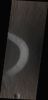
Volcanoes-Ceraunius_Tholus-Summit-PIA16595-PCF-LXTT-IPF.jpgThe Eastern Side of Ceraunius Tholus' Summit Caldera (Absolute Natural Colors; credits for the additional process. and color.: Dr Paolo C. Fienga/Lunar Explorer Italia/Italian Planetary Foundation)70 visiteThis image (taken by the NASA - Mars Odyssey Orbiter during its 47827th orbit around the Red Planet) shows us the Eastern Side of the Summit Caldera of a Volcano known as Ceraunius Tholus (which is part, jointly with Uranius Mons and Uranius Tholus, of the so-called "Uranius Group of Volcanoes"). Ceraunius Tholus is approx. 130 Km across and approx. 5,5 Km high; it was so named after a Classical Albedo Feature and it is located in the Tharsis Quadrangle of Mars. Ceraunius Tholus is generally believed to be a Basaltic Shield-Volcano with the lower part buried beneath the lava-formed Plains forming. Earlier interpretations suggested also that it may be a "Stratovolcano". The Slopes on Ceraunius Tholus are quite steep with an average slope of 8° and with many Radial Erosional Channels and Pitted Valleys extending from just below the Rim of the Caldera, toward the base of the Volcano. The current view, however, is that the Valleys were eroded by Water. Interesting features that characterize Ceraunius Tholus are 3 (three) large Canyons located on the North/Western Flank of the Volcano and which are up to approx. 2,5 km wide and 300 meters deep. The biggest of these 3 (three) Canyons also appears to be the youngest one; it protrudes from the lowest point of the Volcanic Summit Caldera and it ends at the interesting Rahe Crater (an oblique Impact Crater with measures of about 35 × 18 Km), just North from the Volcano, where it formed a Depositional Fan. Its origin is (let us say, "obviously") still debatable and there are at least 3 (three) Main Models proposed to explain it: Creation by way of Fluvial Action, Volcanic (---> Lava) Flows or a combination of both of them. The Caldera of Ceranius Tholus is also dotted with many Collapse Pits (NOT visible in this frame), which, as you should know, are distinct from Impact Craters since they have no Rim and vary in abundance all across the Caldera. Some scientists believe that Glaciers may have existed on many of the Volcanoes located in the District of Tharsis, including Olympus Mons, Ascraeus Mons, and Pavonis Mons. Ceraunius Tholus, on uts side, may also have had its Glaciers Melt to form some temporary Lakes in the past. In fact, the smoothness and flatness of the Ceraunius Tholus' Summit Caldera Floor strongly suggests that, in a far and distant past, some meltwater might actually have accumulated over there, thus forming a so-called (and just temporary, as we said before) "Caldera Lake".
Latitude (centered): 24,0691° North
Longitude: 263,105° East
Instrument: VIS
Captured: September, 25th, 2012
This frame (which is an Original Mars Odyssey Orbiter b/w frame published on the NASA - Planetary Photojournal with the ID n. PIA 16595) has been additionally processed and then colorized in Absolute Natural Colors (such as the colors that a human eye would actually perceive if someone were onboard the NASA - Mars Odyssey Orbiter and then looked down, towards the Surface of Mars), by using an original technique created - and, in time, dramatically improved - by the Lunar Explorer Italia Team.MareKromiumDic 19, 2012
|
|

Channels-Dao_Vallis-PIA15215-PCF-LXTT-IPF.jpgFeatures of Dao Vallis (Absolute Natural Colors; credits for the additional process. and color.: Dr Paolo C. Fienga/Lunar Explorer Italia/Italian Planetary Foundation)73 visiteDao Vallis is a Martian Channel that, as the peculiar texture and color of its bottom and edges show us quite well, was not carved by Molten (and very fluid) Lava, but by real Water instead. Dao Vallis runs South/Westward into the Hellas Planitia Region, and it has been identified (among others, by Dr M.H. Carr) as a so-called Outflow Channel. Dao Vallis has a main Tributary Channel, known as Niger Vallis, and it extends on the Martian Southern Hemisphere's Surface for over 1200 Km. Its name, just out of curiosity, apparently comes from a Thai word meaning "star" (and God only knows why the IAU made such a bizarre and, in our opinion, pointless choice...).
However, talking again about our today's APOD Surface Feature, we can say that we know that the (possible) sources of Dao Vallis are near an extremely old Martian Volcano, called Hadriaca Patera; it is thought by many Scientists that the Water that formed it came out from the Subsurface when a huge quantity of hot Magma, erupted from Hadriaca Patera, melted, in a very short time period (in a case like this, we might be talking about minutes), huge amounts of Ice that was caught in the otherwise already frozen Ground. Anyway, much of this Water may have also been released during the occurrence of a few very large "Outburst Floods".
In addition to the above, and after a carfeul examination of Dao Vallis' now completely desiccated Riverbed, we, as IPF, strongly believe that, whatever the actual origin of the Channel might have been, Dao Vallis must have carried liquid Water for a very long time, before drying up. As a matter of fact, and as it is clearly visible in this NASA - 2001 Mars Odyssey Orbiter frame, on the bottom of the Channel can be identified several layers of dried material (Mud, likely) that, in our opinion, make the physical evidence that the desiccation process of Dao Vallis took some time before it was complete. In other words, the desiccation (or, like some Scientists say, evaporation and/or sublimation) of the Waters that ran through the Channel, was far from being semi-instantaneous or (this, of course, relatively speaking) rather fast. Furthermore, the almost complete lack of Impact Craters on the Riverbed, if seen and evaluated in direct contrast with the strong presence of Impact Craters (of various size and shape - meaning both Primary and Secondary Craters) that exist and is VERY well visible on both the edges of the Channel, proves us that, when Liquid Water ran through Dao Vallis, the strong meteoric activity which scarred most of the Surface of the Red Planet, was already ended. In other words, Dao Vallis hosted liquid and running Waters until a very (always relatively - and geologically - speaking) recent time.
Picture Data: Orbit Number: 44201; Latitude: 39,4843° South and Longitude: 86,4444° East; Instrument: VIS; Captured: December, 1st, 2011; Mars Local Time (M.L.T.): 17:39 (Late Aftrnoon)
This frame has been colorized in Absolute Natural Colors (such as the colors that a human eye would actually perceive if someone were onboard the NASA - 2001 Mars Odyssey Orbiter and then looked down towards the Surface of Mars), by using an original technique created - and, in time, dramatically improved - by the Lunar Explorer Italia Team.MareKromiumDic 04, 2012
|
|

Channels-Marte_Vallis-Streamlined_Islands-PIA16507-PCF-LXTT-IPF.jpgStreamlined Island in Marte Vallis (Absolute Natural Colors; credits for the additional process. and color.: Dr Paolo C. Fienga - Lunar Explorer Italia/Italian Planetary Foundation)61 visiteToday's APOD is a frame taken by the NASA - Mars Odyssey Orbiter which shows us a so-called "Streamlined Island" that formed in the Northern Channel known as Marte Vallis. This Martian Channel is about 185 Km long and it has been identified as an Outflow Channel, carved in a quite distant geological past by the action of catastrophic releases of Water from Aquifers existing beneath the Martian Surface.
Orbit Number: 47605
Latitude: 12,4105° North
Longitude: 182,426° East
Instrument: VIS
Captured: September, 6th, 2012
This frame (which is an Original Mars Odyssey Orbiter b/w frame published on the NASA - Planetary Photojournal with the ID n. PIA 16507) has been additionally processed and then colorized in Absolute Natural Colors (such as the colors that a human eye would actually perceive if someone were onboard the NASA - Mars Odyssey Orbiter and then looked down, towards the Surface of Mars), by using an original technique created - and, in time, dramatically improved - by the Lunar Explorer Italia Team.MareKromiumDic 04, 2012
|
|
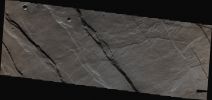
Volcanic_Features-Fractures-AM-PIA16499-PCF-LXTT-IPF.jpgFractures near and around Alba Mons (Absolute Natural Colors; credits for the additional process. and color.: Dr Paolo C. Fienga - Lunar Explorer Italia - Italian Planetary Foundation)79 visiteIn addition to its great size (consider that its Lava Flow Fields extend from over than 1400 Km from the Summit) and relatively low relief (the Summit of the Volcano reaches an elevation of "only" 6,8 Km as to the surrounding Lava Plains), Alba Mons possesses a number of other very distinguishing features. For instance, the central portion of the Volcano is surrounded by an incomplete Ring of Faults (---> Graben) and Fractures (like the ones that we see in today's APOD), called Alba Fossae (the ones located on the Volcano's Western Flank), and Tantalus Fossae (which are found on its Eastern Flank).
Alba Mons also has very long and well preserved Lava Flows that form a Radiating Pattern, starting from its Central Region. The enormous lengths of some individual Flow (something more than 300 Km - such as about 190 miles) implies that the Lavas which formed them were not only very fluid (---> meaning that they possessed very Low Viscosity) at the time of the eruption, but that they also must have been erupted in an extremely high volume (---> quantity). Many of the Flows have distinctive morphologies, consisting of long, sinuous Ridges with discontinuous Central Lava Channels. The low areas between the Ridges (and particularly along the Alba's Northern Flank) show a branching pattern of shallow Gullies and Channels (---> Valley Networks) that likely formed by water runoff. Last, but not least, Alba Mons shows, among other things, some of the oldest, and most extensively exposed Deposits that can be found in the whole Volcanic District of Tharsis.
Orbit Number: 47503
Latitude: 45,2558° North
Longitude: 248,587° East
Instrument: VIS
Captured: August, 29th, 2012
This frame (which is an Original Mars Odyssey Orbiter b/w frame published on the NASA - Planetary Photojournal with the ID n. PIA 16499) has been additionally processed and then colorized in Absolute Natural Colors (such as the colors that a human eye would actually perceive if someone were onboard the NASA - Mars Odyssey Orbiter and then looked down, towards the Surface of Mars), by using an original technique created - and, in time, dramatically improved - by the Lunar Explorer Italia Team.MareKromiumNov 24, 2012
|
|

Aeolian_Features-DD_Tracks-PIA16316-PCF-LXTT-IPF.jpgDust Devils Tracks in Utopia Planitia (Absolute Natural Colors; credits for the additional process. and color.: Dr Paolo C. Fienga/Lunar Explorer Italia/IPF)72 visiteOrbit Number: 47084
Latitude: 52,1033° North
Longitude: 91,7234° East
Instrument: VIS
Captured: July, 26th, 2012MareKromiumNov 24, 2012
|
|

Channels-Maja_Valles-PIA16339-PCF-LXTT-IPF.jpgMaja Valles (Absolute Natural Colors; credits for the additional process. and color.: Dr Paolo C. Fienga/Lunar Explorer Italia/Italian Planetary Foundation)70 visiteOrbit Number: 47426
Latitude: 16,552° North
Longitude: 304,341° East
Instrument: VIS
Captured: August, 3rd, 2012MareKromiumNov 24, 2012
|
|

Aeolian_Features-DD_Tracks-AP-PIA16473-PCF-LXTT-IPF.jpgDust Devils' Tracks in Arcadia Planitia (Absolute Natural Colors; credits for the additional process. and color.: Dr Paolo C. Fienga/Lunar Explorer Italia/Italian Planetary Foundation)81 visiteOrbit Number: 47093
Latitude: 62,264° North
Longitude: 194,781° East
Instrument: VIS
Captured: July, 26th, 2012MareKromiumNov 18, 2012
|
|
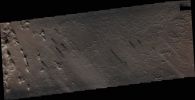
Aeolian_Features-Windstreaks-PIA16495-PCF-LXTT-IPF.jpgWindstreaks near Lycus Sulci (Absolute Natural Colors; credits for the additional process. and color.: Dr Paolo C. Fienga/Lunar Explorer Italia/IPF)59 visiteOrbit Number: 47254
Latitude: 32,905° North
Longitude: 226,441° East
Instrument: VIS
Captured: August, 9th, 2012MareKromiumNov 18, 2012
|
|
| 1003 immagini su 84 pagina(e) |
|
3 | |
|
|
|
|
|
|
|
|
|
|





