| Ultimi arrivi - Titan: The "Foggy" Moon |

Titan-PIA06139-PCF-LXTT-1.jpgTitan (Enhanced Absolute Natural Colors; credits for the additional process. and color.: Dr Paolo C. Fienga - Lunexit Team)182 visitenessun commentoMareKromiumAgo 26, 2011
|
|

Titan-PIA12775-PCF-LXTT.jpgTitan's North Polar "Hood" (Darkened Absolute Natural Colors; credits for the additional process. and color.: Dr Paolo C. Fienga - Lunexit Team)112 visiteCaption NASA:"The Cassini spacecraft examines Titan's north polar hood, the part of the atmosphere of Saturn's largest moon appearing dark at the top of this image. This view looks toward the Anti-Saturn Side of Titan.
North on Titan is up. The South Pole of Titan is going into darkness, with the Sun advancing towards the North with each passing day. The upper layer of Titan's Hazes is still illuminated by Sunlight scattered off the Planet.
The image was taken in Visible Violet Light with the Cassini Spacecraft wide-angle camera on April 19, 2011. The view was acquired at a distance of approx. 137.000 Km (about 85.000 miles) from Titan and at a Sun-Titan-Spacecraft, or Phase, Angle of 18°. Image scale is roughly 8 Km (about 5 miles) per pixel".MareKromiumLug 25, 2011
|
|

Titan-PIA14115.jpgTitan's Haze is going down...80 visiteCaption NASA:"The change in Titan's Haze Layer is illustrated in this figure, derived from data obtained by NASA's Cassini Spacecraft. The picture of Titan in panel "a" was taken on May, 3, 2006, while the picture in panel "b" was taken on April, 2, 2010, several months after Titan's Equinox in August of 2009.
The geometries and Solar Illumination in both images are similar, though Titan's North Pole is at about the one o'clock position (32°) from vertical in panel "a" and nearly vertical in panel "b".
Pictures "c" and "d" magnify the outer regions and show the difference in altitude of the Haze Layer (near 500 Km in "c" and near 380 Km in "d")".MareKromiumGiu 30, 2011
|
|

Titan-Atmosphere-PIA09823-PCF-LXTT.jpgTitan's Upper Atmosphere (Enhanced Natural Colors; credits for the additional process. and color.: Dr Paolo C. Fienga - Lunexit Team)72 visitenessun commentoMareKromiumGiu 26, 2011
|
|
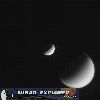
Titan-N00172750-N00172779-GB-LXTT.gifPassing-by... (a GIF-Movie by Dr Gianluigi Barca - Lunexit Team)208 visitenessun commentoMareKromiumGiu 22, 2011
|
|

Titan-Rivers-Unnamed_Rivers_and_Channels-PIA08604-1.jpgCold Titanian Rivers (Possible Natural Colors; credits for the additional process. and color.: Dr Paolo C. Fienga - Lunexit Team)255 visitenessun commentoMareKromiumMag 16, 2011
|
|

Titan-PIA12764.jpgEthereal Ring (Natural Colors; credits for the additional process. and color.: Dr Paolo C. Fienga - Lunexit Team)142 visiteCaption NASA:"The Cassini Spacecraft looks toward the Dark Side of Saturn's largest moon and captures the halo-like ring produced by Sunlight scattering through the periphery of Titan's Atmosphere. A detached, high-altitude Global Haze Layer encircles Titan. This view looks toward the Trailing Hemisphere of Titan (approx. 5150 Km, or 3198,15 miles across). North on Titan is up.
The image was taken with the Cassini Spacecraft narrow-angle camera on Nov. 26, 2010 using a spectral filter sensitive to wavelengths of UltraViolet Light centered at 338 nanometers. The view was obtained at a distance of approx. 1,9 MKM (such as about 1,179 MMs) from Titan and at a Sun-Titan-Spacecraft, or Phase, Angle of 154°.
Image scale is roughly 12 Km (7,452 miles) per pixel".MareKromiumMag 09, 2011
|
|

Titan_and_Callistus-PIA13896.jpgTitan and Callistus (a Mosaic by NASA/JPL)231 visiteCaption NASA:"These images compare Surface Features observed by NASA's Cassini Spacecraft at the Xanadu Region on Saturn's moon Titan (left), and Features observed by NASA's Galileo Spacecraft on Jupiter's cratered moon Callistus (right).
The Cassini Radar Image, obtained during a Titan Fly-By occurred on April, 30th, 2006, is centered at about 10° South Latitude and 85° West Longitude.
The Galileo Camera Image, obtained on June 25, 1997, is centered at about 6° South Latitude and 7° West Longitude.
Titan may originally have had a cratered landscape similar to Callisto that has since been eroded by Rainfall and Runoffs. There are many large Circular Features in Titan's Xanadu Region that have some of the characteristics of impact craters - such as Central Peaks and inward-facing Circular Cliffs - which make scientists think they are, in fact, eroded Impact Craters. The Surface of Callisto also has a substantially eroded cratered landscape". MareKromiumApr 10, 2011
|
|
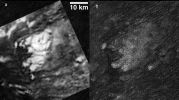
Titan-Regions-Tortula_Facula_Region-PIA13895.jpgTortula Facula (alias "Nondescript Obstacle")230 visiteCaption NASA:"These side-by-side images obtained by NASA's Cassini Spacecraft show the feature named Tortola Facula on Titan. The left image was obtained by the Visual and InfraRed Mapping Spectrometer data on Oct. 26, 2004, at a resolution of about 2 Km (1,242 mile) per pixel. This mosaic focuses on an area around 9° North Latitude and 145° West Longitude.
In 2005, scientists interpreted Tortola Facula as an ice volcano.
The right image shows the same feature, as seen by Cassini's Radar Instrument on May 12, 2008, at a much higher resolution of approx. 300 meters per pixel. Scientists now think that this feature is a "Nondescript Obstacle" surrounded by obvious wind-blown Sand Dunes, similar to those commonly found in this Region of Titan.
In radar images, objects appear bright when they are tilted toward the Spacecraft or have rough surfaces". MareKromiumApr 10, 2011
|
|

Titan-Clouds-Equatorial_Clouds-PIA12810.jpgTitan's Equatorial Clouds 146 visiteCaption NASA:"NASA's Cassini Spacecraft chronicles the change of Seasons as it captures Clouds concentrated near the Equator of Saturn's largest moon, Titan.
Methane Clouds in the Troposphere, the lowest part of the Atmosphere, appear white here and are mostly near Titan's Equator. The darkest areas are Surface Features that have a low albedo, meaning they do not reflect much light.
Cassini observations of Clouds like these provide evidence of a seasonal shift of Titan's weather systems to low latitudes following the August 2009 Equinox in the Saturnian System (during Equinox, the Sun lies directly over the Equator (see PIA11667 to learn how the Sun's illumination of the Saturnian System changed during the Equinox transition to Spring in the Northern Hemispheres and to Fall in the Southern Hemispheres of the Planet and its moons).
In 2004, during Titan's late Southern Summer, extensive Cloud Systems were common in Titan's South Polar Region (see PIA06110, PIA06124 and PIA06241). Since 2005, Southern Polar Systems have been observed infrequently, and one year after the Equinox, extensive near-equatorial Clouds have been seen.
This image was taken on Oct. 18, 2010, a little more than one Earth year after the Saturnian Equinox, which happens once in roughly 15 Earth years.
The cloud patterns observed from late Southern Summer to early Southern Fall on Titan suggest that Titan's Global Atmospheric Circulation is influenced by both the Atmosphere and the Surface. The temperature of the Surface responds more rapidly to changes in illumination than does the thick Atmosphere. Outbreaks such as the Clouds seen here may be the Titan equivalent of what creates the Earth's tropical rainforest climates, even though the delayed reaction to the change of seasons and the apparently sudden shift is more reminiscent of the behavior over Earth's tropical oceans than over tropical land areas.
A few clouds can be seen in Titan's Southern Latitudes here and some clouds are also visible in the high Northern Latitudes.
This view looks toward the Saturn-facing side of Titan (approx. 5150 Km or 3198,15 miles across). North is up. The image appears slightly grainy because it was re-projected to a scale of about 6 Km (3,726 miles) per pixel. Scale in the original image was approx. 15 Km (9,315 miles) per pixel.
This view consists of an average of three images taken using a filter sensitive to Near-InfraRed Light centered at 938 nanometers, which allows for detection of Titan's Surface and Lower Atmosphere, plus an image taken using a filter sensitive to Visible Light centered at 619 nanometers.
The images were taken with the Cassini spacecraft's narrow-angle camera at a distance of approx. 2,5 MKM (1.552.500 MMs) from Titan and at a Sun-Titan-Spacecraft, or Phase, Angle of 56°".MareKromiumMar 22, 2011
|
|

Titan-Clouds-North_Polar_Clouds-PIA12812-PCF-LXTT.jpgNorth Polar Clouds (Absolute Natural Colors; credits for the additional process. and color.: Dr Paolo C. Fienga - Lunexit Team)157 visiteCaption NASA:"Clouds move above Titan's large Methane Lakes and Seas near the Planet's North Pole. Methane Clouds in the Troposphere, such as the lowest part of the Atmosphere, appear white here and are moving East over several of Titan's large Northern Lakes. The darkest areas are Lakes and Seas of liquid Methane, identifiable because they have a low albedo, meaning they do not reflect much light (the difference in brightness and darkness on the Surface here indicates a difference in its composition).
The clouds seen near Lakes and Seas suggest that Titan may have "Lake-effect" Clouds created by weather systems over large bodies of liquid.
However, without earlier observations to show the Clouds did not originate West of the large Sea "Kraken Mare", scientists cannot determine conclusively if these clouds are really "Lake-effect" Clouds.
If full, Kraken Mare, at about 400.000 square Km (248.400 square miles), would be almost five times the size of North America's Lake Superior.
Even if these Clouds are not directly connected to the Lakes and Seas, scientists think that frequent detections of Clouds at High Northern Latitudes since 2007 are related to the abundant availability of Methane at the Surface in this Region.
This view is centered on Terrain at 49° North Latitude and 179° West Longitude. The North Pole is near the upper right. The Clouds are visible above Terrain at about 60 to 82° North Latitude and 220 to 260° West Longitude. Scientists calculate wind speeds from about 0,5 to about 10 meters per second (such as from about 1 to 22 miles per hour), based on tracking of individual cloud features in different images.
Other Cassini observations of Clouds in Titan's Southern Latitudes provide evidence of a Seasonal Shift of Titan's Weather Systems to low Latitudes from higher, South Polar Latitudes following the August 2009 Equinox in the Saturnian System.
This image was taken with the Cassini Spacecraft narrow-angle camera using a spectral filter sensitive to wavelengths of Near-InfraRed Light centered at 938 nanometers. The view was obtained at a range of distances from approx. 406.000 Km (such as 252.126 miles) to approx. 796.000 Km (such as 494.316 miles) from Titan.
Scale is about 2 Km (1,242 miles) per pixel".MareKromiumMar 22, 2011
|
|

Titan-Clouds-PIA12813.jpgTitanian Clouds61 visiteMareKromiumMar 22, 2011
|
|
| 426 immagini su 36 pagina(e) |
 |
|
|
5 | |
|
|
|
|
|
|





