| Ultimi arrivi - Titan: The "Foggy" Moon |

Titan-Undefined_Surface_Features-Radar_View-PIA06995_modest.jpgAnother "radar view" from Titan: the "arrow"56 visiteOccorre la Caption NASA originale per tentare di capire qualcosa di questa "oscura" (da tutti i punti di vista) immagine radar di Titano: "...the (arrow-like) "feature" is approximately 30 Km across and it is formed from 2 straight lines that intersect. Looking more closely, one can distinguish other linear features that seem to follow the left side of the "arrow" and perhaps interact in some way with a dark spot. Straight lines may represent fractures or faults in the icy crust, or they may form from material that has flowed or has been shaped by wind, either recently or in the distant past.
The area shown is about 115 Km wide and 170 Km high and is located near 52° North latitude and 73° West longitude. This radar image is part of a larger strip of data acquired on Oct. 26, 2004, as Cassini passed Titan at a distance of 1.200 Km".
Secondo noi il rilievo che alla NASA chiamano "freccia" potrebbe essere una sorta di ciglio roccioso ma, come vedete Voi stessi, con un'immagine così...ogni ipotesi è buona!Dic 03, 2004
|
|

Titan-Full_Disk-PIA06141_modest.jpgTitan (full disk, no haze) from 300.000 up to 650.000 Km60 visiteThe images that comprise the mosaic have been processed to reduce the effects of the atmosphere and to sharpen surface features. The mosaic has been trimmed to show only the illuminated surface and not the atmosphere above the edge of the moon. Pixel scales of the composite images vary from 2 to 4 Km per pixel. Surface features are best seen near the center of the disc, where the spacecraft is looking directly downwards; the contrast becomes progressively lower and surface features become fuzzier toward the outside, where the spacecraft is peering through haze, which washes out surface features. The brighter region on the right side and equatorial region is named Xanadu. Scientists are debating what processes may have created the bizarre surface brightness patterns seen here. The images hint at a young surface with no obvious craters. The exact nature of that activity, whether tectonic, wind-blown, fluvial, marine or volcanic is still unknown.Nov 24, 2004
|
|

Titan-Undefined_Surface_Features-Radar_Image-PIA06992_modest.jpgTitan - Radar image and false color image56 visiteCaption NASA originale: "In the new color image, brighter areas may correspond to rougher terrains, slopes facing the radar, or different materials. The pink colors enhance smaller details on the surface, while the green color represents smoother areas. Winding linear features that cut across dark areas may be ridges or channels, although their nature is not yet understood. A large dark circular feature is seen at the western (top left) end of the image, but very few features on Titan resembling fresh impact craters are seen.
The area shown is in the northern hemisphere of Titan and is about 150 Km wide by 300 Km long.
The image is a part of a larger strip created from data taken on Oct. 26, 2004, when the Cassini spacecraft flew approximately 1.200 Km above Titan's surface". Nov 06, 2004
|
|

Titan-Clouds-South_Polar_White_Clouds-PIA06510_modest.jpgWhite Clouds near the South Pole of Titan55 visiteThis image shows Titan, Saturn's largest moon (5.150 Km - 3.200 miles - across), with a streak-like cloud near its South Pole. The cloud may be part of a region of polar clouds seen during Cassini’s first flyby of Titan in July 2004, only now covering a larger area.
Titan's atmosphere, like that of Earth, is mostly nitrogen. The pressure at Titan’s surface is 50% higher than on Earth, despite its lower gravity, meaning that the mass of the atmosphere per unit area is more than 10 times that on Earth.
The image was taken in visible light with the Cassini spacecraft narrow angle camera on Sept. 23, 2004, at a distance of 7.1 MKMs (4.4 million miles) from Titan and at a Sun-Titan-spacecraft, or phase, angle of 84°.
The image scale is 42 Km (26 miles) per pixel.Nov 02, 2004
|
|

Titan-W00002390.jpgThe "Dark Side" of Titan from about 107.000 Km68 visiteLa Sonda Cassini-Huygens è passata accanto a Titano ed ora se ne sta rapidamente allontanando. Questa immagine è stata ripresa quando Titano era già stato superato di oltre 100.000 Km. Si tratta, come potete intuire, di una ripresa del lato di Titano immerso nella notte, mentre la luce che emerge dal bordo del Pianeta - formando una sorta di "aureola" - è causata dai raggi del Sole che passano attraverso gli strati superiori della sua atmosfera, generando un curioso fenomeno di diffusione luminosa.
Questo tipo di immagine, oltre ad essere piuttosto suggestiva, ci permette anche di vedere abbastanza bene i vari sub-strati in cui si suddivide (o sembra suddividersi...) l'atmosfera di Titano.Ott 29, 2004
|
|

Titan-PIA06987_modest.jpgTwo Views of Titan's Haze54 visiteCaption NASA originale:"These images show 2 views of Titan's planet-wide stratospheric haze just before (left) and after (right) Cassini's first close encounter with the Shrouded Moon. The image on the left was taken on Oct. 25, 2004, through an ultraviolet filter, which is sensitive to scattering of sunlight by small haze particles. It shows the high-altitude haze at the North Pole (top) illuminated above a surface blanketed in darkness during this winter season. Numerous striations are visible in the haze, indicating either waves passing through the layer or the presence of multiple layers.
The image on the right was taken on Oct. 26, 2004 and shows Titan's night-side backlit by the Sun, after Cassini's closest approach to the moon. The haze layer ringing the planet is illuminated because the small particles scatter significant sunlight in the forward direction. Variations in haze concentration and thickness around the globe are also evident and seem to be symmetric around the north pole (upper left)".Ott 29, 2004
|
|
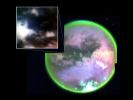
Titan-PIA06983_modest.jpgTitan (false colors) + the Huygens' probe landing site57 visiteCaption NASA originale:"This image taken by Cassini's visual and infrared mapping spectrometer clearly shows surface features on Titan. It is a composite of false-color images taken at three infrared wavelengths: 2 microns (blue); 2.7 microns (red); and 5 microns (green). A methane cloud can be seen at the south pole (top of image). This picture was obtained as Cassini flew by Titan at altitudes ranging from 100.000 to 140.000 Km (88.000 to 63.000 miles), less than two hours before the spacecraft's closest approach. The inset picture shows the landing site of Cassini's piggybacked Huygens probe".Ott 28, 2004
|
|

Titan-PIA06982_modest.jpgTitan from 1.200 Km54 visiteCaption NASA originale:"These images show the surface of Titan at two different infrared wavelengths. They were captured by the visual and infrared mapping spectrometer onboard Cassini as the spacecraft flew by at an altitude of 1200 Km - Cassini's closest approach yet to the Hazy Moon. The image on the left, taken at a wavelength of 2 microns, is the most detailed picture to date of the Titan's surface. It reveals complex landforms with sharp boundaries, which scientists are eager to further study. The image on the right was taken at a wavelength of 1 micron and shows approximately what a digital camera might see". Ad essere sinceri, da queste primissime immagini ravvicinate non riusciamo a distinguere praticamente nulla. Dobbiamo attendere che al Controllo Missione elaborino meglio le immagini giunte sino ad ora prima di lanciarci in nuove speculazioni relative alla configurazione effettiva della superficie di Titano. Abbiamo atteso anni, possiamo aspettare ancora qualche settimana...Ott 28, 2004
|
|

Titan-PIA06980_modest.jpgTitan: a "Secret Dream" for the Oil Companies"?54 visiteTitano, a quanto è emerso sino ad ora, potrebbe davvero essere (o diventare) un "sogno" per le grandi Multinazionali Petrolifere del nostro Pianeta. Perchè? Osservate il grafico e leggete le note originali NASA...:"This graph shows data acquired by Cassini as it flew by Titan at an altitude of 1.200 Km on Oct. 26, 2004 - its closest approach yet to the Hazy Moon. The data is from Cassini's ion and neutral mass spectrometer, which detects charged and neutral particles in the atmosphere. The graph reveals a diversity of hydrocarbons in the high atmosphere above Titan, including benzene and diacetylene". Ora, una delle tante (e neanche tanto nascoste...) verità che giacciono alle spalle dell'esplorazione spaziale, è nella ricerca di fonti energetiche significative e sfruttabili. Titano sembra proprio essere un Pianeta costituito - prevalentemente - da idrocarburi. La domanda è: premesso che un interesse commerciale può esistere, come fare a sfruttare le risorse di Titano in maniera economicamente vantaggiosa?Ott 28, 2004
|
|

Titan-PIA06138_modest.jpgTitan: the anomalous "circular" surface features are "camera artifacts"54 visiteCaption NASA originale from Planetary Photojournal:"The large, bottom image shows a complex interplay between dark and bright material on Titan's surface. This image was taken at a range of about 340.000 Km and the entire view is approximately 2.000 Km across. The surface appears to have been shaped by multiple geologic processes. Although a few "circular features" can be seen, there are no features that can be definitively identified as impact craters. The 3 smaller images show details of some of the features seen within the larger scene. The image on the upper right shows a scene approximately 500 Km across in which bright and dark bands of material span Et to Wt. The upper middle and upper right images show bright material surrounded by dark material in scenes approximately 300 Km across. The dark circular feature that appears at the top of each of the upper images is an artifact that was not removed by the preliminary image processing. There are no shadows or topographic shading visible in these images".Ott 28, 2004
|
|

Titan-Huygens_Landing_Site-08-PIA06136_modest.jpgHuygens' probe landing site56 visiteCaption originale NASA (dal "Planetary Photojournal"):"Shown here are two images of the expected landing site of Cassini's Huygen's probe (latitude 10.6 S, longitude 191 W). At right is a wide-angle image showing most of Titan's disc, with a scale of 10 Km (6.2 miles) per pixel. At left is a narrow-angle image of the landing site at a scale of 0.83 Km (0.5 miles) per pixel (location shown by black box at right). North is tilted about 45 degrees from the top of both images. The surface has bright and dark markings with a streamlined pattern consistent with motion from a fluid, such as the atmosphere, moving from west to east (upper left to lower right). The image at left is 400 Km (249 miles) wide. Both images were taken by Cassini's imaging science subsystem through near-infrared filters". Ott 28, 2004
|
|

Titan-PIA06139.jpgTitan (false colors)53 visiteDa "NASA - Picture of the Day" del 28.10.2004:"Normally hidden by a thick, hazy atmosphere, tantalizing features on Titan's surface appear in this false-color view. The image was recorded as the Cassini spacecraft approached its first close flyby of Saturn's smog-shrouded moon on October 26. Here, red and green colors represent specific infrared wavelengths absorbed by Titan's atmospheric methane while bright and dark surface areas are revealed in a more penetrating infrared band. Ultraviolet data showing the extensive upper atmosphere and haze layers is seen as blue. Sprawling across the 5.000 Km wide moon, the bright continent-sized feature known as "Xanadu" is near picture center, bordered at the left by contrasting dark terrain.
Saturn orbiter Cassini and Titan lander Huygens plan further explorations, but for now the origin and nature of Titan's surface features remain unknown".
...Unknown, per ora, diciamo noi...Ott 28, 2004
|
|
| 426 immagini su 36 pagina(e) |
 |
|
|
|
|
|
|
|
34 | |
|





