| |

| Ultimi arrivi - Titan: The "Foggy" Moon |

Titan-Regions-Fensal_Region-PIA07753.jpgThe "New World": Fensal Region and more56 visiteOriginal caption:"Like an ancient mariner charting the coastline of an unexplored wilderness, Cassini's repeated encounters with Titan are turning a mysterious world into a more familiar place.
During a Titan flyby on Sept. 7, 2005, the spacecraft's narrow-angle camera acquired multiple images that were combined to create the mosaic presented here. Provisional names applied to Titan's features are shown.
The image shows more than half of Titan's Saturn-facing hemisphere at moderate resolution, including the Fensal-Aztlan region, formerly known as "the H." This view is centered at 6,5° North Lat. and 20,6° West Long. and has a pixel scale of approx. 2 Km (about 1 mile) per pixel.
It is an orthographic projection, rotated so that North on Titan is up.
This view is composed of 20 images obtained on Sept. 7, 2005, each processed to enhance surface detail". Nov 05, 2005
|
|

Titan-Regions-Shangri_La_and_Xanadu_Region-PIA07752.jpgThe "New World": Shangri-La and Xanadu Region62 visiteOriginal caption:"This mosaic is a HR close-up of two contrasting Regions: dark Shangri-La and bright Xanadu. This view has a resolution of 1 Km (such as 0,6 mile) per pixel and is centered at 2,5° North Lat. and 145° West Long., near the feature called Santorini Facula.
The mosaic is composed of 10 images obtained on Oct. 28, 2005, each processed to enhance surface detail. It is an orthographic projection, rotated so that North on Titan is up". Nov 05, 2005
|
|
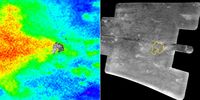
Titan-Huygens_Landing_Site-07-PIA03569.jpgHuygens' Landing Site?56 visiteOriginal caption:"On the left, in color, is a composite of the Imaging Camera and Infrared Data (red areas are brighter and blue darker, as seen in infrared). On the right is the Synthetic Aperture Radar Image. The Huygens descent images are shown inset on the left image and outlined in yellow on the right. The magenta cross in both images shows the best estimate of the actual Huygens Landing Site. This is a preliminary result, based on the best information available at the present time. In the left image, the brighter areas seen by the Huygens camera correspond to the large area depicted in red and yellow. On closer inspection, bright features within the Huygens mosaic seem to correspond to smaller features in the map composed of data from the VIS and Imaging Camera. On the right, the correspondence is less clear. In radar images bright features are usually rougher, so one would not necessarily expect an obvious connection".Nov 02, 2005
|
|

Titan-Dunes-PIA03568.jpgThe "Cat Scratches"55 visiteOriginal caption:"The geologic diversity of Titan's surface is well illustrated by this synthetic aperture radar image, obtained on Oct. 28, 2005, during the Cassini spacecraft's 9th Titan fly-by and 4th radar pass.
The bottom left and top right parts of the image show a series of parallel features resembling those discovered during the second radar pass. Called "cat scratches", these features may be dunes of water ice or hydrocarbon particles. The brighter area on the bottom right is thought to be rougher and possibly higher in elevation than the darker areas. Above the center of the image are dark, narrow winding channels carved by, and possibly still containing, liquids.
This image is about 300 by 250 Km and it is located 10° South Lat. and 292° West Long.".Nov 02, 2005
|
|

Titan-Dunes-PIA03567.jpgTitanian Dunes56 visiteOriginal caption:"Large areas of this Cassini synthetic aperture radar image of Titan are covered by long, dark ridges. They resemble the "cat scratches" seen in other places on Titan, but here they are longer and straighter. Spaced about 1 to 2 Km apart, they curve slightly around teardrop-shaped bright terrain, giving the impression of a Japanese garden of sand raked around boulders. The bright material appears to be high-standing rough material that the ridges bend around. This suggests that the ridges are dunes that winds have blown across the surface of Titan from left to right (roughly West to East).
This image was taken during the ninth Titan flyby on Oct. 28, 2005, (the fourth flyby for Cassini's synthetic aperture radar), at a distance of about 1300 Km (about 800 miles).
The image covers an area roughly 140 by 200 Km. It is located 13° South Lat. and 300° West Long.".
Nota: il vero mistero è 'dove' e 'come' la NASA abbia visto ed interpretato i rilievi in questione come possibili dune...Nov 02, 2005
|
|

Titan-Dunes_and_Ridges-PIA03566.jpgPossible Tectonic fractures on Titan56 visiteOriginal caption:"This synthetic aperture radar image of Titan was taken on Oct. 28, 2005, as the Cassini spacecraft flew by at a distance of 1.350 Km (about 840 miles). This was the first pass dedicated to radar and it was the fourth time Cassini's radar honed in on the smoggy moon.
The bright, curving features are high-standing ridges, poking up above the plains of Titan. Some of the ridges extend for over 100 Km (roughly 60 miles). They are likely to be tectonic in origin, formed by deformation of Titan's icy crust. The low-lying terrain between the ridges is covered in dark streaks, which could be dunes formed by wind. The streaks, spaced 1 to 2 Km apart (0,6 to 1 mile), curve between patches of the bright terrain, which probably act as topographic barriers.
This image is 400 Km (about 250 miles) across and 275 Km-wide (about 170 miles). It is located 8° South Latitude and 215° West Longitude".
Nov 02, 2005
|
|

Titan-Channels-Unnamed_Channels-PIA03565.jpgTitan's rainfall?!?55 visiteIn contrast to the image "Canyonlands on Titan", this bright terrain is cut by channels that are variable in width; they form both radial and branching networks and such patterns are reminiscent of networks formed by rainfall on Earth.
At the bottom of the frame, the channels radiate from a possible source into a dark, smooth region that seems flatter and more plains-like. One interpretation is that the higher, rougher terrain has been cleansed of organic debris and eroded by methane rainfall. The removed material has then been deposited into the lower plains.
This Cassini SAR image of Titan was taken on Sept. 7, 2005, at a distance of 2000 Km from Titan. It is located near 48° South Latitude, 14° West Longitude and extends about 240 Km right to left.Set 17, 2005
|
|

Titan-Channels-Unnamed_Channels-PIA03564.jpgCanyonland on Titan56 visiteFluids have flowed and cut these deeply-incised channels into the icy surface of Titan as seen in this SAR image. The channels are roughly 1 Km across (about 0,6 miles) and perhaps 200 mt deep (about 650 feet); some can be traced as far as 200 Km (about 120 miles). Many of them have angular segments suggesting they may follow faults in Titan's crust.
Taken together with the two other radar passes (October 2004 and February 2005), these very HR images have identified at least two distinct types of drainage and channel formation on Titan. The style shown in this image consists of long valleys following angular patterns without many tributaries, suggesting that fluids flow over great distances.
This Cassini radar image was acquired as a part of the Titan flyby observations taken on Sept. 7, 2005, from a distance of about 2000 Km. The area is located at about 55° South Latitude, 7,5° West Longitude and extends over 300 km (about 186 miles) right to left.Set 17, 2005
|
|

Titan-Shoreline-PIA03563_modest.jpgShoreline on Titan?55 visiteCaption originale:"This SAR (Synthetic Aperture Radar) image of the surface of Saturn's moon Titan, was obtained by the Cassini spacecraft on Sept. 7, 2005. The bright, rough Region on the left side of the image seems to be topographically "high terrain" that is cut by "channels" and "bays".
The boundary of the bright (rough) Region and the dark (smooth) Region appears to be a "shoreline". The patterns in the dark area indicate that it may once have been flooded, with the liquid having at least partially receded.
The image is 175 Km high and 330 Km wide (about 109 by 205 miles), and is located at 66 degrees south latitude, 356° West Longitude in the Southern Hemisphere of Titan".Set 17, 2005
|
|

Titan-Regions-Fensal_and_Aztlan_Region-PIA07732.jpgFensal and Aztlan Region on Titan58 visiteDuring its Sept. 7, 2005, flyby of Titan, Cassini acquired images of territory on the moon's Saturn-facing hemisphere that were assembled to create this mosaic. Once known only as "The H" because the Region looks something like the letter on its side, features in this Region now possess provisional names. The Northern Branch of the H is now called Fensal, while the Southern Branch is known as Aztlan.
Fensal is littered with small "islands" ranging in size from 5 to 40 Km across. These landforms currently are thought to be water ice upland areas, surrounded by shallower terrain that is filled-in with dark particulate material from the atmosphere. A few larger islands are also seen, like Bazaruto Facula (near right, containing a dark crater) and several islands in Western Fensal. When viewed in images of Shangri-La (on the other side of Titan), island-like landforms of this size tend to occur in clusters with apparent preferred orientations. The small islands in Fensal appear much more scattered (and most appear roughly circular), although a few islands do have an east-west orientation to their long axis.
Aztlan, on the other hand, appears comparatively devoid of small islands, with three large islands in its western reaches, plus only a few smaller islands. The largest of these islands is called "Sotra Facula" (just right of center in the bottom left mosaic frame), and measures 240 by 120 kilometers (149 to 75 miles) across.
Set 15, 2005
|
|

Titan-PIA07729.jpgTitan, from about 213.000 Km (natural colors)55 visiteAs Cassini approached Titan on Aug. 21, 2005, it captured this natural color view of the moon's orange (nota: veramente, a parte i nostri occhi - che, come tutti sanno, possono sbagliare -, il software che utilizziamo per valutare la densità cromatica dei frames NASA che pubblichiamo e che ci permette altresì di identificare i 'colori maggiori' che sono presenti in essi ci dice che il colore dominante è il "giallo"...), global smog. Titan's hazy atmosphere was frustrating to NASA Voyager scientists during the first tantalizing Titan flybys 25 years ago, but now Titan's surface is being revealed by Cassini with startling clarity (...).
Images taken with the wide-angle camera using red, green and blue spectral filters were combined to create this color view. The images were acquired at a distance of approximately 213.000 Km from Titan and at a Sun-Titan-spacecraft, or phase, angle of 55°. Resolution in the image is about 13 Km per pixel.Ago 26, 2005
|
|

Titan-PIA07730.jpgTitan, from about 159.000 Km54 visiteThis processed image from Cassini's Aug. 22, 2005, flyby of Titan reveals mid-latitudes on the Moon's Saturn-facing side.
Provisional names recently have been applied to a number of features on Titan. Features within the Region seen here - long known informally as the "H" - now have names like Tsegihi, Aztlan and Quivira.
The bright 215-Km-wide feature provisionally named "Bazaruto Facula" is clearly visible right of center, with its dark, unnamed 80-Km-wide crater at its center.
This view was acquired with the wide-angle camera at a distance of approx. 159.000 Km from Titan using a spectral filter centered on infrared wavelengths at 939 nnmts. The image scale is 9 Km per pixel.
Previous observations indicate that, due to Titan's thick and very hazy atmosphere, the sizes of surface features that can be resolved are a few times larger than the actual pixel scale.Ago 26, 2005
|
|
| 426 immagini su 36 pagina(e) |
|
|
|
|
|
28 | |
|
|
|
|
|
|





