| |

| Ultimi arrivi - Titan: The "Foggy" Moon |

Titan-W00028749.jpgOn the "Dark Side" of Titan...58 visitenessun commentoMareKromiumGiu 10, 2007
|
|

Titan-Huygens_Landing_Site-00-LS27_PSS_LSoderblom_DISR_Topo20070323.jpgHuygens Probe Landing Site (perspective)58 visiteThis West-looking perspective of the Huygens Landing Site shows the Huygens descent trajectory in blue (the blue vertical lines indicate the ground track location). The base map (16 metres per pixel) is a mosaic obtained by the Descent Imager and Spectral Radiometer (DISR) on board Huygens.MareKromiumGiu 04, 2007
|
|

Titan-Huygens_Landing_Site-02-LS28_PSS_LASoderblom_VIMSRADAR20070323.jpgHuygens Probe Landing Site58 visiteThese images of the Huygens Landing Site on Titan were obtained by Cassini’s SAR radar (1st and 3rd rows) and VIMS (2nd and 4th rows) instruments, and are correlated in this composite view.
The 4 upper images show the Region of the Sinlap Crater in the Huygens Landing Site Region. The area shown is about 850 by 1150 Km wide.
The 4 lower images are colour-mapped as: red, to indicated solid dunes; yellow, to indicate a partial dune coverage; and green to indicate not mappable areas.MareKromiumGiu 04, 2007
|
|

Titan-Regions-Omacati_Macula_Region-01-LS28_PSS_LASoderblom_VIMSRADAR20070323.jpgDunes in the "Omacati Macula" Region59 visiteThe first two images of Titan (from the top) were obtained by Cassini’s SAR radar and the VIMS imager, respectively. They cover an area about 300 by 1000 Km wide and centred at 20° North and 45° West in the Omacatl Macula Region.
Dunes are generally rare in this area, even if some of them can still be seen in the enlargement provided by the bottom right radar image (blue arrow). These dunes are correlated to the brown spot visible in the VIMS image.
The green arrows linking the lower left radar image with the VIMS image illustrate that in this region the dark blue units are correlated to with sinuous channels and flow features.MareKromiumGiu 04, 2007
|
|

Titan-Regions-Sinlap_Region-LS28_PSS_LASoderblom_VIMSRADAR20070323.jpgSinlap Region and Guabonito Crater61 visiteIn this composite image, Titan’s surface areas are correlated.
The top pair is composed by Cassini’s radar images, while the bottom pair shows Cassini’s VIMS images. Each of the four panels corresponds to an area about 200 Km wide.
The left views show the Sinlap Crater; the brown features in the bottom panel correspond to the large dune fields visible in the top panel.
The right views show the Guabonito Region situated at about 150 Km East of the Huygens Landing Site. MareKromiumGiu 04, 2007
|
|

Titan-Huygens_Landing_Site-05-LS27_PSS_LSoderblom_DISR_Topo20070323.jpgTectonic and fluid-flow patterns on Titan (HR)58 visiteThis image of Titan’s surface, obtained by Huygens’ DISR imager, shows patterns of tectonic and fluid-flow activity.
The tectonic patterns are indicated by blue lines; the drainage divide is indicated by the red line; flow directions are indicated by the green arrows.
The Huygens Landing Site is marked by a white cross.
MareKromiumGiu 04, 2007
|
|

Titan-Surface-00-LS28_PSS_LASoderblom_VIMSRADAR20070323.jpgHuygens Probe Landing Site57 visiteThis image composite shows three different views of the Huygens landing site. The top image was obtained by Cassini’s VIMS instrument in the infrared. The middle one is a mosaic of all the images obtained by the DISR visible camera on board Huygens, and shows surface features. The bottom image was obtained by Cassini’s SAR radar. MareKromiumGiu 04, 2007
|
|
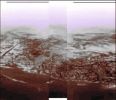
Titan-Huygens_Landing_Site-03-IMG002628-br500.jpgCoastline on Titan58 visiteThe deposits form when solar ultraviolet radiation and charged particles react at high altitudes with Titan’s abundant methane to produce carbon- and hydrogen-bearing (hydrocarbon) molecules like ethane and acetylene, and more complex nitrogen-bearing molecules generally called tholins. These products drift down to the surface as aerosols much in the same way smog particles on Earth form and coat surfaces. On Titan however these deposits may accumulate to thicknesses of hundreds of metres deep.
The dunes are composed of sand-sized material that agglomerated, either during its descent or when reworked by geological processes on the surface. The ice and organic landforms are as different from one another as they are spectacular. To the north of Huygens’ landing site are the bright highlands, displaying channels in a very ramified pattern, branching four or five times as they climb into the hills.
Stereoscopic images from the Descent Imager/Spectral Radiometer (DISR) camera on Huygens have now been analysed and show that some of the ridges between the channels rise to 150 - 200 metres in height, with slopes of thirty degrees. “This is extremely rugged terrain,” says Soderblom. The shape suggests that they are drainage channels, cut by liquid methane falling as rain.
MareKromiumGiu 04, 2007
|
|

Titan-Huygens_Landing_Site-04-IMG002629-br500.jpgDrainage, flow and erosion on the Huygens landing site58 visiteClose - by are stubby canyons with only a few branches. They have probably been formed by ‘spring sapping’, whereby methane flows through the subsurface before emerging as a spring near the base of a hill. The spring erodes the hillside, causing it to collapse and form a cliff face.
The third area is the flat dark plain. This is mostly water ice mixed with tholin grit. “Titan’s river channels, canyons, and flood plains rival the variety seen on Earth,” says Soderblom. The dark plains show markings that suggest the region occasionally experiences flash flooding, but not from the highland drainage channels. Instead large quantities of liquid methane appear to flow from east to west.
Planetary scientists can now begin to piece together the sequence of events that led to the formation of this exotic landscape. “Huygens and Cassini have taken giant steps forward in our understanding of Titan,” says Soderblom.
MareKromiumGiu 04, 2007
|
|

Titan-PIA09034_H-1.jpgCrescent Titan74 visiteHuygens scored a first in 2005 by measuring the electrical conductivity of Titan’s atmosphere. The results hint at a new way to investigate the subsurface layers of Titan and could provide insight into whether or not Titan has a subsurface ocean.
The Permittivity, Waves and Altimetry (PWA) sensor on the Huygens Atmosphere Structure Instrument (HASI) detected an extremely low frequency (ELF) radio wave during the descent. It was oscillating very slowly for a radio wave, just 36 times a second, and increased slightly in frequency as the probe reached lower altitudes.
If the PWA team confirms that the signal is a natural phenomenon and not an artefact of the way the instrument worked, they will have discovered a powerful new way to probe not just the atmosphere of Titan but its subsurface as well.
The only other world on which ELF waves were detected before was Earth. They are reflected by both the surface of the Earth and its ionosphere, the rarefied region of the atmosphere where most particles are electrically charged. This turns the atmosphere into a giant ‘sound box’ where certain frequencies of ELF waves resonate and are reinforced, whilst other die away.
On Titan, however, the surface is a poor reflector because of its low conductivity and so these waves penetrate the interior. “The wave could have been reflected by the liquid-ice boundary of a subsurface ocean of water and ammonia predicted by theoretical models,” says Fernando Simões, CETP/IPSL-CNRS, France, and a member of the PWA team.
If Simões is right, successful modelling of how ELF waves resonate on Titan could lend support to the ocean’s existence and tell scientists about the depth at which it sits. Understanding the resonance however, is difficult.
Above about 100 kilometres altitude on Earth, the ionosphere provides the upper reflecting layer of the resonating cavity. At Titan, PWA revealed that things are more complicated. Apart from the ionosphere, at a much higher altitude of about 1200 kilometres, Huygens found a layer of ionized particles consisting of electrons, at 63 kilometres. “This does not match any previous prediction for Titan,” says Simões. To some extent, it splits Titan’s atmosphere into two resonating chambers.
With so much at stake, the PWA team are checking to make sure the detection is real and not an artefact generated by the spacecraft. They have already ruled out electrical interference from the instrument itself.
Two small arms, one on either side of Huygens, create an antenna and the team’s next goal is to investigate whether the arms could have oscillated during the descent. Simões and colleagues are building a special chamber to hold a replica of the instrument at the low temperature of Titan’s atmosphere, between 100-200 degrees Kelvin (about -173 to -73 °C), in order to check whether the antenna resonates at 36 hertz. If it does, it probably means that the signal is an artefact. If it does not, confidence in the signal’s reality will increase and the investigation of the atmosphere and subsurface can begin.
But perhaps the biggest mystery is what generated the ELF wave in the first place. On Earth, they are initiated by lightning strikes that make electrons in the atmosphere oscillate, releasing the ELF waves.
The PWA was designed to search for ELF waves on Titan while a microphone on Huygens kept an ear out for thunder – a sure sign of lightning. Cassini has also been watching for lightning using its cameras.
However, Huygens suggests that there is no lightning, or very little. “If there is lightning on Titan, it is significantly less than the amount of lightning that Earth experiences,” says Simões. So what generated Titan’s ELF? No one is quite sure yet. “It might be generated by an interaction with Saturn’s magnetosphere or related to Titan’s intrinsic fields,” suggests Simões. “Titan is proving to be an intriguing environment.”
One thing is certain: there is plenty to investigate. “The measurement of atmospheric electricity is something really new and exciting,” says Jean-Pierre Lebreton, ESA Huygens Project Scientist. “We could send similar instruments to study atmospheric electricity on other celestial bodies, in particular Venus, Mars, and the giant planets,” adds Simões.
The PWA team expect to release more definitive results when their investigation is complete.
MareKromiumGiu 04, 2007
|
|

Titan-Seas-PIA09211.jpgJust like California...60 visiteOn May 12, 2007, Cassini completed its 31st Fly-By of Saturn's moon Titan, which the team calls T30. The radar instrument obtained this image showing the coastline and numerous island groups of a portion of a large sea, consistent with the larger sea seen by the Cassini imaging instrument.
Like other bodies of liquid seen on Titan, this feature reveals channels, islands, bays, and other features typical of terrestrial coastlines and the liquid, most likely a combination of methane and ethane, appears very dark to the radar instrument. What is striking about this portion of the sea compared to other liquid bodies on Titan is the relative absence of brighter regions within it, suggesting that the depth of the liquid here exceeds tens of meters.
Of particular note is the presence of isolated islands, which follow the same direction as the peninsula to their lower right, suggesting that they may be part of a mountain ridgeline that has been flooded. This is analogous to, for example, Catalina Island off the coast of Southern California.
MareKromiumMag 25, 2007
|
|

Titan-PIA08945.jpgA new "Ortographic View" of Titan69 visiteBright and dark terrains on Titan's Trailing Hemisphere are revealed by Cassini's Imaging Science Subsystem in this mosaic of images taken during the T28 flyby in April 2007. The Region shown in this image, centered on the northern part of Titan's Trailing Hemisphere (near 31,2° North and 220,7° West), had only been seen at very low resolution until February 2007, when Cassini flew over this area for the first time. This mosaic consists of images taken during one of a series of flybys in early 2007 designed to study this long unavailable part of Titan.
Several intriguing surface features can be seen in this mosaic that warrant further study. Along the top of the mosaic is a series of dark lineaments, or linear features, that stand out against the blandness of the Northern, Mid-Latitude Terrain.
These features were also observed by the RADAR instrument in December 2006 and represent an area of potential future co-analysis for the RADAR and camera teams. Another such region is the large bright area known as Adiri at bottom center, also imaged by RADAR in October 2005.
The mosaic shows a number of dark areas within Adiri Regio that line up with small dune fields observed by RADAR. A portion of the dark terrain surrounding Adiri was also observed in 2005 by RADAR, and likewise was found to consist of large stretches of longitudinal dune fields - further supporting the correlation between equatorial dark regions and dune "seas".
To the East of Adiri is a dark spot surrounded by a ring of bright material, which may be associated with an impact crater similar to Sinlap, discovered earlier in the Cassini mission (see PIA6222).
This mosaic consists of 29 separate frames using a total of 116 images.
Each frame consists of three images, taken using a filter sensitive to near-infrared light centered at 938 nanometers, allowing for observations of Titan's surface and lower atmosphere, added together. An image taken using a filter sensitive to visible light centered at 619 nanometers was then subtracted from the product, effectively removing the lower atmosphere contribution to the brightness values in the image, increasing image contrast and improving the visibility of surface features.
This process is also intended to reduce noise, but some camera artifacts still remain, such as a dark ring caused by dust in the camera system near the bottom right of each frame.
The images used for this mosaic were taken on April 11, 2007 from distances ranging from approx. 106.000 to 180.000 Km (such as from about 66.000 to 112.000 miles).
This mosaic is in an orthographic view of Titan (an orthographic view is most like the view seen by a distant observer looking through a telescope).
MareKromiumMag 23, 2007
|
|
| 426 immagini su 36 pagina(e) |
|
|
|
|
|
20 | |
|
|
|
|
|
|





