| Ultimi arrivi - Titan: The "Foggy" Moon |

Titan-W00062861-920.gifIn-Transit (GIF-Movie in Natural Colors; credits: Elisabetta Bonora)55 visiteChe dire? Uno SPETTACOLARE Gif-Movie realizzato in "Natural Colors" dalla nostra eccezionale Amica e Partner, Elisabetta Bonora.
Un Lavoro davvero fantastico che, se non altro "pubblicamente", la NASA NON HA ancora prodotto (rectius: NON HA VOLUTO PRODURRE).
E questo dato, sia detto chiaramente ed una volta per tutte, ci rende non solo orgogliosi, ma anche - e se non altro dal punto di vista della Tempestività e della (grandissima!) Qualità dei Lavori prodotti e pubblicati on-line - il Sito Scientifico/Divulgativo numero UNO in Europa (e, forse, uno dei Top Five al Mondo)!
Grazie a Tutti. MareKromiumFeb 01, 2010
|
|

Titan-EB-MV.jpg"Methane View" of Titan (credits: Elisabetta Bonora)56 visitenessun commentoMareKromiumFeb 01, 2010
|
|

Titan-EB.gifTitan (highly overexposed) with Startrails and a really bizarre "Light-Shadows' Effect" (GIF-Movie; credits: Elisabetta Bonora - Lunexit Team)56 visitenessun commentoMareKromiumGen 31, 2010
|
|

Titan-Mountains-PIA12496.jpgNew Wrinkles on Titan (Colorization made on Radar Image - credits: Dr Paolo C. Fienga - Lunexit Team)55 visiteIn this Synthetic Aperture Radar (SAR) image obtained by NASA's Cassini Spacecraft, two generally similar features, upper center and lower right, appear to be low Mountains with Grooves running roughly in the up-down direction.
A set of straight lines are also visible at lower left.
But what made the Grooves?
Grooves can result from forces that originate from within a planet - including forces that pull the Crust of a planet apart and cracks produced by melt intruding into the Crust.
They can also come from external forces like wind or rainfall, which produces river channels that can cut down through layers of rock.
All of these produce grooves on Earth's Surface, and may also be at work on Titan.
Another intriguing thing about this image is that in this image the "light" (actually the radar illumination) comes from the top. With this kind of illumination, the upper side of these mountains should be bright because they face the illumination, but the left side of the upper-center feature and the right side of the lower feature are bright. The brightness indicates that there is a different material in these areas, and the Grooves exist in both dark and light materials.
The Titan Radar Mapper acquired this image at 41° North Latitude and 213° West Longitude on December 28, 2009.
The image measures approx. 250 Km (about 160 miles) high and approx. 285 Km (about 180 miles) wide, with resolution of roughly 350 meters (1100 feet) per pixel. North is on the left, and the image is illuminated from the top.
The S.I.A. varies from 11 to 25°.
Two dark horizontal lines that run across the middle of the image show the joints between individual radar beams and are not features on the Titan Surface.MareKromiumGen 26, 2010
|
|

Titan-Regions-Fensal_Aztlan_Aaru_and_Senkyo_Regions-PIA12531.jpgTitanian Geography (Natural Colors; credits: Dr Paolo C. Fienga - Lunexit Team)56 visiteCaption NASA:"The Cassini Spacecraft gazes at several albedo features on Saturn's largest moon, Titan.
Left to right are four Dark Regions: Fensal, Aztlan, Aaru and a part of Senkyo. The bright area Quivira lies near the center of the image, separating Fensal and Aztlan. This view looks toward the Saturn-facing side of Titan. North on Titan is up and rotated 24° to the right.
The image was taken with the Cassini Spacecraft narrow-angle camera on June 25, 2009 using a spectral filter sensitive to wavelengths of Near-InfraRed Light centered at 938 nanometers. The view was obtained at a distance of approx. 1,3 MKM (about 808.000 miles) from Titan and at a Sun-Titan-Spacecraft, or Phase, Angle of 12°.
Image scale is roughly 8 Km (about 5 miles) per pixel".MareKromiumGen 23, 2010
|
|

Titan-N00149992-N00150001.jpgTitan, in Time... (Natural Colors; credits: Elisabetta Bonora - Lunexit Team)54 visitenessun commentoMareKromiumGen 17, 2010
|
|

Titan_and_Tethys-PIA12528.jpgMutual Event Sequence (Natural Colors; credits: NASA/JPL/Space Science Institute)58 visiteCaption NASA:"Saturn's moon Tethys with its prominent Odysseus Crater silently slips behind Saturn's largest moon Titan and then emerges on the other side.
Tethys is not actually enshrouded in Titan's Atmosphere. Tethys is more than twice as far from Cassini than Titan in this sequence: Tethys is about 2,2 MKM (such as approx. 1,4 MMs) from Cassini, while Titan is about only 1 MKM (approx. 621.000 miles) away.
These two color views were captured about 18 minutes apart, with the view on the right side taking place first.
These images are part of a so-called "Mutual Event Sequence" in which one moon passes close to or in front of another (from CASSINI point of view). Such observations help scientists refine their understanding of the orbits of Saturn's moons.
Images taken using red, green and blue spectral filters were combined to create this Natural Color view. The images were obtained with the Cassini Spacecraft narrow-angle camera on Nov. 26, 2009.
The images were obtained with the Cassini Spacecraft narrow-angle camera on Nov. 26, 2009.
Image scale is roughly 6 Km (a little less than 4 miles) per pixel on Titan and apprx. 13 Km (a little more than 8 miles) per pixel on Tethys".
MareKromiumGen 15, 2010
|
|

Titan_and_Tethys-N00147394-96-EB-LXTT.jpgSaturnian Gems: Titan and Tethys (Natural Colors; credits: Elisabetta Bonora - Lunexit Team)55 visitenessun commentoMareKromiumDic 26, 2009
|
|

Titan-PIA12511.jpgTitanian Afterlight (Natural Colors; credits: Dr Paolo C. Fienga - Lunexit Team)66 visiteCaption NASA:"The Cassini Spacecraft looks toward the dark side of Saturn's largest moon as a circle of light is produced by sunlight scattering through the periphery of Titan's Atmosphere.
A detached, high-altitude global Haze Layer encircles the Planet.
North on Titan is up and rotated 2° to the left.
The image was taken in Visible Blue Light with the Cassini Spacecraft narrow-angle camera on Oct. 9, 2009. The view was acquired at a distance of approx. 1,4 MKM (about 870.000 miles) from Titan and at a Sun-Titan-Spacecraft, or Phase, Angle of 157°.
Image scale is roughly 9 Km (about 5,5 miles) per pixel".MareKromiumDic 23, 2009
|
|
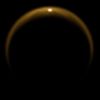
Titan-Lakes-Unnamed_North_Polar_Lake-PIA12481.jpgReflection of Sunlight off a Titanian Northern Lake (Natural Colors; credits: NASA/JPL/University of Arizona/DLR)173 visiteThis image shows the first flash of sunlight reflected off a lake on Saturn's moon Titan. The glint off a mirror-like surface is known as a specular reflection. This kind of glint was detected by the visual and infrared mapping spectrometer (VIMS) on NASA's Cassini spacecraft on July 8, 2009. It confirmed the presence of liquid in the moon's northern hemisphere, where lakes are more numerous and larger than those in the southern hemisphere. Scientists using VIMS had confirmed the presence of liquid in Ontario Lacus, the largest lake in the southern hemisphere, in 2008.
The northern hemisphere was shrouded in darkness for nearly 15 years, but the sun began to illuminate the area again as it approached its spring equinox in August 2009. VIMS was able to detect the glint as the viewing geometry changed. Titan's hazy atmosphere also scatters and absorbs many wavelengths of light, including most of the visible light spectrum. But the VIMS instrument enabled scientists to look for the glint in infrared wavelengths that were able to penetrate through the moon's atmosphere. This image was created using wavelengths of light in the 5 micron range.
By comparing the new image to radar and near-infrared light images acquired from 2006 to 2008, Cassini scientists were able to correlate the reflection to the southern shoreline of a Titan lake called Kraken Mare. The sprawling Kraken Mare covers about 400,000 square kilometers (150,000 square miles). The reflection appeared to come from a part of the lake around 71 degrees north latitude and 337 degrees west latitude.
It was taken on Cassini's 59th flyby of Titan on July 8, 2009, at a distance of about 200,000 kilometers (120,000 miles). The image resolution was about 100 kilometers (60 miles) per pixel. Image processing was done at the German Aerospace Center in Berlin and the University of Arizona in Tucson.
MareKromiumDic 18, 2009
|
|

Titan-Regions-Senkyo_Region-PIA11636.jpgThrough the Fog, in the Darkness: the Senkyo Region (Absolute Natural Colors; credits for the additional process. and color.: Dr Paolo C. Fienga - Lunexit Team)57 visiteCaption NASA:"The low albedo feature known as Senkyo is (barely!) visible through the haze of Titan's Atmosphere.
See PIA08231 to learn about this area that appears dark near Titan's Equator. This view looks toward Saturn-facing Side of Titan and is centered on terrain at 1° South Lat. and 345° West Longitude. North on Titan is up and rotated 10° to the right.
The image was taken with the Cassini Spacecraft narrow-angle camera on Oct. 12, 2009 using a spectral filter sensitive to wavelengths of Near-InfraRed Light centered at 938 nanometers. The view was acquired at a distance of approx. 296.000 Km (about 184.000 miles) from Titan and at a Sun-Titan-Spacecraft, or Phase, Angle of 11°.
Image scale is about 2 Km (approx. 1,3 mile) per pixel".MareKromiumDic 02, 2009
|
|

Titan-N00141759_to_N00141771_RAWC-SD.jpgTitan (Superdefinition and Enhanced Natural Colors; credits for the additional process. and color.: Dr M. Faccin - Lunexit Team)56 visitenessun commentoMareKromiumNov 22, 2009
|
|
| 426 immagini su 36 pagina(e) |
 |
|
|
|
|
11 | |
|
|
|
|





