| Ultimi arrivi - Mars, Deimos and Phobos: Maps |

008-Mars_South_East.jpgThe South-Eastern Region of Mars116 visitenessun commentoApr 22, 2005
|
|
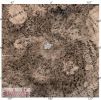
007-Mars_South_Pole.jpgThe South Polar Region of Mars115 visitenessun commentoApr 22, 2005
|
|

006-Mars_Topography.jpgMars Global Map: Topography112 visitenessun commentoApr 22, 2005
|
|

012-Thermal_Inertia.jpgMars Global Map: Thermal Inertia109 visitenessun commentoApr 22, 2005
|
|

005-Surface_Ages.jpgMars Global Map: Age of Main Surface Features107 visitenessun commentoApr 22, 2005
|
|

004-Mars_Nomenclature.jpgMars Global Map: Main Albedo Features and Nomenclature141 visitenessun commentoApr 22, 2005
|
|

002-Mars_Map.jpgMars Global Map (Mariner 9): Main Regions and Landing Sites186 visitenessun commentoApr 22, 2005
|
|

000-Mars_Map_Global.jpgMars Global Map - MGS210 visiteNegli ultimi tempi alcuni Amici Lettori ci hanno scritto chiedendoci delucidazioni in ordine alla posizione ("dislocazione geografica", ad essere precisi) di qualche rilievo Marziano particolarmente interessante e famoso (basti pensare a Cydonia Mensae - la Regione della Sfinge - come alla Valles Marineris, o all'Olympus Mons, oppure alla Regione di Acidalia e così via...).
Domande oneste e legittime che ci hanno fatto capire che non tutti conoscono la Geografia Marziana e che è errato "darla per scontata".
Come saprete, esistono svariati Siti che riportano mappe di tutti i tipi che definiscono il Pianeta Rosso sin nei minimi dettagli, ma forse non faremo cosa sgradita ai nostri Lettori riprendendo e riproponendoVi qualcuna delle mappe più precise e leggibili.Apr 22, 2005
|
|
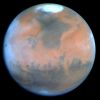
000-Mars.jpgMars: the Red Planet with "Blue Limbs"...266 visiteMars Data and Statistics
Mass (kg) = 6.421e+23
Mass (Earth = 1) = 1.0745e-01
Equatorial radius = 3.397,2 Km
Equatorial radius (Earth = 1) = 5.3264e-01
Mean density (gm/cm^3) = 3,94
Mean distance from the Sun = 227.940.000 Km
Mean distance from the Sun (Earth = 1) = 1,5237
Rotational period (hours) = 24,6229
Rotational period (days) = 1,025957
Orbital period (days) = 686,98
Mean orbital velocity = 24,13 Km per second
Tilt of axis = 25,19°
Orbital inclination = 1,850°
Equatorial surface gravity (m/sec^2) = 3,72
Equatorial escape velocity = 5,02 Km per second
Magnitude (Vo) = - 2.01
Minimum surface temperature = - 140°C
Mean surface temperature = - 63°C
Maximum surface temperature = + 35°C
Atmospheric pressure (bars) = 0,007
Atmospheric composition: Carbon Dioxide (C02) 95,2%; Nitrogen 2,7%; Argon 1,6%; Oxygen 0,13%; Carbon Monoxide 0,07%; Water 0,03%; Neon 0,00025%; Krypton 0,00003%Dic 15, 2004
|
|

Mars-013.jpgMars: Yesterday and Today264 visiteDoes Mars have canals? A hot debate topic of the late 1800s, several prominent astronomers including Percival Lowell not only claimed to see an extensive system of long straight canals on Mars, but used them to indicate that intelligent life exists there. The relatively close opposition of 1894 was used to make drawings like the one digitally re-scaled on the above left. The above map was originally prepared by Eugene Antoniadi and redrawn by Lowell Hess for the book Exploring Mars, by Roy A. Gallant. In more modern times, the latest Mars opposition has allowed the Hubble Space Telescope to capture a picture of similar orientation. Comparison of the two images shows that large features were impressively recorded, but that an extensive system of long and straight canals just does not exist. Satellites orbiting Mars have now shown conclusively that the red planet does indeed have surface features similar to canals, but that these are usually smaller, curved, and less extensive than that previously claimed. Real canyon systems like Noctis Labyrinthus are most likely cracks caused by surface stress.
Set 14, 2004
|
|

MARS-007.jpgMars from Earth241 visiteUna visione solo apparentemente identica alla precedente: in questo secondo caso, infatti - anche se stentiamo a crederlo... - l'immagine arriva da Terra! L'inclinazione dell'asse del Pianeta Rosso è diversa; la calotta Sud-Polare ci appare un pò più sviluppata rispetto a quanto si vedeva nell'immagine HST ed anche la circonferenza del Pianeta sembra leggermente più grande. La definizione è addirittura migliore rispetto al frame HST; il colore della superficie di Marte è più intenso ed i bordi azzurri (blue limbs) sono spariti.
Domanda: ma quale delle due immagini è più veritiera?Set 10, 2004
|
|

MARS-005.jpgMars from the Hubble Space Telescope239 visiteI riflessi azzurri che apparivano evidentissimi nel frame precedente (immagine ripresa da Terra) sono ancora visibili, sia pure in forma meno marcata, in questo fotogramma HST. Che ne dite? Si tratta di segni evidenti che il cielo di Marte è azzurro (magari non sempre, ma comunque abbastanza di frequente)? Oppure sono "scherzi" dello sviluppo delle fotografie? Oppure sono "effetti speciali" creati per confondere le idee?Set 10, 2004
|
|
| 54 immagini su 5 pagina(e) |
 |
|
4 |
|








