| Ultimi arrivi - From Ashes to Eternity: the Phoenix Mars Mission |

C-Phoenix-PolarDunes.jpgPossible Northern Scenarios (1) - Dark Dunes and Ice65 visitenessun commentoMareKromiumAgo 04, 2007
|
|

C-Phoenix-PolarTexture.jpgPossible Northern Scenarios (2) - Layers73 visitenessun commentoMareKromiumAgo 04, 2007
|
|
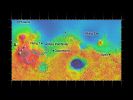
C-Phonix_Others.jpgPhoenix will not be alone on Mars...64 visitenessun commentoMareKromiumAgo 04, 2007
|
|

B-PIA09944.jpgFar-Northern Destination for Phoenix Mars Lander69 visiteCaption NASA:"The planned Landing Site for NASA's Phoenix Mars Lander lies at a latitude on Mars equivalent to Northern Alaska on Earth. It is within the region designated "D" on this global image.
This is an orthographic projection with color-coded elevation contours and shaded relief based on data from the Mars Orbiter Laser Altimeter on NASA's Mars Global Surveyor Orbiter. Total vertical relief is about 28 Km (about 17 miles) from the top of the highest volcano (red) to the Northern Lowlands (blue).
North Pole is where the longitude lines converge".MareKromiumAgo 04, 2007
|
|
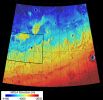
B-PIA09945.jpgTopographical Context of Phoenix Landing Region65 visiteCaption NASA:"Color coding indicates the topography in this map of the region of Mars from 65 to 72° North Latitude and from 230 to 250° East Longitude. This area was designated "Region D" in the process of evaluating potential Landing Sites for NASA's Phoenix Mars Lander. The location chosen for safe landing sites is within the box bordered with a heavy black line along the western boundary of this region.
Elevation in the region varies from about 3600 meters (11.800 feet) to 4400 meters (14.400 feet) below the zero reference point for Martian Surface Elevation.
The topographical information is from the Mars Orbiter Laser Altimeter on NASA's Mars Global Surveyor Orbiter".MareKromiumAgo 04, 2007
|
|

B-PIA09946-1.jpgPossible Landing Ellipses for Phoenix (1)65 visiteCaption NASA:"Launch date makes a difference in the orientation of ellipses marking where NASA's Phoenix Mars Lander will have a high probability of landing, given the planned targeting for the Spring 2008 Landing Site. This map shows possible landing ellipses for the Aug. 3, 2007, opening of the launch period (the ellipse oriented North-West to South-East) and for launch dates at the middle and end of the 3-week period of launch opportunities.
The map also shows a color-coded interpretation of geomorphic units -- categories based on the surface textures and contours. The yellow-coded area surrounding a crater informally named "Heimdall" appears to have even fewer boulders on the surface than other units. The geomorphic mapping is overlaid on a shaded relief map based on data from the Mars Orbiter Laser Altimeter on NASA's Mars Global Surveyor orbiter.
The red box indicates the location of an image PIA09947 from the Context Camera on NASA's Mars Reconnaissance Orbiter".MareKromiumAgo 04, 2007
|
|
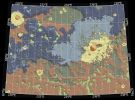
B-PIA09946-2.jpgPossible Landing Ellipses for Phoenix (2)64 visitenessun commentoMareKromiumAgo 04, 2007
|
|

A-Phoenix-006.jpgLooking at the Twilights...71 visitenessun commentoMareKromiumAgo 04, 2007
|
|
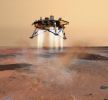
A-Phoenix-005.jpgThe Landing Phase: the powered Landing on Mars72 visitenessun commentoMareKromiumAgo 04, 2007
|
|

000-Phoenix_Logo.jpgThe Phoenix Mars Lander Logo73 visiteThe Phoenix, a fabulous mythical bird the size of an eagle, symbolizes rebirth in many ancient cultures. According to the ancient Greeks, the bird lives in Arabia, nearby a cool well and sings a beautiful morning song. The Phoenix lives 500 years or longer with only one Phoenix existing at a time.
When the bird's death approaches, it bursts into flames, and a new bird springs from the consumed pyre.
Similar to its namesake, the Phoenix Mission "raises from the ashes" a spacecraft and instruments from 2 previous unsuccessful attempts to explore Mars: the Mars Polar Lander and the Mars Surveyor 2001 Lander. The Mars Polar Lander failed to return data upon its arrival to Mars' antarctic region on December 3, 1999 and left many ambitious science goals undone. Phoenix uses 3 instruments from this earlier Polar Lander, the SSI, the RA and the TEGA.
The Phoenix Mission uses the Mars Surveyor 2001 Lander, built in 2000, but later administratively mothballed. The '01 lander is undergoing modifications to improve the spacecraft's robustness and safety during entry, descent, and landing. Phoenix recovers two instruments delivered for the '01 lander that have been in protected storage: the MARDI and the MECA. Also, the RA has been modified from the '01 lander version.
MareKromiumAgo 04, 2007
|
|

A-Phoenix-000.jpgThe (fully assembled) Phoenix Mars Lander70 visitenessun commentoMareKromiumAgo 04, 2007
|
|
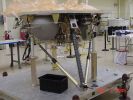
A-Phoenix-001.jpgThe Phoenix Lander: Hot-Fire Test Mock-Up67 visitenessun commentoMareKromiumAgo 04, 2007
|
|
| 399 immagini su 34 pagina(e) |
 |
|
|
|
|
|
|
|
|
33 |
|








