| Ultimi arrivi - From Ashes to Eternity: the Phoenix Mars Mission |

PHOE-SOL001-M-Photocomposite-00.jpgThe Surface of Vastitas and the Sky above - Sol 1 (Photocomposite; RAW Color Data; credits: Dr M. Faccin)69 visiteQuesta immagine è una fotocomposizione in colori "RAW", ossìa interpretando le informazioni-colore contenute nel frame e SENZA applicazione di filtri e procedimento MULTISPECTRUM. Probabilmente, le prime immagini a colori "false" ed "approximate true" Made by NASA, saranno simili a questa (una conclusione ovvia anche perchè, come potete vedere bene Voi stessi, l'Immaginario Collettivo non viene disturbato da questo tipo di colorizzazione: il Pianeta Rosso, infatti ed anche nella Regione di Vastitas, appare ancora del suo tipico colorito arancio-mattone con sfumature ruggine e giallo chiaro: il colore, ribadiamo, dell'Immaginazione).
Ma Marte NON E' esattamente così, come ormai sappiamo bene tutti... MareKromiumMag 26, 2008
|
|

PHOE-SOL001-M-Photocomposite-01.jpgThe Surface of Vastitas and the Sky above - Sol 1 (Photocomposite; True Colors + MULTISPECTRUM; credits: Dr M. Faccin & Lunexit)69 visiteUna splendida immagine, ad oggi - e LETTERALMENTE! - Unica al Mondo. Un Grazie davvero infinito al Dr Faccin, al Dr Barca (che sta già operando su altri frames Phoenix) ed a tutti coloro che leggono le nostre pagine.MareKromiumMag 26, 2008
|
|

PHOE-SOL001-lg_437.jpgThe soil of Vastitas Borealis - Sol 1 (Natural Colors + MULTISPECTRUM; credits: Lunexit)67 visiteImmagine ottenuta alle 17:12:26 Mars Local Solar Time.MareKromiumMag 26, 2008
|
|

PHOE-SOL001-lg_400-001.jpgVastitas Borealis - Sol 1 (Natural Colors + MULTISPECTRUM; credits: Lunexit)69 visiteCaption NASA:" This flat horizon stretches across the Red Planet as seen by the Phoenix Spacecraft after yesterday's landing on Mars. Touching down shortly after 7:30 pm Eastern Time, Phoenix made the first successful soft landing on Mars, using rockets to control its final speed, since the Viking landers in 1976. Launched in August of 2007, Phoenix has now made the northernmost landing and is intended to explore the Martian arctic's potentially ice-rich soil.
The lander has returned images and data initially indicating that it is in excellent shape after a nearly flawless descent. News updates will be available throughout the day".MareKromiumMag 26, 2008
|
|

PHOE-SOL001-lg_398-001.jpgGood-Evening Phoenix! - Sol 1 (True Colors and MULTISPECTRUM; credits: Lunexit)122 visiteL'immagine non è particolarmente suggestiva o impressionante, ma è piuttosto chiara (forse leggermente sfuocata, ma non sapremmo dire se si tratta di O.A. oppure di una calibrazione ancora imperfetta degli strumenti di ripresa di Phoenix) e ci mostra il suolo della Regione Marziana nota come Vastitas Borealis: Regione di "poligoni", terreni e crateri ghiacciati e, forse, di piccoli "laghetti" (abbiamo diverse immagini MRO che mostrano rilievi circolari ad albedo elevatissima, ergo rilievi coerenti con l'idea di laghetti gelati). Che dire? Grandissimi complimenti alla NASA, al Phoenix Lander Team ed a Lunar Explorer Italia che è stata la prima Libera Associazione di Ricerca in Europa (e, riteniamo, al Mondo) a mostrare gli "early frames" ottenuti da Phoenix in versione "a colori" (True e Natural, con trattamento Multispettrale). Bravi tutti.
Ed ora, vediamo che cosa accadrà nei prossimi Soles...MareKromiumMag 26, 2008
|
|

PHOE-SOL001-lg_398-003.jpgGood-Evening Phoenix! - Sol 1 (Natural Colors and MULTISPECTRUM; credits: Lunexit)70 visitenessun commentoMareKromiumMag 26, 2008
|
|

E-PIA10633.jpgDust Devils and Frozen Craters at Phoenix Landing Site (MULTISPECTRUM; credits: Lunexit)67 visiteNASA's Phoenix Mars Lander is scheduled to land on the Martian Northern Plains near 68° North Lat. and 127° West Long. on May 25, 2008. In preparation for the landing, NASA's Mars Reconnaissance Orbiter has been monitoring weather in the Region around the Landing Site.
On April 20, 2008, the orbiter's Context Camera captured this view showing two active DD within the Phoenix Landing Ellipse.
This is a subframe covering an area about 26 Km (approx. 16 miles) on each side (...). It shows two Dust Devils and their shadows. Based on measurement of the shadows cast by the DD, one of the vortices towered about 590 meters (about 1930 feet) with a dust plume extending 920 meters (about 3020 feet) above the surface. The other reached about 390 meters (1280 feet) high, with a dust plume extending to 790 meters (2590 feet). The resolution here is 6 meters (19,7 feet) per pixel.
When the Context Camera acquired this image, the season in Mars' Northern Hemisphere was late Spring. A few weeks earlier, the Phoenix Landing Site was still covered with seasonal frost left over from the previous Winter. White patches in small craters near the center of the picture are areas where the Winter frost remained, even as late as April 20, 2008.
As Spring gives way to Summer, DD are likely to occur more frequently, as local temperatures rise. These two DD observed in late April are among the first of the season. The cameras on the Phoenix Lander might be able to spot additional Dust Devils after the spacecraft arrives, as the Mars Exploration Rover Spirit has been able to do at its Southern Hemisphere Landing Site.
Dust Devils are whirling vortices that have picked up dust from the ground. Such vortices can occur even when no dust is present, but then they are not visible to the cameras onboard the Mars Reconnaissance Orbiter. Such vortices commonly form as hot air rises from the surface on an otherwise generally calm day with little or no breeze. Dust Devils will travel across the surface on the gentle breezes that do occur. Sometimes, DD have been observed by cameras orbiting Mars to create streaks on the ground as they disrupt and pick up dust, though no streaks are observed in this image.
The Mars Orbiter Camera onboard NASA's Mars Global Surveyor orbiter observed Dust Devils — and streaks created by them — throughout its 1997 to 2006 mission. During that time, scientists at Malin Space Science Systems observed more than 12.000 active Dust Devils. They were seen over the full range of elevations and nearly all latitudes on Mars. Dust Devil Streaks were found in Mars Orbiter Camera images as far North as the edge of the North Polar Residual Cap and the dune fields that surround the Region.
However, the northernmost active DD captured by that camera was at 62,2° North Latitude, which is further South than the Phoenix Landing Site.
Another camera on the Mars Reconnaissance Orbiter, the Mars Color Imager, captured a simultaneous, wider-field, color view of the area included in this Context Camera image. That view can be seen at PIA10634.MareKromiumMag 09, 2008
|
|
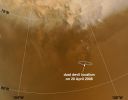
D-Vastitas-PIA10634.jpgPhoenix Landing Site, from MRO65 visiteNASA's Phoenix Mars Lander is scheduled to land on the Martian Northern Plains near 68° North Lat. and 127° West Long. on May 25, 2008. In preparation for the landing, NASA's Mars Reconnaissance Orbiter has been monitoring weather in the Region around the Landing Site. On April 20, 2008, the orbiter's Mars Color Imager camera captured this view of a large region of Northern Mars that includes the landing target area in the lower right quadrant.
This version of the image indicates the location of the landing ellipse, about 100 Km(approx. 60 miles) long. The Context Camera on the MRO took an image of the Landing Area at the same time the Mars Color Imager took this image.
A dot within the Landing Ellipse marks the location of two active DD visible in the Context Camera image, PIA10633.
When the Mars Color Imager acquired this image, the season in Mars' Northern Hemisphere was late Spring. A few weeks earlier, the Phoenix Landing Site was still covered with seasonal frost left over from the previous winter.MareKromiumMag 09, 2008
|
|

00-PhoenixLiftoff.jpgThe beginning...95 visiteCaption NASA:"Can Mars sustain life? To help answer this question, last week NASA launched the Phoenix Mission to Mars. In May 2008, Phoenix is expected to land in an unexplored North Polar Region of Mars that is rich in water-ice. Although Phoenix cannot move, it can deploy its cameras, robotic arm, and a small chemistry laboratory to inspect, dig, and chemically analyze its landing area. One hope is that Phoenix will be able to discern telling clues to the history of ice and water on Mars. Phoenix is also poised to explore the boundary between ice and soil in hopes of finding clues of a habitable zone there that could support microbial life.
Phoenix has a planned lifetime of 3 months on the Martian surface".MareKromiumAgo 08, 2007
|
|

A-Phoenix-003A.jpgThe Road to Mars70 visitenessun commentoMareKromiumAgo 04, 2007
|
|

B-PIA09947.jpgContext Image of Planned Landing Site64 visiteCaption NASA:"This view covers an area about 27 Km (about 17 miles) wide within the planned landing area for NASA's Phoenix Mars Lander. It was taken by the Context Camera on NASA's Mars Reconnaissance Orbiter and catalogued as image P02_001893_2485_XI_68N126W_061221 from that instrument.
Note the crater near the top (north) of the image. The red box indicates the position of a higher-resolution image PIA09948 of ground texture in this area".MareKromiumAgo 04, 2007
|
|

B-PIA09948.jpgSweet Spot for Landing on Mars79 visiteCaption NASA:"This view shows scattered rocks and a polygonal ground texture within the "sweet spot" of the planned landing area for NASA's Phoenix Mars Lander.
This is a subframe, covering a patch of ground about 250 meters (820 feet) across, from a larger image taken by the High Resolution Imaging Science Experiment (HiRISE) camera on NASA's Mars Reconnaissance Orbiter on Jan. 1, 2007.
The full image, catalogued as HiRISE image PSP_002170_2485, is centered at 68,3° North Latitude and 232,9° East Longitude".MareKromiumAgo 04, 2007
|
|
| 399 immagini su 34 pagina(e) |
 |
|
|
|
|
|
|
|
32 | |
|








